The 1614–1626 MHz band sits just above the globally protected radio astronomy segment at 1610.6–1613.8 MHz and plays a major role in satellite communications. Unlike the passive-only adjacent spectrum, this range is heavily used for mobile-satellite services (MSS), particularly satellite phones, data terminals, and safety-of-life communications.
Below is a full breakdown of what operates in this band and how it is allocated worldwide.
🛰️ Primary Use: Mobile-Satellite Service (MSS)
The ITU allocates 1613.8–1626.5 MHz to the Mobile-Satellite Service, mainly for uplink (Earth-to-space) operations.
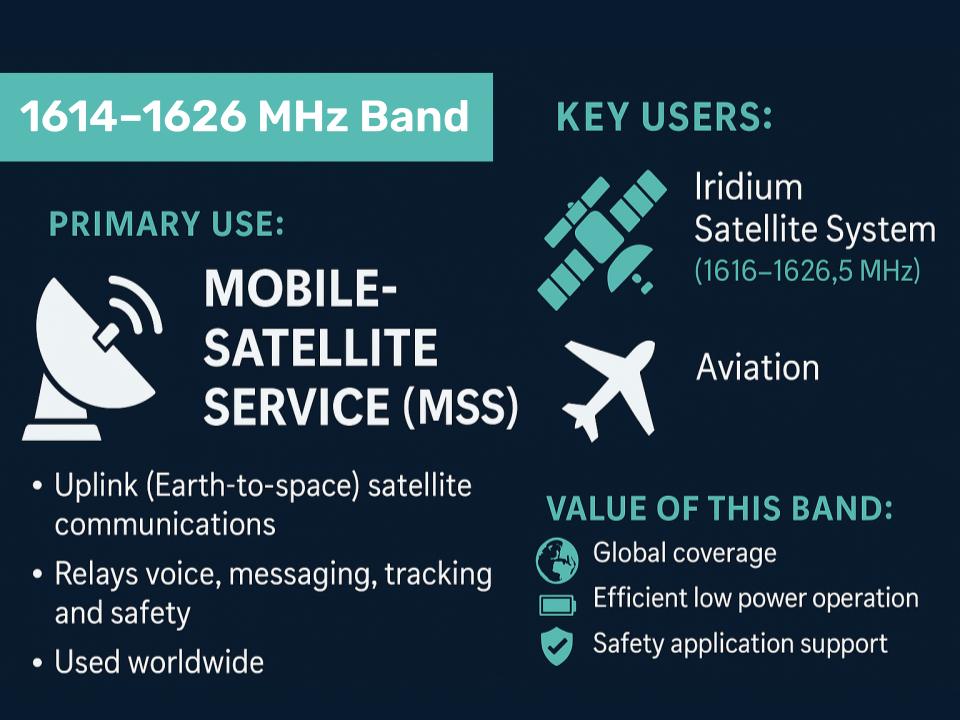
Key MSS users include:
- Iridium Satellite System
- Inmarsat (certain terminals)
- Globalstar (adjacent bands)
- Aviation and maritime safety uplinks
- Emergency locator uplink paths
- Government and military satellite uplinks
This band is essential for:
- Global voice communications
- Satellite messaging
- Tracking and telemetry
- Air traffic services (ATS)
- Safety-of-life communication in remote areas
🛰️ Iridium: The Most Significant User (1616–1626.5 MHz)
The Iridium network relies heavily on this spectrum.
Iridium uses the following:
- 1616–1626.5 MHz — Mobile Earth Station uplink
- L-band mesh network between satellites
This enables:
- Satellite phones
- Iridium Short Burst Data (SBD) modems
- Global aviation communications (FANS, ACARS over Iridium)
- Maritime distress systems
- IoT and M2M terminals
Iridium’s unique polar orbit constellation makes this band mission-critical for global coverage.
🌍 ITU Allocations (High-Level Overview)
1613.8–1626.5 MHz
- Mobile-Satellite Service (Earth-to-space) — Primary
- Used worldwide for satellite uplinks
- Shared with certain aviation safety systems
Protection requirements
Even though the adjacent 1610.6–1613.8 MHz segment is radio-astronomy, MSS systems must avoid interference into it. Power flux and band-edge emission limits are regulated strictly.
✈️ Aviation and Maritime Uses
This band supports several aviation and maritime systems through satellite uplinks:
Aviation:
- ATS communications via Iridium
- Controller–Pilot Data Link Communications (CPDLC)
- ADS-C reporting
- SATVOICE channels
Maritime:
- GMDSS communication through Iridium
- Long-range ship tracking
- Emergency communication beyond VHF ranges
📡 Why This Band Is Valuable
1. Global Coverage
L-band frequencies penetrate clouds, rain, and atmospheric conditions far better than higher-frequency bands.
2. Low Power Requirements
Portable satellite phones and handheld terminals can operate efficiently.
3. Interference-Resistant
L-band is less crowded compared to VHF/UHF terrestrial services.
4. Critical for Safety and Remote Coverage
Used in regions without infrastructure: oceans, deserts, polar routes.
🔧 Adjacent Band Considerations
| Frequency Range | Use |
|---|---|
| 1610.6–1613.8 MHz | Radio Astronomy (passive, protected) |
| 1613.8–1626.5 MHz | MSS uplink (Iridium, safety-of-life services) |
| 1626.5–1660 MHz | MSS downlink (Inmarsat, others) |
The transition from passive RAS to heavy MSS uplinks requires strict filtering and coordination.
📶 Summary: What Operates in 1614–1626 MHz?
✔ Satellite phones
✔ Iridium uplinks
✔ Aviation data link communications
✔ Maritime distress and tracking
✔ Government and military satellite communication
✔ Global M2M / IoT devices via Iridium SBD
❌ Not used for:
- Wi-Fi
- GPS (L1 is at 1575.42 MHz)
- Cellular LTE/5G services
- Consumer electronics
🧭 The Bottom Line
The 1614–1626 MHz band is one of the most important uplink ranges in the L-band spectrum. It enables critical global communication systems, including Iridium’s voice and data network, maritime safety communications, and aviation long-range operations. While adjacent to the protected radio astronomy segment, this band itself is an active, high-value satellite communications band used worldwide for both commercial and safety functions.