The 1627–1660 MHz segment is one of the most important pieces of the L-band for mobile-satellite communications, supporting global voice, safety-of-life, maritime, aviation, and data services. This upper-L-band slice forms the downlink (space-to-Earth) portion of well-known satellite systems such as Inmarsat and Globalstar, making it indispensable for communications in regions where terrestrial networks don’t reach.
This band sits just above the Iridium uplink range (1618.725–1626.5 MHz) and transitions into a heavily used set of frequencies that deliver mission-critical connectivity worldwide.
🛰️ Primary Use: Mobile-Satellite Service (MSS Downlink)
The International Telecommunication Union (ITU) allocates 1626.5–1660.5 MHz to the Mobile-Satellite Service (MSS) for space-to-Earth operations. This is the segment used by satellite constellations to transmit signals from orbit down to users on Earth.
Key users include:
Inmarsat
- Classic Aero and SwiftBroadband services
- Maritime distress and safety communications
- Aviation safety (ICAO-approved systems)
- Broadband satellite terminals
Globalstar
- Satellite phone downlink
- Consumer and commercial satellite messaging services
- IoT/Asset tracking terminals
Maritime, Distress & Safety Systems
- GMDSS services
- SafetyNET broadcasts
- Search-and-rescue messaging
Government & Military
- Secure satellite communications
- Command and control downlinks
- Mission-critical coordination
This broad ecosystem makes the band one of the core global allocations for worldwide mobile satellite connectivity.
📶 Why the 1627–1660 MHz Band Matters
This range supports services that must work everywhere, regardless of:
- Terrain
- Weather
- National boundaries
- Disaster conditions
Satellite downlinks in this band allow:
- Ships to maintain continuous communication
- Aircraft to use approved safety systems
- Remote workers and emergency responders to stay connected
- IoT devices to function in areas with no terrestrial coverage
Unlike higher-frequency satellite bands (such as Ka-band), L-band has excellent rain-fade resistance, making it ideal for reliable global coverage.
🌍 ITU Allocations & Structure
1626.5–1660.5 MHz (Primary MSS Allocation)
- Space-to-Earth downlink
- Shared by multiple MSS operators
- Harmonized worldwide under ITU Radio Regulations
Regional Notes
- Regions 1, 2, and 3 broadly align
- Some sub-band priority distinctions exist between operators
- Aviation applications receive additional protection
Adjacent Bands
- Below: 1610.6–1613.8 MHz (RAS protected), 1618.725–1626.5 MHz (Iridium uplink)
- Above: Broadcast and fixed allocations depending on the country
✈️ Aviation Use: Critical Safety Systems
Inmarsat’s L-band services support aviation communications including:
- ADS-C
- CPDLC
- SATVOICE
- SwiftBroadband Safety
These services enable:
- Aircraft position reporting
- Controller-pilot data messaging
- Distress communications
- Oceanic route coordination
This is why the band is considered safety-of-life spectrum with strong international protection.
⚓ Maritime Use: Global Safety & Connectivity
L-band downlinks provide:
- GMDSS services
- Distress alerts
- Weather and navigational broadcasts
- Reliable ship communications anywhere on Earth
Even in storms and severe maritime conditions, L-band remains operational.
📡 How MSS Downlink Works in This Band
- Satellite receives uplink from ground terminal (uplink in 1626.5–1660 MHz’s counterpart band)
- Satellite reprocesses or relays signal
- Satellite transmits downlink to Earth within 1627–1660 MHz
- User terminals decode voice/data with small L-band antennas
This architecture enables handheld satellite phones and compact maritime terminals.
🛑 Interference Considerations
Because the band supports safety-critical services, regulators place strict controls on:
- Terrestrial transmitters
- Adjacent-band emissions
- High-powered ground stations
- Unauthorized mobile repeaters
MSS operators coordinate globally to avoid cross-system interference.
🛰️ Real-World Applications
Satellite Phones
- Globalstar and Inmarsat handsets
- Professional remote communications
- Search-and-rescue operations
Maritime Terminals
- Cargo vessels, cruise ships, fishing fleets
- Weather routing, reports, safety messaging
Aviation Safety
- Transoceanic voice and data links
- Emergency and priority messaging
IoT & SCADA
- Remote infrastructure monitoring
- Pipeline and asset tracking
- Mission-critical telemetry
Government & Defense
- Reliable field communications
- Mobile command posts
- Strategic coordination
🧭 Summary
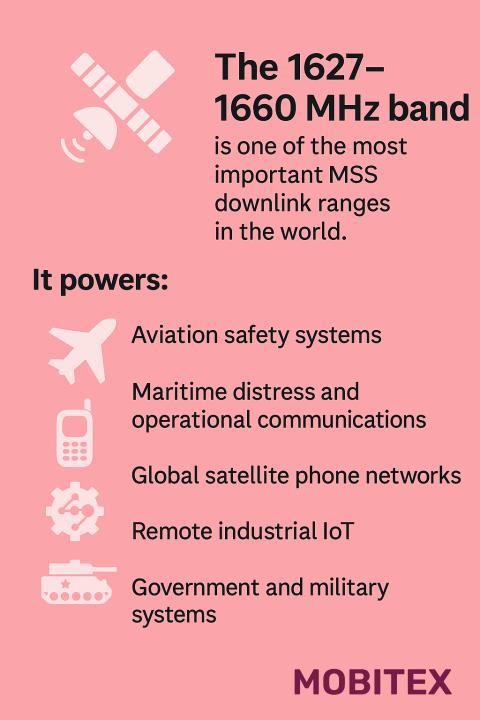
The 1627–1660 MHz band is one of the most important MSS downlink ranges in the world. It powers:
- Aviation safety systems
- Maritime distress and operational communications
- Global satellite phone networks
- Remote industrial IoT
- Government and military systems
Built for reliability, this L-band downlink range ensures communications remain operational anywhere, anytime, even in the harshest environments.
When terrestrial networks fail or simply don’t exist, 1627–1660 MHz keeps the world connected.