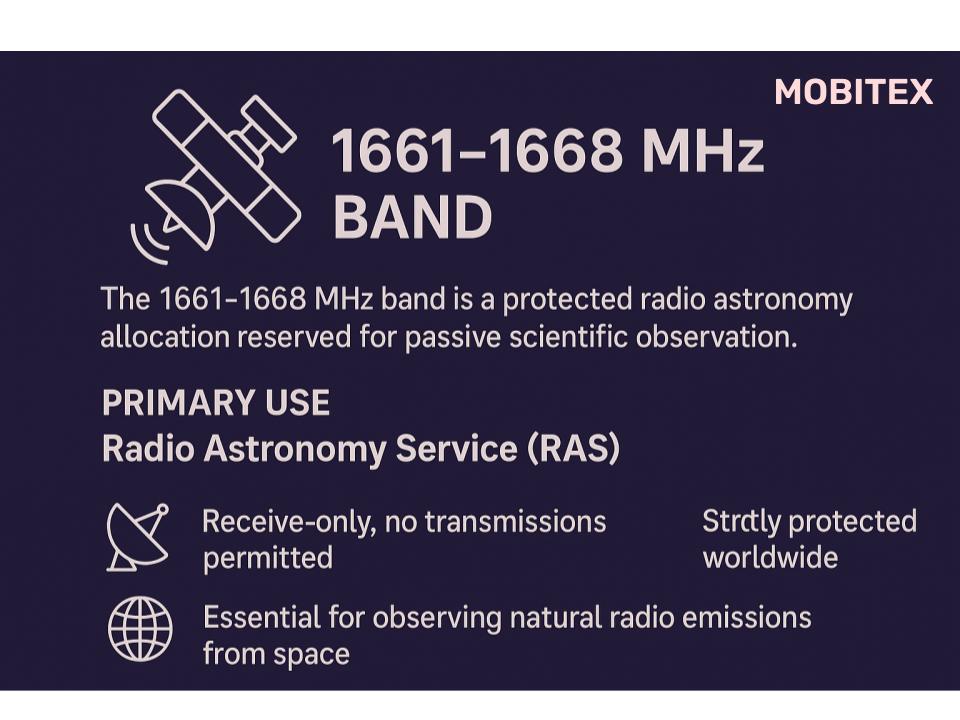
The 1661–1668 MHz band is a uniquely important slice of the L-band spectrum, not because it enables communications, but because it is protected for passive scientific observation. Unlike neighboring frequencies used for mobile-satellite or navigation services, this band is reserved almost entirely for the Radio Astronomy Service (RAS).
Its purpose is simple and critical: to allow astronomers to observe extremely weak natural radio emissions from space without interference from human-made transmitters.
🔭 Primary Use: Radio Astronomy Service (RAS)
The International Telecommunication Union (ITU) allocates 1661–1668 MHz on a primary basis to the Radio Astronomy Service in all three ITU regions.
Key characteristics of RAS in this band:
- Receive-only, no transmissions permitted
- Used by large radio telescopes and observatories
- Designed to detect signals billions of times weaker than typical communication signals
- Requires extremely low noise and strict interference protection
There are no commercial, consumer, or industrial transmitters operating in this range by design.
🌌 What Astronomers Observe in This Band
Radio astronomy bands are chosen because they align with natural spectral phenomena. While not as famous as the hydrogen line at 1420 MHz, the 1661–1668 MHz region supports observations related to:
- Molecular and atomic emissions from interstellar space
- Galactic structure and star-forming regions
- Cosmic background measurements
- Long-baseline interferometry experiments
Even tiny amounts of interference can permanently contaminate scientific data.
🛑 Why This Band Is Strictly Protected
Radio astronomy receivers are among the most sensitive instruments on Earth. A nearby transmitter operating at even milliwatt levels could overwhelm them.
Because of this, regulators enforce:
- Strict out-of-band emission limits for adjacent services
- Geographic protection zones around observatories
- Power and spectral mask constraints on nearby transmitters
- International coordination requirements for satellite systems operating nearby
This protection ensures long-term scientific access to clean spectrum.
🌍 Global Allocation Status
The 1661–1668 MHz band is:
- Harmonized worldwide
- Allocated to RAS in ITU Regions 1, 2, and 3
- Recognized by national regulators including:
- FCC (United States)
- ISED (Canada)
- Ofcom (United Kingdom)
- CEPT administrations across Europe
Because it is passive, licensing does not apply in the traditional sense. Instead, the band is protected through regulation and enforcement.
📶 Relationship to Adjacent Bands
Understanding this band requires looking at what surrounds it:
Below 1661 MHz
- 1626.5–1660.5 MHz: Mobile-Satellite Service (MSS) downlink
- Used for aviation, maritime, satellite phones, and IoT
- Carefully engineered to limit emissions into the RAS band
Above 1668 MHz
- National allocations vary
- May include fixed, mobile, or broadcast services depending on country
- Subject to emission limits to protect radio astronomy
The boundary between MSS and RAS is one of the most tightly regulated transitions in the L-band.
🚫 What Is Not Allowed in 1661–1668 MHz
This band does not support:
- Mobile networks
- Satellite uplinks or downlinks
- IoT devices
- GNSS or navigation signals
- Experimental or unlicensed transmissions
Any active transmission here is considered harmful interference.
🧪 Scientific Importance
Protecting passive bands like 1661–1668 MHz enables:
- Long-term astronomical datasets
- Discovery of new cosmic phenomena
- Calibration of space science instruments
- International collaboration in radio astronomy
Once corrupted by interference, scientific observations cannot be recovered.
🧭 Summary
The 1661–1668 MHz band plays a quiet but vital role in global spectrum use.
It is:
- A protected L-band radio astronomy allocation
- Reserved exclusively for passive scientific observation
- Guarded by strict international interference rules
- Essential for advancing our understanding of the universe
While invisible to consumers and industry, this band ensures that humanity can continue listening to the faint signals coming from the cosmos.