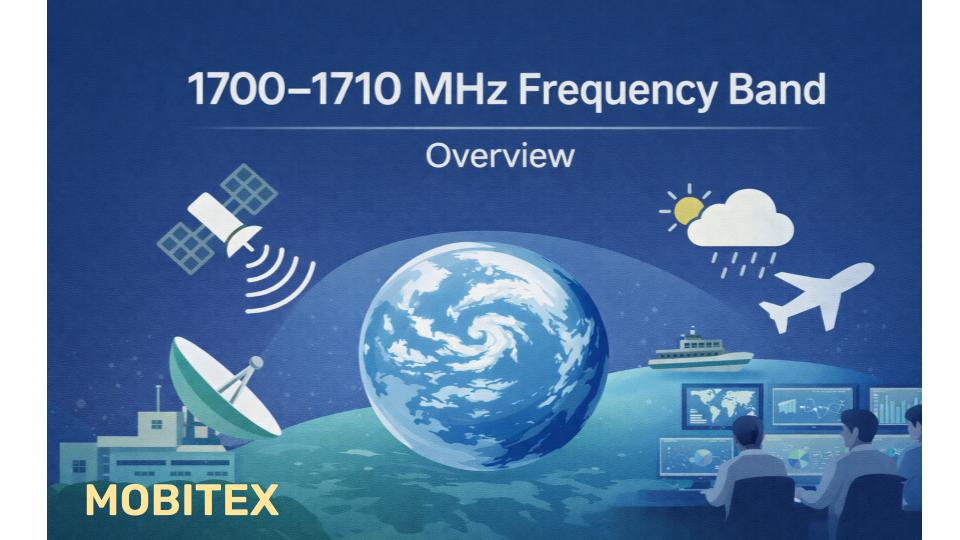
The 1700–1710 MHz band is a specialized slice of the L-band reserved primarily for meteorological and Earth-observation satellite downlinks. Unlike consumer wireless or navigation spectrum, this range is used to receive mission-critical environmental data from satellites that support weather forecasting, climate monitoring, and public safety.
This band is carefully protected and coordinated worldwide because the information it carries feeds directly into systems that aviation authorities, maritime operators, and emergency managers rely on every day.
🌦️ Primary Uses: Meteorological Satellite and Earth Observation
The dominant services operating in 1700–1710 MHz are:
- Meteorological-Satellite Service (MetSat), space-to-Earth
- Earth Exploration-Satellite Service (EESS), space-to-Earth
These services transmit data from satellites down to fixed ground stations on Earth. The band is not designed for two-way communication or consumer devices.
🛰️ Meteorological-Satellite Service (MetSat)
Weather satellites use this band to deliver downlink data such as:
- Atmospheric temperature and humidity profiles
- Cloud structure and precipitation data
- Inputs for numerical weather prediction models
- Real-time observations for severe weather tracking
National meteorological agencies receive these signals at fixed earth stations, where the data is processed and distributed to forecasting systems worldwide.
There are no handheld terminals, mobile receivers, or consumer products associated with MetSat use in this band.
🌍 Earth Exploration-Satellite Service (EESS)
In parallel with meteorological use, EESS operations in the 1700–1710 MHz range support broader Earth-observation missions, including:
- Climate and environmental monitoring
- Land, ocean, and atmospheric studies
- Long-term climate trend analysis
The data collected helps scientists understand weather patterns, climate change, and large-scale environmental processes.
🌐 Global Allocation and Regulatory Status
Internationally, the International Telecommunication Union (ITU) recognizes 1700–1710 MHz for MetSat and EESS space-to-Earth transmissions across all three ITU regions.
National regulators such as:
- The FCC in the United States
- ISED in Canada
- Ofcom in the United Kingdom
align closely with the ITU framework, treating this band as receive-only spectrum for authorized earth stations, with strict coordination and protection requirements.
📶 Relationship to Adjacent Bands
Below 1700 MHz
The spectrum below includes other meteorological and Earth-observation allocations, as well as bands that are tightly protected for scientific use. Out-of-band emissions from 1700–1710 MHz systems must be carefully controlled to avoid interference.
Above 1710 MHz
Higher frequencies transition into bands used for different services depending on region, including mobile and other satellite applications. Clear separation and filtering are required to maintain compatibility.
🛑 Interference and Protection Considerations
Although the 1700–1710 MHz band supports active satellite transmissions, it is highly sensitive on the receive side.
Key protection measures include:
- Strict out-of-band emission limits
- Coordination requirements near earth station sites
- Controls on high-power terrestrial transmitters in adjacent bands
Interference in this range can degrade weather data quality, which can directly impact forecasting accuracy and safety-of-life decisions.
🚫 What the 1700–1710 MHz Band Is Not Used For
This band is not used for:
- Mobile phones or cellular networks
- GNSS or navigation services
- Consumer IoT devices
- Unlicensed radios or Wi-Fi
Any implication of mass-market or consumer use would be incorrect.
🧭 Summary
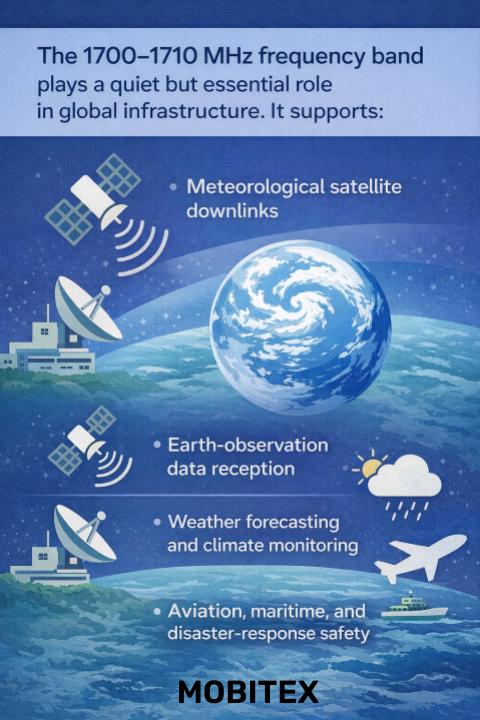
The 1700–1710 MHz frequency band plays a quiet but essential role in global infrastructure. It supports:
- Meteorological satellite downlinks
- Earth-observation data reception
- Weather forecasting and climate monitoring
- Aviation, maritime, and disaster-response safety
Purpose-built for reliability rather than scale, this L-band segment ensures that governments and scientists can continuously observe Earth’s atmosphere and environment, helping protect lives and support critical decision-making around the world.