The 1711–1755 MHz frequency band is a cornerstone of modern mobile communications. It forms the uplink portion of the AWS and IMT spectrum, meaning it is used by mobile devices to transmit signals from the ground up to cellular base stations. This band plays a direct role in enabling LTE and 5G networks used daily by billions of people worldwide.
Unlike nearby satellite and scientific bands, 1711–1755 MHz is firmly rooted in terrestrial commercial mobile use, with heavy traffic, dense deployments, and strict regulatory control.
📱 Primary Use: Mobile Network Uplink (IMT / AWS)
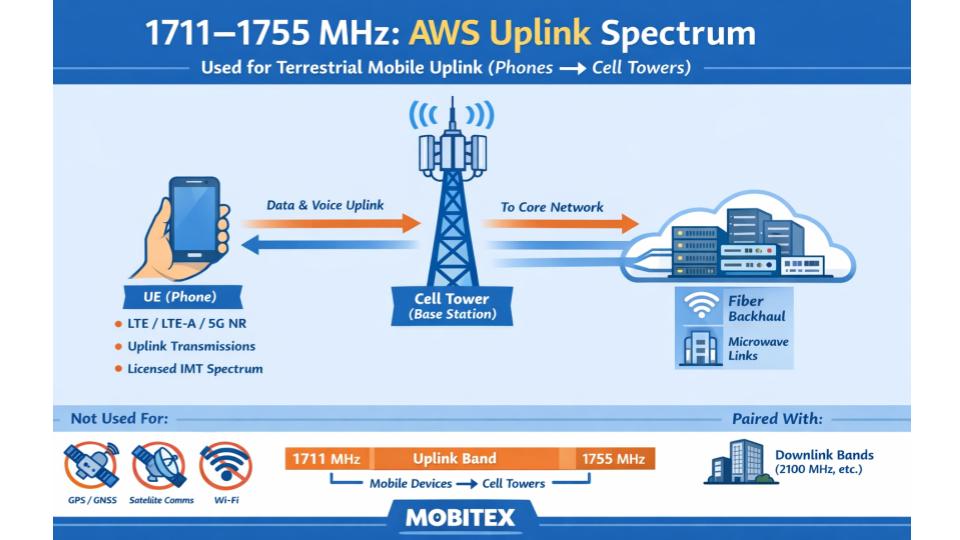
The dominant use of 1711–1755 MHz is as a licensed mobile uplink band under the International Mobile Telecommunications (IMT) framework.
Key characteristics include:
- Used by mobile phones, tablets, hotspots, and IoT devices
- Carries uplink transmissions from devices to cell towers
- Operates as part of a paired FDD system
- Licensed exclusively to mobile network operators
This band does not carry broadcast content or satellite downlinks. It is optimized for high-capacity, low-latency mobile transmission.
🔁 Duplexing and Band Pairing
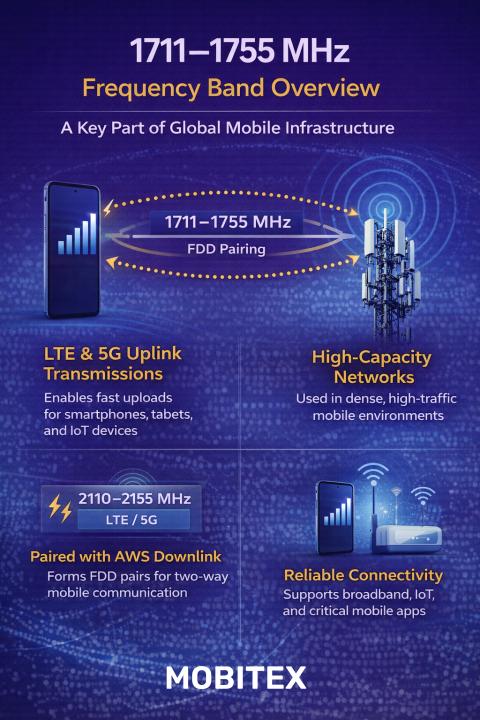
The 1711–1755 MHz band is paired with a higher-frequency downlink band to form a complete two-way communication channel.
- Uplink: 1711–1755 MHz
- Downlink pair: 2110–2155 MHz
- Duplex mode: Frequency Division Duplex (FDD)
In practical terms, this means:
- Your phone transmits in 1711–1755 MHz
- The base station responds in 2110–2155 MHz
This pairing is foundational to AWS-1 and AWS-3 deployments, and corresponds to 3GPP Band 4 and Band 66 variants used globally.
🌍 Global Regulatory Status
Internationally, the ITU identifies this band for mobile and fixed services, with most administrations implementing it specifically for IMT uplink.
National regulators align closely with this model:
- United States: Licensed under FCC Part 27 for AWS
- Canada: Assigned to mobile operators under ISED frameworks
- United Kingdom: Used for mobile networks under Ofcom licensing
- Other regions: Widely harmonized for LTE and 5G uplink use
Because of this harmonization, devices designed for AWS bands can operate across multiple countries with minimal modification.
🏙️ Real-World Deployment and Device Ecosystem
The 1711–1755 MHz band is heavily used in:
- Urban and suburban cellular networks
- Nationwide LTE and 5G deployments
- Dense macrocell and small-cell environments
- Public and private mobile broadband systems
Typical devices operating in this band include:
- Smartphones
- Cellular modems and routers
- Mobile hotspots
- Licensed IoT and M2M modules
This band supports a large, mature device ecosystem, with widespread chipset and hardware support.
🛑 Interference and Spectrum Management
Because 1711–1755 MHz is a high-occupancy uplink band, interference management is critical.
Regulators enforce:
- Strict emission masks for mobile devices
- Limits on out-of-band emissions
- Network coordination between operators
- Cross-border spectrum agreements
Interference is typically managed through network planning and engineering, rather than exclusion zones, since the band is designed for dense reuse.
🚫 What the 1711–1755 MHz Band Is Not Used For
It is important to distinguish this band from nearby spectrum with very different roles.
The 1711–1755 MHz band is not used for:
- GNSS or satellite navigation
- Meteorological satellite downlinks
- Earth observation reception
- Unlicensed or consumer radio services
Any framing of this band as satellite-based or receive-only would be incorrect.
🧭 Summary
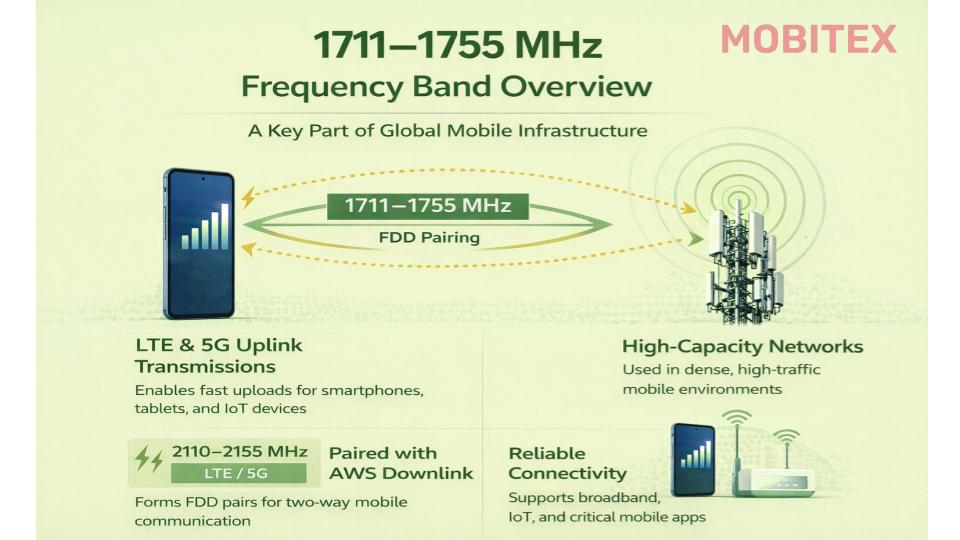
The 1711–1755 MHz frequency band is a foundational component of global mobile infrastructure. It enables:
- LTE and 5G uplink transmissions
- High-capacity commercial mobile networks
- Paired FDD operation with AWS downlink bands
- Reliable connectivity for smartphones, IoT, and broadband users
While it operates quietly in the background, every call uploaded, message sent, or photo shared from a mobile device relies on spectrum like 1711–1755 MHz doing its job efficiently and reliably.