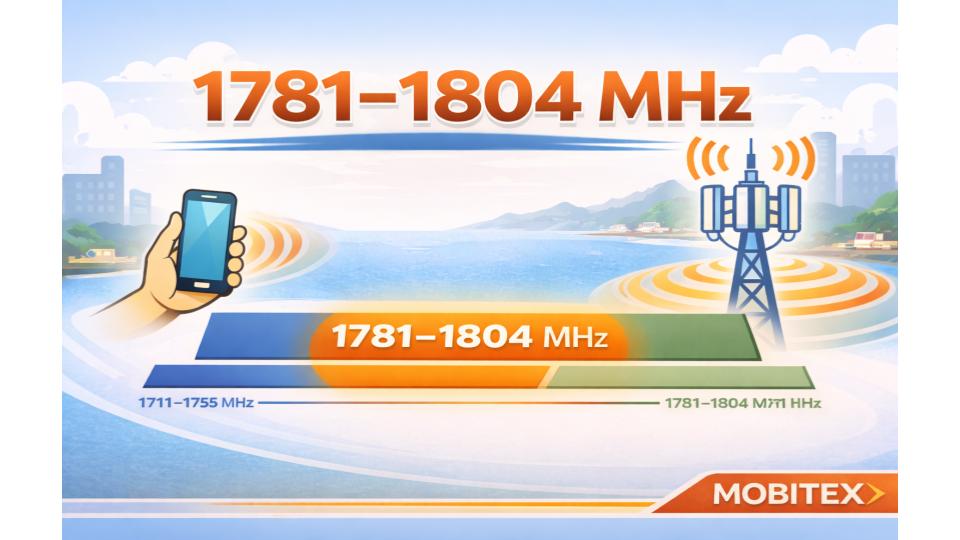
The 1781–1804 MHz frequency band sits just above the AWS uplink range and below well-known downlink cellular spectrum. While it rarely gets public attention, this slice of spectrum plays a specialized and transitional role in mobile communications and spectrum planning.
Rather than being a single, globally uniform band, 1781–1804 MHz is best understood as a band-edge and coordination segment, shaped heavily by regional regulations and neighboring services.
📱 Primary Role: Upper Uplink / Transition Segment
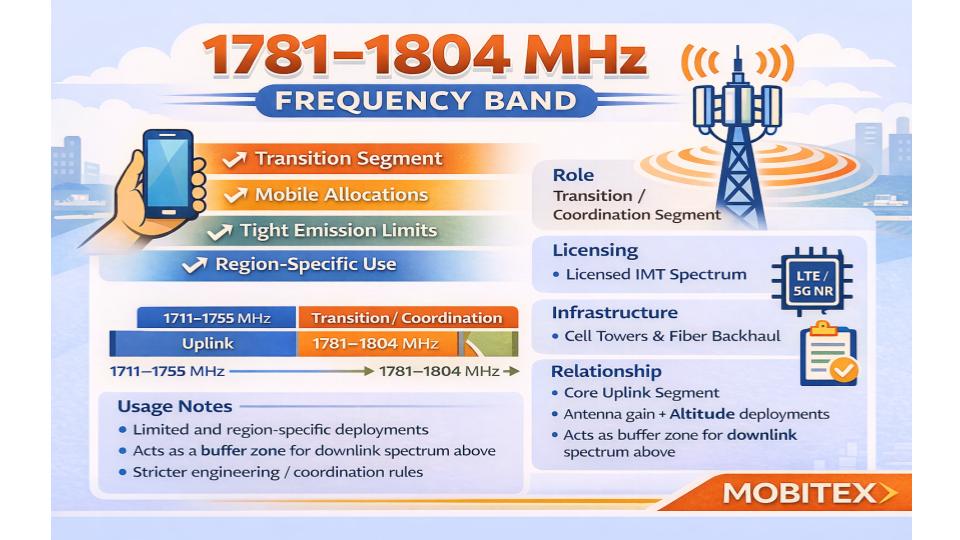
In most regulatory frameworks, 1781–1804 MHz is associated with terrestrial mobile services, but it is not a core cellular uplink band like 1711–1755 MHz or 1756–1780 MHz.
Instead, it is commonly used as:
- An upper-edge extension of cellular uplink allocations
- A coordination or buffer segment between uplink and adjacent services
- A region-specific mobile or fixed allocation, depending on national rules
In practical deployments, this band is used conservatively, with tighter constraints than lower uplink spectrum.
🏗️ How the Band Is Typically Deployed
Where 1781–1804 MHz is authorized for mobile use, it relies on standard terrestrial cellular infrastructure.
Typical characteristics include:
- Infrastructure: Macrocell towers and limited small-cell use
- Antenna gain: ~15–18 dBi sector antennas
- Tower height: ~15–50 m
- Backhaul: Fiber-optic networks, with microwave backhaul where needed
There is no satellite uplink or space-segment usage in commercial mobile contexts for this band.
🌍 Licensing and Regulatory Context
The 1781–1804 MHz band is licensed spectrum, but unlike lower uplink ranges, its usage is highly country-specific.
Common regulatory traits include:
- Allocation to mobile and/or fixed services, depending on the region
- Tighter emission masks due to adjacency with other bands
- Coordination requirements near downlink or mixed-use spectrum
- Limited or selective deployment compared to core uplink bands
In some regions, parts of this range act as a guard-like transition zone, while still remaining operational spectrum.
🔍 Relationship to Adjacent Bands
The importance of 1781–1804 MHz becomes clearer when viewed in context:
- Below (1756–1780 MHz):
Supplemental cellular uplink used to add capacity during congestion - 1781–1804 MHz:
Upper-edge mobile segment with stricter coordination and limited use - Above (≈1805 MHz and up):
Widely deployed cellular downlink spectrum in many regions
Because of this positioning, 1781–1804 MHz often serves as a boundary band, helping protect higher-power downlink transmissions above it.
⚠️ Interference and Coordination Considerations
This band typically comes with more conservative engineering rules than lower uplink spectrum.
Key considerations include:
- Strict out-of-band emission limits
- Careful coordination with adjacent downlink services
- Reduced transmit power or limited channelization in some regions
It is not a passive guard band, but it is often treated as sensitive edge spectrum.
❌ What This Band Is Not Used For
The 1781–1804 MHz band is not used for:
- GPS or GNSS services
- Satellite navigation or RNSS
- Satellite phone uplinks
- Wi-Fi, Bluetooth, or other unlicensed systems
Any classification suggesting satellite or navigation use here is incorrect.
🧭 Why the 1781–1804 MHz Band Matters
Even though it is not a headline cellular band, 1781–1804 MHz plays an important supporting role in spectrum planning.
It helps:
- Smooth the transition between uplink and downlink allocations
- Reduce interference at critical band edges
- Provide regulators flexibility in national band plans
For network operators, it represents potential capacity or coordination space, rather than guaranteed everyday throughput.
📌 Summary
- Frequency range: 1781–1804 MHz
- Primary role: Terrestrial mobile / transition segment
- Deployment: Selective, region-specific
- Infrastructure: Standard cellular towers and backhaul
- Regulatory status: Licensed, tightly coordinated
- Not satellite, not GNSS
While quieter than neighboring bands, 1781–1804 MHz plays a key role in keeping cellular spectrum orderly, efficient, and interference-free.