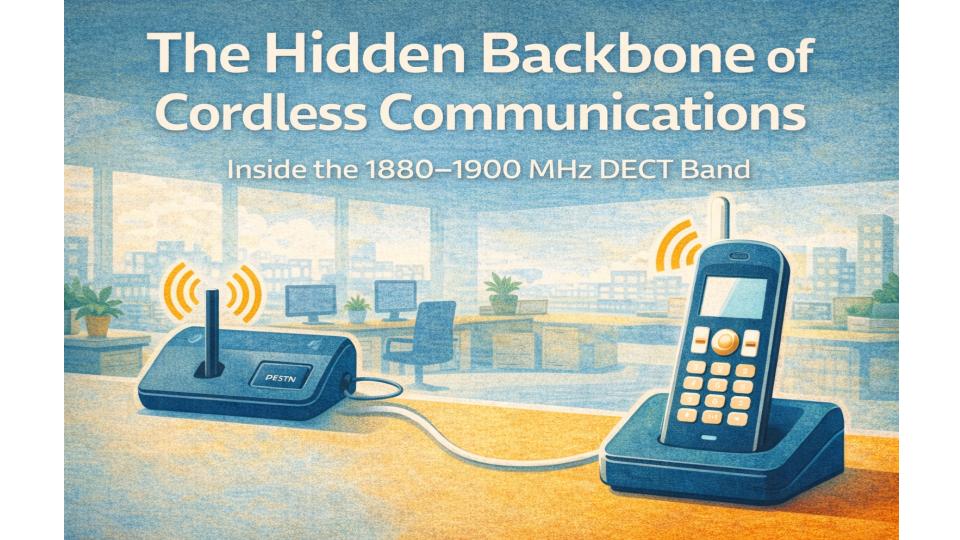
The 1880–1900 MHz frequency band is a quiet but essential part of the global radio spectrum. Unlike nearby cellular bands built for wide-area coverage, this range is dedicated to short-range cordless communications, most notably DECT (Digital Enhanced Cordless Telecommunications).
It rarely appears in conversations about 4G or 5G, yet it supports hundreds of millions of devices worldwide in homes, offices, hospitals, and enterprise environments. Its role is specialized, stable, and deliberately separated from high-power cellular systems.
What the 1880–1900 MHz Band Is Used For
DECT Cordless Telephony
The dominant use of the 1880–1900 MHz band is DECT cordless phones.
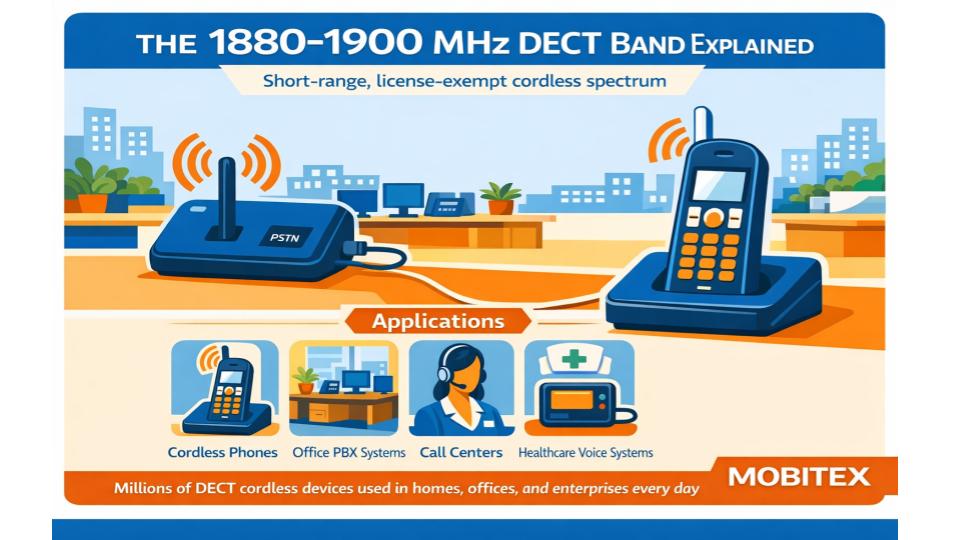
A typical DECT system includes:
- A base station connected to PSTN, VoIP, or PBX systems
- One or more cordless handsets
- Short-range, low-power radio links between them
Common use cases include residential cordless phones, office PBX handsets, call centers, hospitality systems, and healthcare voice communications. DECT is optimized for voice, prioritizing reliability, low latency, and interference avoidance over raw data throughput.
Why This Band Is Reserved for DECT
Clean Spectrum Separation
Regulators intentionally placed DECT in 1880–1900 MHz to keep it:
- Separated from high-power cellular downlinks
- Protected from uplink congestion caused by mobile devices
- Suitable for dense indoor reuse
Unlike cellular spectrum, this band is not designed for wide-area coverage or nationwide licensing. It is reused many times within buildings, making it ideal for high device density in small physical spaces.
Technical Characteristics
Duplexing and Channel Structure
DECT uses Time Division Duplexing (TDD), where uplink and downlink share the same frequency and alternate in time.
Key technical features include:
- 10 RF carriers across the band
- 1.728 MHz carrier spacing
- 24 time slots per carrier
- Dynamic channel and slot selection
This design allows many DECT systems to coexist in the same building with minimal interference.
Power Levels and Range
DECT devices operate at very low power:
- Typical transmit power below 10 mW
- Indoor range of roughly 30–50 meters
- Optimized for room-to-room and floor-to-floor coverage
As a result, DECT systems generate negligible interference beyond their immediate surroundings.
Regulatory Status
License-Exempt but Regulated
In most regions, 1880–1900 MHz is license-exempt for DECT use, governed by technical rules rather than spectrum auctions.
Regulatory frameworks are typically defined by ETSI in Europe and adopted by national regulators elsewhere, with regional variants such as DECT 6.0 in North America. Despite these variations, the core DECT operating model remains consistent worldwide.
Relationship to Adjacent Bands
Below 1880 MHz
The spectrum immediately below, 1850–1880 MHz, is used for cellular services. In the Americas it supports PCS uplink, while in much of the rest of the world it forms part of the DCS-1800 downlink. These are high-power, wide-area mobile networks.
Above 1900 MHz
Above the DECT band, 1900–1920 MHz may be used for IMT TDD (3GPP Band 39) in selected regions, while 1920–1980 MHz is widely used for cellular uplink. The DECT band sits between these services, protected by strict emission and power limits.
DECT Beyond Voice
Modern DECT Variants
While traditional DECT focuses on voice, newer variants support packet data and specialized enterprise applications.
Examples include DECT-based sensors, private on-premise voice systems, and secure communications in environments where Wi-Fi or public cellular networks are unsuitable. These applications benefit from DECT’s predictable performance and controlled interference environment.
Why This Band Still Matters
Even in a world dominated by smartphones and Wi-Fi, DECT remains relevant because it offers:
- Guaranteed access to spectrum
- Consistent voice quality
- Strong security
- Independence from public cellular networks
- Reliable operation in RF-noisy indoor environments
Hospitals, factories, offices, and homes continue to rely on DECT because it delivers exactly what it was designed for, reliable short-range communication.
Conclusion
The 1880–1900 MHz frequency band is a purpose-built home for DECT cordless communications. It is not cellular, not wide-area, and not high-power, and that is precisely why it works so well.
By keeping this band dedicated to short-range, low-power systems, regulators have preserved a clean and dependable slice of spectrum that quietly supports everyday voice communications across millions of buildings worldwide.