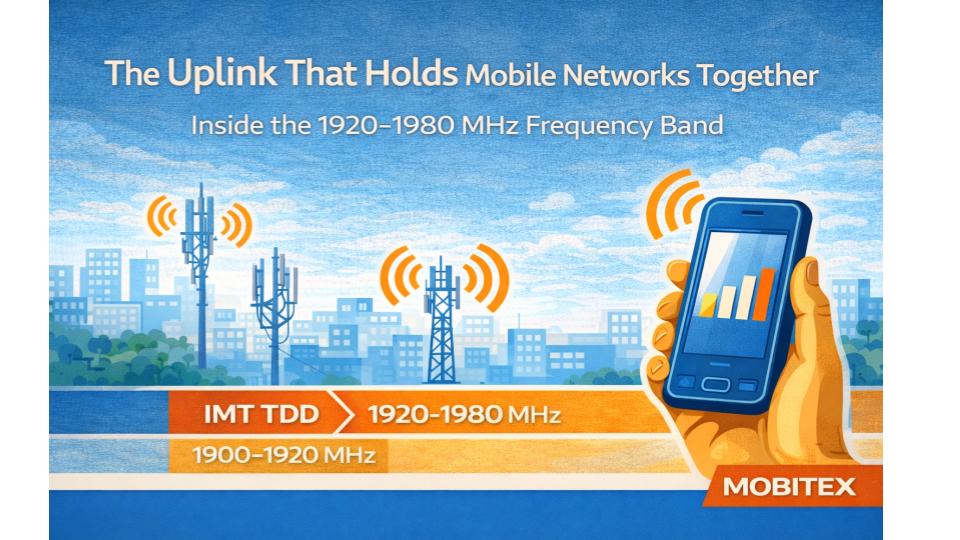
The 1920-1980 MHz frequency range represents one of the most striking examples of global spectrum fragmentation in modern wireless communications. While most of the world uses this band for mobile uplink transmissions, the Americas deploy it for completely opposite purposes—creating a complex landscape that requires multi-band devices and careful regulatory coordination.
Regional Divergence: Same Frequency, Opposite Directions
Americas: PCS 1900 Downlink and Guard Band
In the United States, Canada, Mexico, and Latin America, the 1920-1980 MHz range serves two distinct functions within the Personal Communications Service (PCS) 1900 MHz allocation:
Guard Band (1920-1930 MHz)
The first 10 MHz acts as a critical transition zone separating PCS uplink from downlink operations. This guard band prevents interference between mobile devices transmitting on 1850-1910 MHz and base stations transmitting on 1930-1990 MHz. With strict emission limits, this 20 MHz buffer (when combined with the 1910-1930 MHz portion) ensures clean FDD (Frequency Division Duplex) operation.
Band 2 Downlink (1930-1980 MHz)
The remaining 50 MHz comprises part of the 3GPP Band 2 downlink spectrum, where cellular base stations transmit to mobile devices. This is paired with uplink spectrum at 1850-1910 MHz, creating a comprehensive FDD system that has served the Americas since the 1990s.
Europe, Asia, and Africa: Band 1 Uplink
In contrast, the rest of the world allocates the entire 1920-1980 MHz range as 3GPP Band 1 uplink spectrum. Here, mobile devices transmit to base stations across all 60 MHz, with the corresponding downlink located much higher at 2110-2170 MHz—a 190 MHz separation that eliminates the need for a guard band.
This fundamental difference creates a scenario where a smartphone operating at 1950 MHz would be transmitting in London but receiving in New York—using the exact same frequency for opposite purposes.
Applications and Services
Americas: Downlink-Centric Services
In the Americas, the 1930-1980 MHz portion supports high-capacity downlink services:
- Mobile Broadband Downlink: Base stations deliver 4G LTE and 5G NR data streams to smartphones, tablets, and IoT devices
- Voice Services: VoLTE (Voice over LTE) calls from towers to mobile devices
- Video Streaming: High-definition content delivery optimized for asymmetric data flows
- Technology Evolution: From GSM-1900 (2G) through CDMA2000 and UMTS (3G) to modern LTE Band 2 and 5G NR n2
Major carriers including AT&T, Verizon, and T-Mobile in the US, along with Rogers, Telus, and Bell in Canada, rely heavily on this spectrum for their nationwide networks. Mexican carrier Telcel similarly uses Band 2 as a cornerstone of its mobile infrastructure.
Europe and Asia: Uplink Backbone
Globally, Band 1 uplink serves as the transmission path for:
- 3G UMTS Networks: The original IMT-2000 allocation that brought mobile broadband to Europe and Asia
- 4G LTE Band 1: Continuing the uplink role for high-speed data
- 5G NR n1: Modern 5G networks maintaining backward compatibility
- Voice and Data Upload: All mobile-originated traffic including voice calls, file uploads, and IoT sensor data
European operators like Vodafone, Orange, and Telefónica, along with Asian giants China Mobile, China Unicom, and NTT DoCoMo, depend on Band 1 uplink for their 2 billion+ subscribers.
Power Limits: The Uplink-Downlink Divide
The regional allocations create dramatically different power level requirements:
Americas Band 2 Downlink
Base Station Transmit Power:
- Macro cells: 43-49 dBm conducted power (20-80 watts)
- With antenna gain: Up to 61 dBm EIRP (equivalent isotropic radiated power)
- Small cells: 24-37 dBm for indoor and distributed antenna systems
Mobile Device Reception:
- Receive-only mode in this band
- Sensitivity requirements: Better than -100 dBm for reliable demodulation
- Adjacent channel selectivity: ≥33 dB per 3GPP TS 36.101
Europe/Asia Band 1 Uplink
Mobile Device Transmit Power:
- Maximum: +24 dBm (250 milliwatts) outdoor
- Typical: +21 dBm indoor environments
- Power control: Dynamic adjustment from +24 dBm down to -50 dBm based on link conditions
Base Station Reception:
- Highly sensitive receivers to detect weak mobile signals
- Typical sensitivity: -120 to -130 dBm
- Advanced interference cancellation for dense deployments
The power differential is staggering: Americas base stations transmit at levels 100 to 1,000 times higher than European/Asian mobile devices use for transmission at the same frequencies.
Modulation Schemes and Channel Bandwidth
Legacy Technologies
GSM-1900 (Americas, 2G):
- Modulation: GMSK (Gaussian Minimum Shift Keying)
- Channel width: 200 kHz
- Data rate: Up to 14.4 kbps (GPRS: 170 kbps)
UMTS/CDMA2000 (3G):
- Modulation: QPSK, 16-QAM
- Channel width: 5 MHz (UMTS) or 1.25 MHz (CDMA2000)
- Data rate: Up to 42 Mbps (HSPA+)
Modern LTE and 5G
4G LTE (Band 1/Band 2):
- Modulation: QPSK, 16-QAM, 64-QAM, 256-QAM
- Channel bandwidth: 1.4, 3, 5, 10, 15, or 20 MHz
- Peak downlink: 300+ Mbps (20 MHz carrier, 4×4 MIMO, 256-QAM)
- Peak uplink: 75 Mbps (20 MHz carrier, 64-QAM)
5G NR (n1/n2):
- Modulation: QPSK through 256-QAM
- Bandwidth: Flexible 5-100 MHz allocations
- Peak rates: 1+ Gbps with carrier aggregation
- Advanced features: Massive MIMO, beamforming, flexible numerology
Carrier aggregation enables combining Band 2 with other bands (Band 4, Band 12, Band 66 in Americas; Band 1 with Band 3, Band 7 globally) to achieve multi-gigabit speeds.
Typical Devices and Ecosystem
Consumer Devices
Smartphones:
- Apple iPhone (all recent models support both Band 1 and Band 2)
- Samsung Galaxy series (global variants)
- Google Pixel devices
- Multi-band radios enable worldwide roaming
Tablets and Laptops:
- iPad Cellular models
- Samsung Galaxy Tab
- Microsoft Surface with LTE/5G
- Chromebooks with cellular connectivity
IoT and M2M:
- LTE Cat-M1 and NB-IoT devices for asset tracking
- Smart meters and industrial sensors
- Connected vehicles and telematics
- Wearables (smartwatches, fitness trackers)
Infrastructure Equipment
Base Stations:
- Macro cells: Ericsson, Nokia, Samsung, Huawei tower-mounted units
- Small cells: Indoor DAS (Distributed Antenna Systems), microcells
- Massive MIMO panels: 64+ antenna elements for 5G
Chipsets:
- Qualcomm Snapdragon (universal Band 1/2 support)
- MediaTek Dimensity series
- Samsung Exynos with integrated modems
- Apple A-series with integrated 5G
The mature ecosystem spans billions of devices globally, with nearly universal chipset support ensuring that modern smartphones work seamlessly across both regional allocations.
Propagation Characteristics and Coverage
The 1.9-2.0 GHz range offers favorable propagation for cellular networks:
Path Loss: Free space path loss at 1920 MHz over 1 kilometer is approximately 98 dB, increasing to 118 dB at 10 km. This represents a middle ground between lower-frequency coverage bands and higher-frequency capacity bands.
Coverage Range:
- Urban areas: 0.5-2 km cell radius
- Suburban: 2-10 km
- Rural: Up to 35 km with macro towers
Building Penetration: Better than higher frequencies (2.6 GHz, 3.5 GHz) but inferior to low-band spectrum (700-900 MHz). Typical penetration loss: 10-20 dB through modern construction.
Fresnel Zone: At 1920 MHz over 1 km, the first Fresnel zone radius is 6.25 meters, requiring careful consideration for line-of-sight microwave backhaul links but less critical for mobile deployments with multipath-rich environments.
Regulatory Framework and Coordination
Americas Regulations
- FCC (United States): Part 27 governs PCS operations
- ISED (Canada): SRSP-512 defines Canadian PCS allocation
- Cross-border coordination: Critical at US-Canada and US-Mexico borders to prevent interference
European and Asian Regulations
- CEPT/ECC: Harmonized Band 1 allocation across Europe
- Ofcom (UK): Mobile (primary) allocation for Band 1 uplink
- National regulators: Individual licensing across EU member states, Asian countries
The lack of global harmonization complicates device design but has driven the widespread adoption of multi-band, multi-mode radios that seamlessly support both allocations.
Challenges and Future Outlook
Spectrum Refarming
Both regions are transitioning legacy 2G and 3G services to more efficient 4G LTE and 5G NR technologies:
- Americas: GSM-1900 and CDMA2000 shutdown enables full LTE/5G deployment
- Global: UMTS phase-out releases Band 1 capacity for LTE and 5G NR
Interference Management
The opposite directional use creates minimal cross-border interference, but within each region:
- Guard band compliance (Americas): Strict out-of-band emission limits
- Adjacent channel interference (Global): Coordination between operators
- Cross-polarization: MIMO systems require careful antenna design
5G Evolution
5G NR continues to use Band 1 and Band 2 as anchor bands, with:
- Dynamic spectrum sharing: Coexistence of LTE and 5G on same spectrum
- Standalone (SA) architecture: Independent 5G core networks
- Carrier aggregation: Combining with mid-band and mmWave spectrum for multi-gigabit speeds
Conclusion
The 1920-1980 MHz frequency band exemplifies the complexity of global spectrum management. What appears as a simple 60 MHz slice of radio spectrum actually represents two fundamentally different network architectures: Americas downlink with a guard band versus global uplink operations. This dichotomy has shaped device design, forcing manufacturers to support both allocations in virtually all modern smartphones.
Despite the fragmentation, the band remains crucial for mobile networks worldwide. In the Americas, it provides essential downlink capacity for hundreds of millions of subscribers. Globally, it serves as the uplink backbone for billions of Band 1 users. As 5G networks mature and 6G research begins, this spectrum will continue its dual role—a testament to the enduring value of sub-2 GHz frequencies for mobile communications, regardless of whether signals flow from tower to phone or phone to tower.