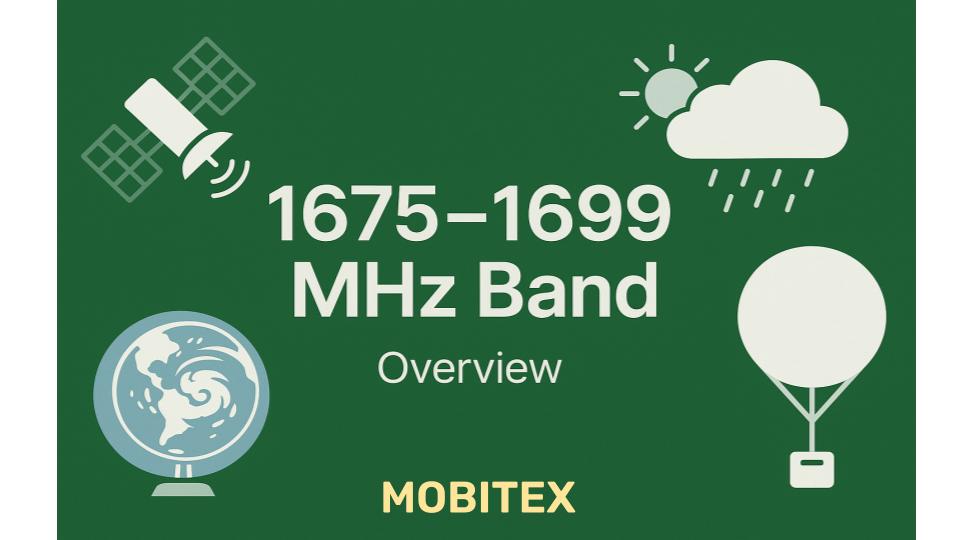
The 1675–1699 MHz band is a critical slice of the L-band used primarily for meteorological satellite data reception and atmospheric science. Unlike consumer or mobile communication spectrum, this range supports government, scientific, and operational weather systems that feed real-time data into forecasting models used worldwide.
This band sits above the protected radio astronomy segment and below higher-frequency Earth-observation allocations, making it a carefully managed transition zone in global spectrum planning.
🌦️ Primary Uses: Meteorological Satellite & Meteorological Aids
The dominant services in the 1675–1699 MHz range are:
- Meteorological-Satellite Service (MetSat), space-to-Earth
- Meteorological Aids (MetAids), such as radiosondes
Together, these services deliver essential environmental data rather than two-way communications.
🛰️ Meteorological-Satellite Service (MetSat)
In this band, weather satellites transmit downlink data from orbit to Earth. Typical data products include:
- Atmospheric sounding measurements
- Temperature and humidity profiles
- Cloud structure and water vapor distribution
- Inputs for numerical weather prediction models
These downlinks are received by fixed ground stations operated by national weather agencies, research institutions, and satellite operators.
There are no consumer terminals and no mobile user equipment associated with MetSat use in this band.
🎈 Meteorological Aids (Radiosondes)
Portions of this range are also associated with meteorological aids, especially radiosondes launched on weather balloons.
Radiosondes provide:
- Vertical profiles of temperature, pressure, and humidity
- Wind speed and direction measurements
- Upper-air data critical for forecast accuracy
These systems operate under strict regulatory control and are typically managed by national meteorological organizations.
🌍 Global Allocation & Regulatory Status
Internationally, the 1675–1699 MHz band is recognized under ITU Radio Regulations as supporting:
- Meteorological-Satellite Service (space-to-Earth)
- Meteorological Aids
Most national regulators, including those in the United States, Canada, and the United Kingdom, align closely with this framework.
Key characteristics of the allocation include:
- Global harmonization for scientific and operational use
- Licensed or agency-controlled access
- Protection from incompatible services
📶 Relationship to Adjacent Bands
Below 1675 MHz
The 1661–1668 MHz range is reserved for the Radio Astronomy Service (RAS). These frequencies are extremely sensitive and used for passive scientific observation, which is why strong out-of-band emission limits apply to protect astronomy.
Above 1699 MHz
Higher portions of the L-band support additional Earth-observation and satellite services. Allocation details vary by country but remain tightly coordinated.
Because of this positioning, emissions in 1675–1699 MHz are carefully controlled to avoid interference into neighboring bands.
🛑 Interference & Protection Considerations
Although this band supports active transmissions, it is not interference-tolerant in the way consumer bands are.
Regulatory protections include:
- Strict spectral masks
- Power limits on satellite downlinks
- Coordination requirements between satellite operators
- Explicit protection of radio astronomy below 1668 MHz
Interference in this band can directly degrade weather forecasts, aviation planning, and disaster response.
🚫 What This Band Is Not Used For
The 1675–1699 MHz band is not used for:
- Mobile phones or cellular networks
- GNSS or navigation systems
- Consumer IoT devices
- Wi-Fi, unlicensed radios, or experimental emitters
Any implication of consumer or mass-market usage in this range would be inaccurate.
🧭 Summary
The 1675–1699 MHz band plays a quiet but indispensable role in global infrastructure.
It supports:
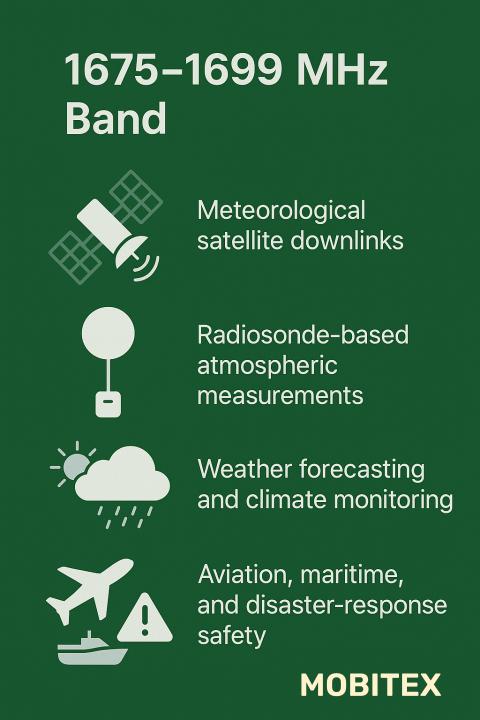
- Meteorological satellite downlinks
- Radiosonde-based atmospheric measurements
- Weather forecasting and climate monitoring
- Aviation, maritime, and disaster-response safety
Designed for precision rather than popularity, this L-band segment ensures that governments and scientists can reliably observe Earth’s atmosphere and deliver accurate forecasts that affect billions of people every day.