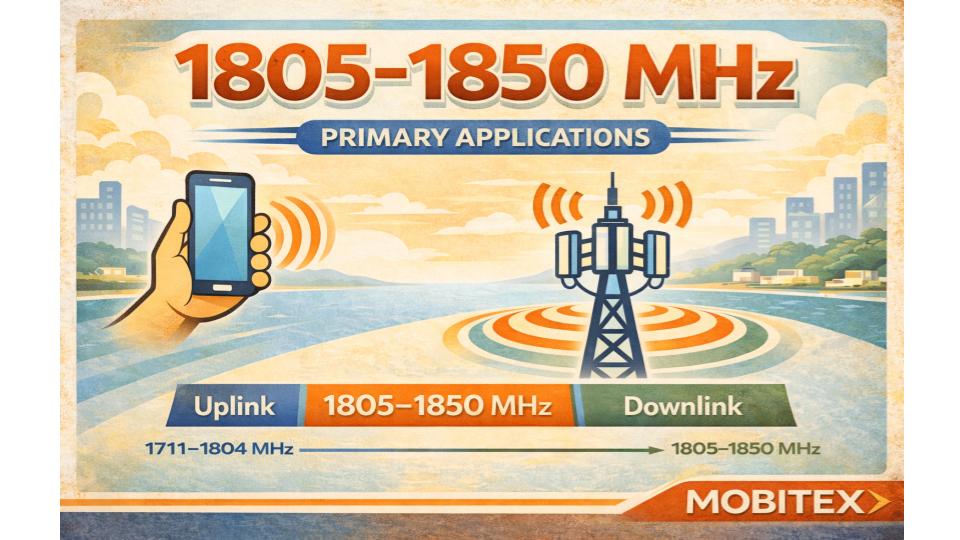
The 1805–1850 MHz frequency band is one of the most widely deployed and economically important blocks of spectrum in the world. It forms the core downlink portion of the 1800 MHz cellular band, carrying high-power transmissions from base stations to user devices.
This band underpins everyday mobile connectivity across cities, suburbs, and rural areas, supporting billions of devices globally.
📱 Primary Use: Cellular Downlink (Tower → Device)
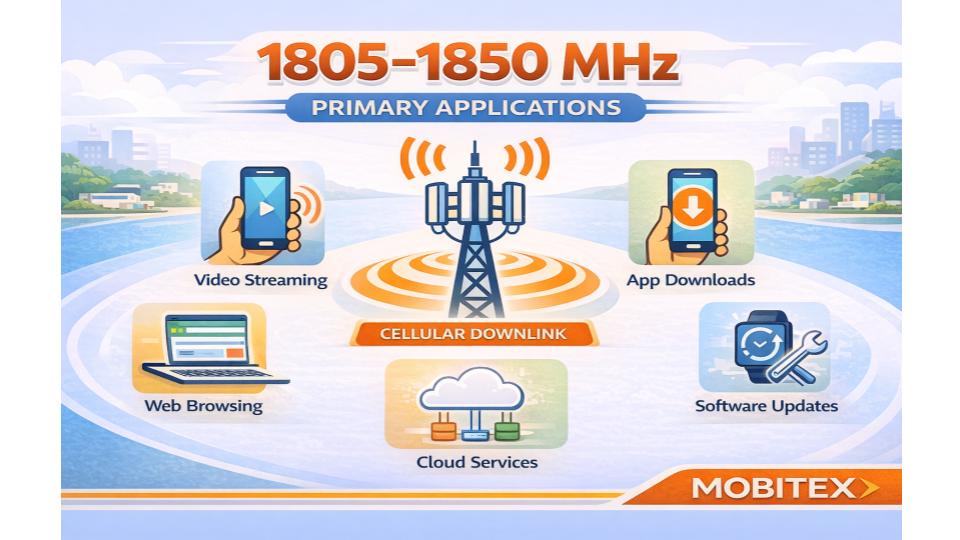
The 1805–1850 MHz band is used almost exclusively for cellular downlink, meaning signals flow from cell towers to phones, modems, and IoT devices.
It supports:
- GSM 1800 (historically)
- LTE (4G) downlink
- LTE-Advanced carrier aggregation
- 5G NR (in refarmed or shared deployments)
Because base stations transmit at significantly higher power than user devices, this band is engineered for wide-area coverage and high throughput.
🏗️ How the Band Is Deployed
This band is deployed using standard terrestrial cellular infrastructure and is one of the most mature cellular bands in existence.
Typical deployment characteristics include:
- Infrastructure: Macrocell towers, rooftops, and small cells
- Antenna gain: ~15–18 dBi sector antennas
- Tower height: ~20–60 m
- Backhaul: Fiber-optic networks, with microwave backhaul where fiber is unavailable
The band performs well in both urban and suburban environments, balancing coverage and capacity.
🌍 Licensing and Global Adoption
The 1805–1850 MHz band is licensed IMT spectrum and is harmonized across most regions of the world.
It is heavily used in:
- Europe
- Asia-Pacific
- Africa
- The Middle East
- Parts of the Americas
This global harmonization makes it especially valuable, enabling:
- International roaming
- Mass-produced, low-cost devices
- Mature network equipment ecosystems
Few bands can match its level of worldwide adoption.
🔍 Relationship to Adjacent Bands
Understanding 1805–1850 MHz requires looking at what surrounds it:
- Below (1781–1804 MHz):
Transition and coordination segment with tighter emission limits - 1805–1850 MHz:
Primary high-power cellular downlink - Above (1850 MHz and higher):
Additional cellular downlink or paired spectrum depending on region
This positioning is deliberate. The 1781–1804 MHz band acts as a buffer, protecting downlink transmissions in 1805–1850 MHz from uplink interference below.
⚠️ Interference and Engineering Considerations
Because this is a high-power downlink band, it is subject to strict engineering rules.
Key considerations include:
- Carefully controlled base-station emission masks
- Protection of adjacent uplink spectrum below
- Power management in dense urban deployments
Despite these constraints, the band remains highly efficient due to decades of optimization.
❌ What This Band Is Not Used For
The 1805–1850 MHz band is not used for:
- GPS or GNSS services
- Satellite navigation
- Satellite uplinks
- Wi-Fi, Bluetooth, or other unlicensed systems
It is strictly a licensed, terrestrial cellular band.
🧭 Why the 1805–1850 MHz Band Matters
This band carries a large share of mobile downlink traffic, including:
- Video streaming
- Web browsing
- App downloads
- Cloud services
- Software updates
Because downlink traffic typically exceeds uplink traffic, the reliability and capacity of 1805–1850 MHz directly affect user experience.
It is also a key enabler of:
- Carrier aggregation
- Spectrum refarming from GSM to LTE and 5G
- Long-term network stability
📌 Summary
- Frequency range: 1805–1850 MHz
- Primary role: Cellular downlink (tower → device)
- Technology: GSM (legacy), LTE, LTE-Advanced, 5G NR
- Licensing: Licensed IMT spectrum
- Infrastructure: Terrestrial cellular networks
- Global status: One of the most widely deployed mobile bands worldwide
The 1805–1850 MHz band is not experimental or transitional, it is foundational. It forms the backbone of modern mobile networks and will continue to do so well into the 5G era.