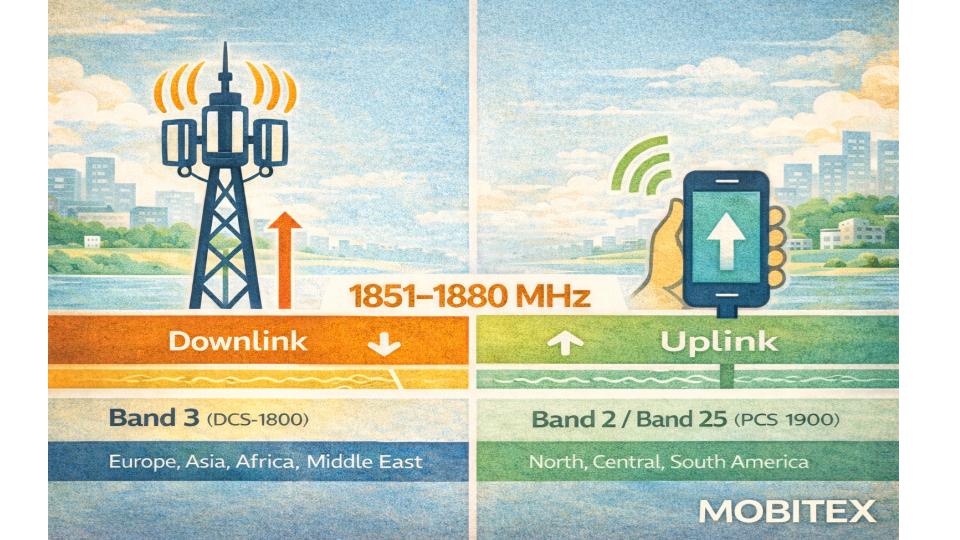
The 1851–1880 MHz frequency band is one of the clearest examples of how historical spectrum decisions still shape modern networks. Unlike most cellular bands, which are globally harmonized, this 30 MHz slice behaves very differently depending on geography.
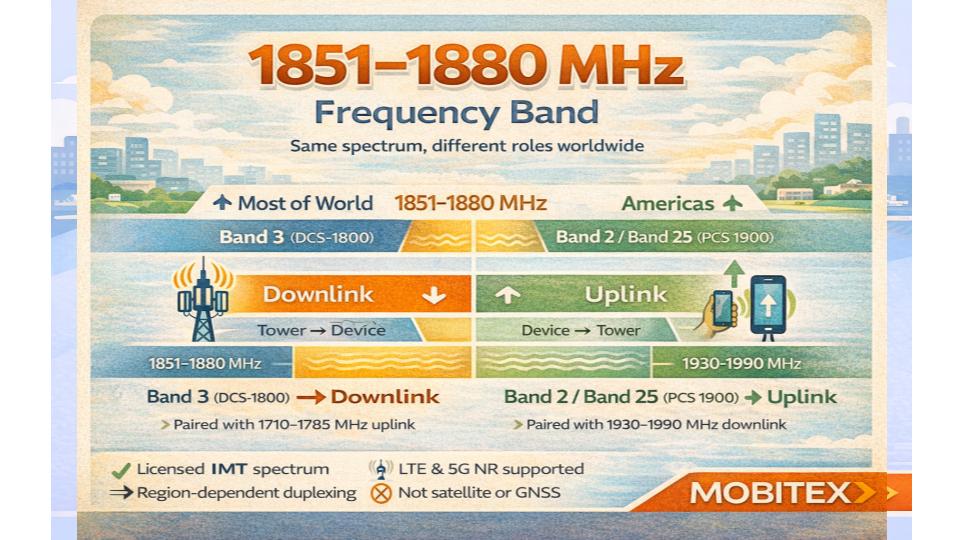
Across Europe, Asia, Africa, and much of the Middle East, it functions as downlink spectrum within the DCS-1800 system. In the Americas, the same frequencies are used for uplink as part of PCS 1900. Same spectrum, opposite directions, highlighting how spectrum coordination is as much historical as it is technical.
This article explains how that split happened and what it means in real networks.
The Global Split, Band 3 vs Band 2
Europe, Asia, Africa, and the Middle East, Band 3 Downlink
In most of the world, 1851–1880 MHz sits at the top of 3GPP Band 3, commonly known as DCS-1800.
Key characteristics
- Frequency range: 1851–1880 MHz (part of 1805–1880 MHz downlink)
- Direction: Downlink (base station to device)
- Paired uplink: 1710–1785 MHz
- Duplex spacing: 95 MHz
- 3GPP bands: LTE Band 3, 5G NR n3
- Typical base-station power: 43–49 dBm (macro sites)
This band has been in continuous use since the GSM-1800 era and remains a foundational layer for LTE and 5G. Its balance of coverage and capacity makes it especially valuable in dense urban networks while still performing well in suburban areas.
The Americas, Band 2 and Band 25 Uplink
In North, Central, and South America, 1851–1880 MHz plays a completely different role. Here, it is uplink spectrum, carrying transmissions from user devices to the network.
Key characteristics
- Frequency range: 1851–1880 MHz (subset of 1850–1910 or 1915 MHz uplink)
- Direction: Uplink (device to base station)
- Paired downlink: 1930–1990 MHz
- Duplex spacing: 80 MHz
- 3GPP bands: LTE Band 2, Band 25, 5G NR n2 and n25
- Typical device power: +23 to +31 dBm
Known as PCS 1900, this allocation emerged from U.S. FCC auctions in the 1990s and remains a core uplink band for mobile networks across the Americas.
Why the Difference Exists
European origins, GSM-1800
Europe developed GSM-1800 as an extension of GSM-900, allocating:
- 1710–1785 MHz for uplink
- 1805–1880 MHz for downlink
This structure became deeply embedded and was later adopted across much of the Eastern Hemisphere.
American divergence, PCS auctions
The United States took a different approach, building PCS allocations around 1.9 GHz:
- 1850–1910 MHz for uplink
- 1930–1990 MHz for downlink
Latin America largely followed this model, while Canada extended the uplink slightly, creating Band 25. By the time global standards emerged, both approaches were already locked into infrastructure and devices.
Technical Implications
Opposite transmission directions
The most important consequence is directional.
In Band 3 regions, 1851–1880 MHz carries high-power downlink transmissions from towers.
In Band 2 regions, it carries low-power uplink transmissions from devices.
This affects interference planning, antenna design, and overall network engineering.
Different duplex pairing
Band 3 pairing
- Uplink: 1710–1785 MHz
- Downlink: 1805–1880 MHz
Band 2 pairing
- Uplink: 1850–1910 MHz
- Downlink: 1930–1990 MHz
Despite sharing frequencies, the two systems are not interoperable at the RF level.
Technology support
Both allocations support the same cellular generations:
- GSM (2G)
- UMTS/WCDMA (3G)
- LTE (4G)
- 5G NR
The distinction is not capability, but which side of the link the spectrum serves.
Applications and Use Cases
Mobile broadband
In Band 3 regions, this band delivers downlink capacity for streaming, browsing, and app downloads.
In Band 2 regions, it supports uplink traffic, including uploads, video calls, and user-generated content.
Voice and IoT
The band continues to support:
- VoLTE and VoNR
- LTE-M and NB-IoT
- Legacy voice where still deployed
Devices and Roaming
Modern smartphones handle this split transparently by supporting both Band 2 and Band 3. High-end and mid-range devices routinely include dozens of bands, enabling seamless international roaming.
Lower-cost or region-locked devices may support only one allocation, which can limit usability outside their home markets.
Deployment and Coverage
The 1.8–1.9 GHz range offers strong real-world performance:
- Urban cells: 500–2,000 m
- Suburban cells: 2–10 km
- Rural macro cells: up to 35 km
It strikes a balance between coverage and capacity that few bands can match.
Regulatory Context
The ITU designates this spectrum for mobile services but leaves duplexing decisions to regional regulators.
As a result:
- CEPT and ETSI enforce Band 3 pairing in Europe
- The FCC framework defines Band 2 and Band 25 in the Americas
- Asia-Pacific and Africa largely follow the European model
Looking Ahead
Both Band 2 and Band 3 are being:
- Refarmed from legacy 2G and 3G
- Shared between LTE and 5G using dynamic spectrum sharing
- Integrated into increasingly complex carrier-aggregation schemes
These bands are expected to remain core mid-band spectrum well into the 5G era and beyond.
Conclusion
The 1851–1880 MHz band is a rare case where geography determines function. In most of the world, it delivers downlink capacity. In the Americas, it carries uplink traffic. That dual identity reflects decades of independent regulatory decisions and highlights the long-term consequences of early spectrum planning.
Despite the complexity, modern networks and devices manage the split effectively. The result is a band that continues to quietly underpin global mobile connectivity as networks evolve toward 5G and future generations.