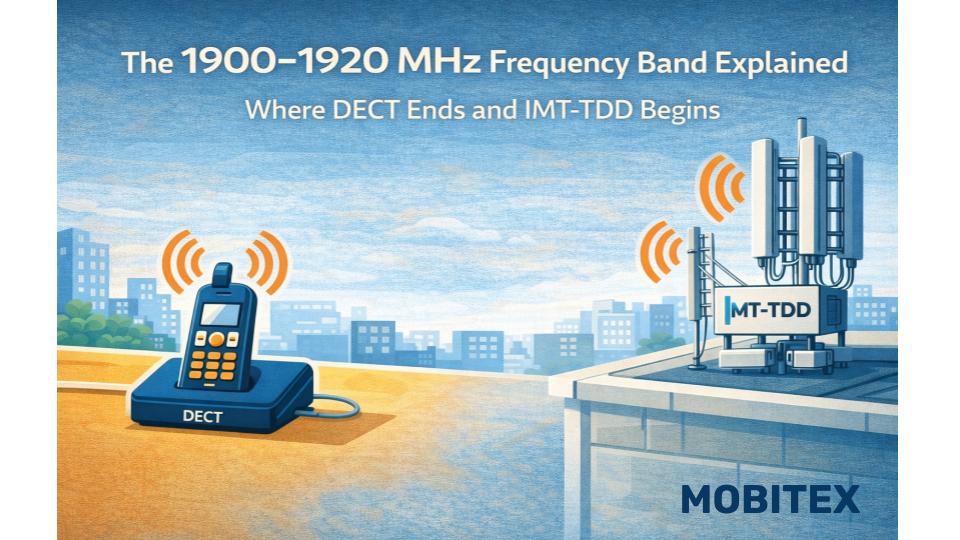
The 1900–1920 MHz frequency band sits at a subtle but important transition point in the radio spectrum. It marks the upper edge of traditional DECT cordless allocations and the lower boundary of cellular-grade mobile spectrum in many regions. While it does not enjoy the global prominence of mainstream LTE or 5G bands, this 20 MHz slice plays a specialized role in Time Division Duplex (TDD) mobile systems and regional deployments.
This article explains how the 1900–1920 MHz band is used, where it is deployed, and why it matters despite its limited footprint.
What the 1900–1920 MHz Band Is Used For
IMT TDD (3GPP Band 39)
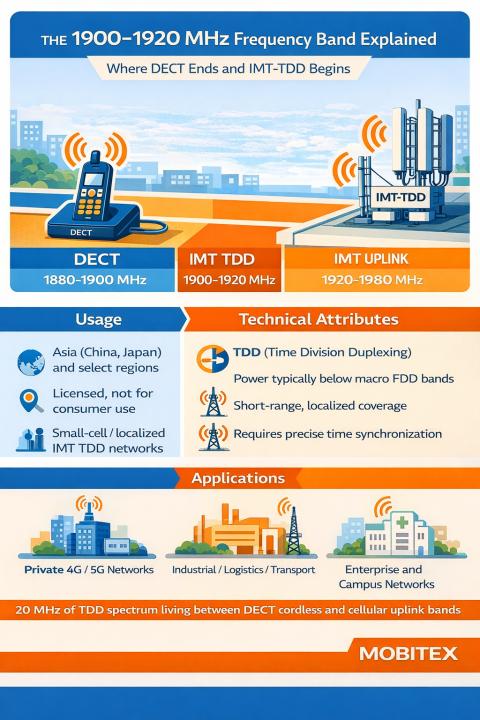
The primary standardized use of 1900–1920 MHz is as part of 3GPP Band 39, an IMT TDD band defined for mobile broadband systems.
Key characteristics:
- Duplex mode: TDD (uplink and downlink share the same frequencies in time)
- Bandwidth: up to 20 MHz
- 3GPP designations: LTE Band 39, 5G NR n39
- Typical deployment: localized, regional, or small-cell networks
Unlike paired FDD cellular bands, Band 39 does not separate uplink and downlink by frequency. Instead, traffic direction is controlled by time slots, allowing flexible adaptation to asymmetric data demand.
Where the Band Is Deployed
Region-Specific Usage
Unlike globally harmonized bands such as Band 3 or Band 2, 1900–1920 MHz is used selectively.
Common deployment patterns include:
- Parts of East Asia, particularly China and Japan
- Limited regional allocations in parts of Southeast Asia
- Experimental, enterprise, or campus networks in select markets
In most regions, the band is licensed, with access granted to specific operators or institutional users rather than nationwide consumer networks.
Why This Band Exists
Spectrum Continuity and Planning
The 1900–1920 MHz band exists largely because of historical and regulatory factors:
- 1880–1900 MHz was reserved for low-power DECT cordless systems
- 1920–1980 MHz became a core cellular uplink band (UMTS, LTE, 5G)
That left 1900–1920 MHz as a narrow window suitable for TDD mobile use without disrupting DECT below or FDD uplinks above. Regulators that needed additional mid-band capacity could exploit this gap for IMT-TDD deployments.
Technical Characteristics
Duplexing and Timing
As a TDD band, 1900–1920 MHz:
- Uses synchronized uplink/downlink time slots
- Requires tight network timing coordination
- Is sensitive to interference from unsynchronized neighboring cells
This makes the band better suited to controlled environments, such as:
- Campus networks
- Industrial facilities
- Dense urban micro-cells
Power Levels and Coverage
Typical deployments feature:
- Lower transmit power than macro FDD cellular bands
- Small-cell or rooftop installations
- Coverage ranging from a few hundred meters to a few kilometers
The band is rarely used for wide-area rural coverage.
Relationship to Adjacent Bands
Below 1900 MHz
- 1880–1900 MHz is dominated by DECT cordless systems
- Low power, license-exempt, indoor-focused
- Strict coexistence rules protect DECT from cellular interference
Above 1920 MHz
- 1920–1980 MHz is widely used for cellular uplink (UMTS, LTE, 5G)
- High-power, wide-area mobile networks
- One of the most heavily used uplink ranges globally
The 1900–1920 MHz band sits neatly between these two worlds, neither cordless nor mainstream cellular.
Applications and Use Cases
Private and Enterprise Mobile Networks
The band is well-suited for:
- Private LTE or 5G networks
- Industrial communications
- Logistics and transportation hubs
- Secure, on-premise wireless systems
TDD flexibility allows operators to tailor uplink-to-downlink ratios based on local traffic needs.
Supplemental Capacity
In some regions, the band is used to:
- Supplement existing FDD spectrum
- Offload traffic in dense urban areas
- Support fixed wireless or specialized data services
Its narrow bandwidth limits its role, but it can be valuable where spectrum is scarce.
Regulatory Status
Licensed and Coordinated
Unlike DECT, the 1900–1920 MHz band is typically:
- Individually licensed
- Subject to coordination and interference rules
- Allocated under mobile (IMT) service frameworks
National regulators determine availability and licensing conditions, often aligning with regional spectrum plans rather than global harmonization.
Why the Band Still Matters
Even with limited deployment, the 1900–1920 MHz band remains relevant because it:
- Provides additional mid-band TDD capacity
- Supports private and industrial networks
- Offers flexible duplexing where paired spectrum is unavailable
- Serves as a buffer between incompatible services on either side
In spectrum-constrained markets, even small allocations like this can be strategically important.
Conclusion
The 1900–1920 MHz frequency band is a niche but purposeful part of the radio spectrum. Positioned between DECT cordless systems below and mainstream cellular uplinks above, it enables IMT TDD deployments where flexibility and localized coverage are more important than nationwide reach.
While it will never be a flagship consumer band, its role in private networks, regional deployments, and supplemental capacity ensures it remains a relevant and carefully managed slice of spectrum in the evolving wireless landscape.