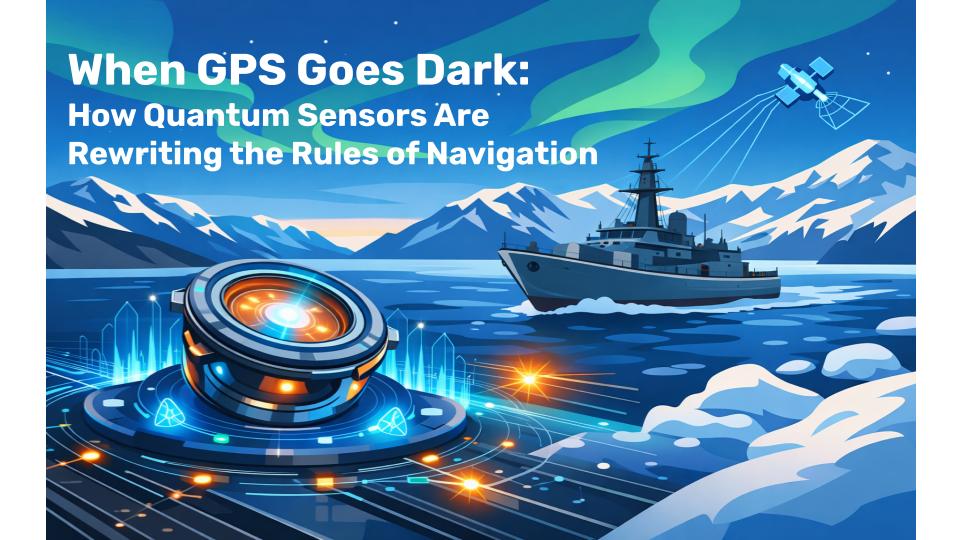
As GPS jamming reaches crisis levels, scientists are teaching atoms to navigate – no satellites required
Arctic Trials Demonstrate Satellite-Free Navigation
In December 2025, the Royal Navy completed Arctic sea trials of a navigation system that does not rely on GPS or any external radio signals. Instead, the system uses quantum inertial sensors, which determine position by precisely measuring motion using clouds of ultra-cold atoms and laser pulses.
The trials were conducted in regions where GPS interference is increasingly common. High-latitude environments present additional challenges for satellite navigation due to geometry, atmospheric effects, and electronic interference. The tests showed that vessels could maintain accurate navigation even when satellite signals were degraded or unavailable.
The trials were designed to address a growing operational problem: GPS, long treated as a reliable global utility, has become increasingly vulnerable to deliberate interference.
GPS Interference Is Increasing Worldwide
Navigation disruptions linked to GPS jamming and spoofing are no longer limited to conflict zones.
Aviation authorities have reported thousands of commercial flights affected by degraded navigation signals over the past several years. Maritime operators in the Baltic Sea, North Sea, Black Sea, and Arctic regions now treat GPS interference as routine rather than exceptional.
In many cases, affected aircraft and vessels report incorrect position data rather than complete signal loss. This scenario is considered particularly dangerous, as systems may appear to be functioning normally while producing false navigation information.
According to a December 2025 analysis by MIT Technology Review, GPS spoofing can silently mislead safety-critical systems, making it more dangerous than outright signal loss.
Because GPS underpins Positioning, Navigation, and Timing (PNT) services, disruptions can affect air traffic management, shipping operations, telecommunications networks, and power grids.
Why GPS Is Difficult to Defend
The vulnerability of GPS is structural rather than technical.
GPS satellites orbit approximately 20,000 kilometers above Earth. By the time their signals reach the surface, they are extremely weak, making them easy to overpower with low-cost jamming equipment.
More sophisticated attacks involve spoofing, where false GPS-like signals are transmitted to deceive receivers into calculating incorrect positions or times. Because receivers still detect what appears to be a valid signal, these errors may persist undetected.
As long as navigation depends on faint signals transmitted from space, those signals remain susceptible to interference.
Quantum Navigation Uses Physics Instead of Signals
Quantum navigation takes a fundamentally different approach.
Rather than relying on external signals, quantum inertial sensors track acceleration and rotation from a known starting point with extreme precision. This is a form of inertial navigation, but with accuracy far exceeding conventional systems.
Quantum sensors exploit atom interferometry, a technique that measures motion using the wave-like behavior of atoms cooled to near absolute zero. Because the measurements are tied to atomic properties rather than mechanical components, quantum sensors drift far more slowly than traditional inertial devices.
Field trials by Q-CTRL have demonstrated navigation performance improvements of more than 100× compared to conventional inertial systems in GPS-denied environments. These systems operate passively and emit no signals, making them inherently resistant to jamming and spoofing.
From Research Labs to Operational Platforms
Quantum navigation technology has progressed rapidly from laboratory experiments to field trials.
Researchers at Imperial College London demonstrated early quantum navigation sensors in 2018. By 2023, those systems were tested aboard a Royal Navy research vessel. The December 2025 Arctic trials marked a significant step toward operational deployment.
Recent work has focused on ensuring that quantum sensors can withstand vibration, temperature changes, and mechanical shock encountered on ships and aircraft.
Defense Agencies Accelerate Investment
Rising GPS vulnerabilities have prompted accelerated investment by defense agencies.
In September 2025, the Defense Advanced Research Projects Agency (DARPA) awarded Q-CTRL $24.4 million under its Robust Quantum Sensors program. The initiative aims to develop quantum navigation systems capable of operating reliably on aircraft, ships, and ground vehicles under real-world conditions.
Lockheed Martin is participating as a subcontractor, focusing on system integration and ruggedization.
Similar efforts are underway in Europe and Australia, reflecting a growing consensus that reliance on GPS alone is no longer sufficient for safety-critical navigation.
Civilian Implications Extend Beyond Defense
Although military requirements are driving much of the development, the implications extend to civilian sectors.
Civil aviation relies heavily on satellite navigation for route planning, approach procedures, and surveillance. Aviation safety authorities such as the European Union Aviation Safety Agency have issued repeated warnings about GNSS disruptions affecting aircraft operations.
Rail networks depend on GPS for signaling and train control. Maritime ports use precise positioning for vessel traffic management. Autonomous vehicles and drones also rely on accurate navigation and timing.
Experts increasingly emphasize the need for sensor fusion, combining multiple independent navigation sources. Quantum inertial sensors could serve as a trusted reference, cross-checking satellite navigation, magnetic data, visual positioning, and cellular-based systems.
Satellite Navigation Continues to Evolve
GPS itself is evolving, with newer satellites introducing more robust civilian and military signals. Low-Earth-orbit navigation systems are also emerging, offering stronger signals and lower latency.
Companies such as Xona Space Systems are developing LEO-based navigation constellations designed to complement GNSS and improve resilience against interference.
However, most experts agree that no satellite-based system alone can fully eliminate the risk of jamming and spoofing. Signal-independent navigation technologies are increasingly viewed as a necessary complement.
A Shift Toward Resilient Navigation
Navigation is undergoing a structural transition.
Instead of relying on a single source of truth, future navigation systems are expected to combine multiple independent measurements. Quantum navigation represents one of the most promising approaches, offering positioning based on fundamental physical principles rather than vulnerable radio signals.
As GPS interference becomes more common in certain regions, satellite-independent navigation is moving from experimental research into operational necessity.