Frequency
1662 MHz
Range
1660.5–1668.4 MHz
Band Group
L‑Band RAS
🌐 Summary
The 1662 MHz allocation is part of the L‑Band RAS spectrum. This range is used worldwide for critical applications that keep our communications and infrastructure running smoothly. On this page we highlight how each band is applied in real systems, from regulatory assignments to everyday devices. Our goal is to make spectrum data clear and practical for engineers, regulators, and enthusiasts alike.
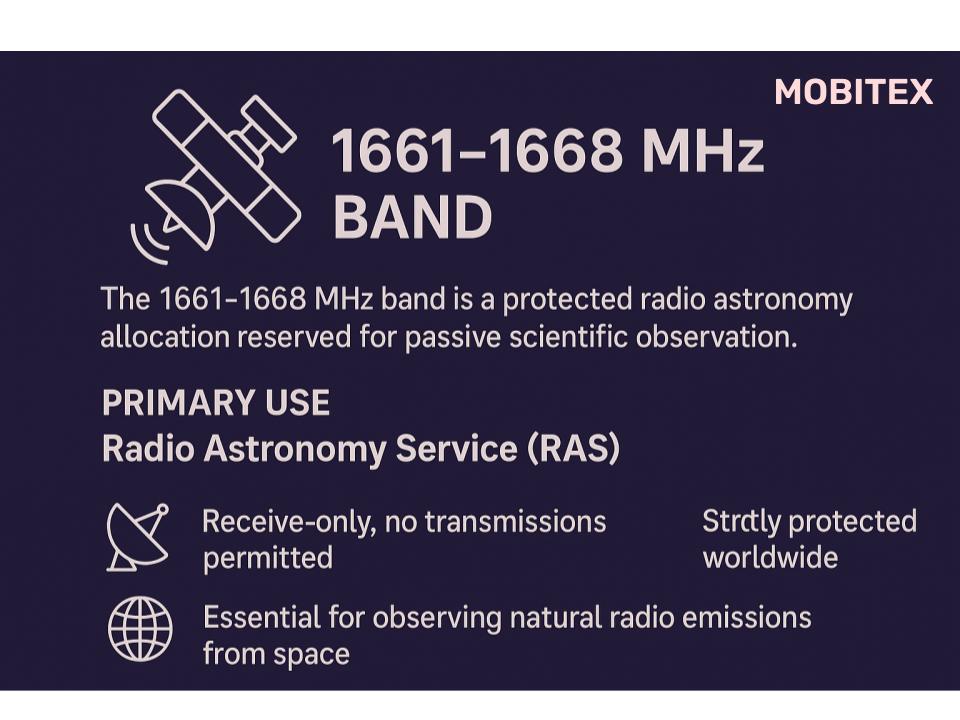
Key uses of this band include: 1662 MHz lies within the Radio Astronomy Service window used for sensitive spectral line observations. All transmitters must meet stringent protection criteria (e.g., ITU‑R RA.769) to prevent harmful interference..
Core Radio Astronomy navigation band; critical for global PNT services.
🔍 Explore the full RF Spectrum database
📡 Band & Geometry key
| Field | Value |
|---|---|
| Wavelength (m) | 0.18038054031288 |
| Waveforms | BPSK(1), BOC(1,1), MBOC – per system specs |
| Antenna Form Factor (Typical) | Passive or active patch (25–35 mm), helical, or chip antenna tuned for ~1575 MHz. |
| Band Family | L‑Band MSS Downlink (1626.5–1660.5 MHz) |
| Band | L‑Band |
| Primary Common Name | Radio Astronomy Service (RAS) |
| FSPL @ 1 km [dB] | 96.3 |
| FSPL @ 10 km [dB] | 116.3 |
| Fresnel Radius @ 1 km (m) | 0.212 |
| Band Group | L‑Band RAS |
| Tax Band Family | L‑Band |
| Tax Band Class | 1661 MHz – 1668 MHz L-Band Radio Astronomy Service |
🧩 Applications & Usage
| Field | Value |
|---|---|
| Primary Application | Radio astronomy observations (passive, receive-only) |
| Lower Neighbor Use | MSS Downlink (1626.5–1660.5 MHz) |
| Upper Neighbor Use | Region-specific allocations above 1668.4 MHz |
| Typical Services Devices | Radio Astronomy receivers, timing modules, IoT location devices |
| Market Common Devices | Satellite phones, gateways, IoT receivers |
| Refarming Use | Not applicable (passive allocation) |
| Device Ecosystem Size | >10 billion Radio Astronomy-capable devices globally |
| Device Hotspots (MHz) | N/A |
| Device Category | Consumer, automotive, aviation, maritime, IoT, military receivers |
| Typical Use Cases | Positioning, navigation, timing (PNT) for civilian and military systems |
| Modulation (Device) | N/A |
| Channel Width (Device) [kHz] | ~2000–4000 kHz main‑lobe equivalent (receiver bandwidths vary 2–24 MHz by design) |
| Device Region Profiles | N/A |
| Per-Region EIRP Or Duty (Device) | N/A – receivers only; no transmit EIRP or duty cycle. |
| Allocation Relevance (Device) | Critical: RAS allocation defines protected receive‑only operation; devices must meet susceptibility thresholds. |
| Adjacent-Band Collision Risks (Device) | High risk from adjacent MSS (≤1559 MHz) and out‑of‑band cellular/ISM emitters; use SAW/ceramic filters, LNA linearity, and tight front‑end selectivity. |
| Example Devices Or Skus | u‑blox M10/M9 series, Broadcom BCM47765, Qualcomm multi‑Radio Astronomy chipsets, Trimble/Septentrio receivers, timing modules (OCXO‑disciplined). |
| Common Protocols | N/A |
🗒️ Notes
| Field | Value |
|---|---|
| Receiver Selectivity Notes | High selectivity (≥60 dB rejection across 1559–1610 MHz) |
| Interference Notes | Receive-only, extremely sensitive band. Emissions in/near 1661–1668 MHz can disrupt observations. |
| Compatibility Risk Notes | 0 |
| Notes | Core Radio Astronomy navigation band; critical for global PNT services. |
| Propagation Notes | Free-space propagation dominated; global satellite visibility required |
⚙️ Technical Rules
| Field | Value |
|---|---|
| Lower Band Frequency Limit | 1660.5 |
| Upper Band Frequency Limit | 1668.4 |
| EIRP Indoor Limits | Not applicable – receive-only band |
| EIRP Outdoor Limits | Not applicable – receive-only band |
| PSD Limit | Not applicable – receive-only band |
| Emission Mask Class | N/A – receive-only (RAS) |
| Guardband Minimum [kHz] | N/A – receive-only band |
| Typical Bandwidths | 12.5 kHz–5 MHz (system‑dependent) |
| Autocalculated Bandlimits | 0 |
| Typical Bandwidths (Estimated) | 12.5 kHz–5 MHz (system‑dependent) |
| Max EIRP [dBm] | N/A – receivers only; no transmit EIRP or duty cycle. |
| Power Source Or Duty Profile (Typical) | Receiver‑side only; duty driven by application (tracking vs. timing holdover). |
| Channelization Plan | No channelization (passive allocation) |
| Channelization | Continuous navigation carrier signals (BPSK, BOC, MBOC) |
| Guard Band Requirement | Strict OOBE to protect Radio Astronomy (RAS) observations |
| OOB Emission Limit [dBm/MHz] | Very strict OOBE required (protect RAS, 1661–1668 MHz) |
| Spurious Emission Limit (dBm) | Very strict spurious limits required (protect RAS) |
| RX Blocking Min [dBm] | N/A – passive receiver |
| Duplexing | N/A – passive |
| Duplexing Information | Downlink (space‑to‑Earth) |
| Uplink Pairing | Not applicable – unpaired downlink only (space-to-Earth) |
| Downlink Pairing | Not applicable – unpaired downlink only (space-to-Earth) |
| Paired Band Info | N/A – passive band |
| Max EIRP [dBm] | N/A – receive-only band |
| Channelization Block Size | Operator carriers (kHz–MHz) |
| 3GPP Band Number | |
| Example 3GPP Bands | Not applicable – no 3GPP/LTE/NR band association |
| LTE Uplink Bands | Not applicable – no 3GPP/LTE/NR band association |
| LTE Downlink Bands | Not applicable – no 3GPP/LTE/NR band association |
| NR Uplink Bands | Not applicable – no 3GPP/LTE/NR band association |
| NR Downlink Bands | Not applicable – no 3GPP/LTE/NR band association |
| Guard Bands | Adjacent-band emissions must protect RAS (passive); strict OOBE required |
| Protocol Or Standard | N/A – passive scientific service |
🌎 Country Overrides
| Field | Value |
|---|---|
| Tax Service Category | Passive Scientific Service |
| Tax License Type | Protected passive service (no transmit) |
| Tax Regions | Global (ITU Regions 1–3) |
| ITU Region 1 (Europe, Africa, Middle East (west of Persian Gulf), Western Russia & Mongolia) | Radio astronomy |
| ITU Region 2 (North America, South America, Central America, Caribbean, Greenland, Eastern Pacific Islands (Americas region)) | Radio astronomy |
| ITU Region 3 (Asia, Australia, Pacific Islands, Oceania, Indian Subcontinent, East Asia & Southeast Asia) | Radio astronomy |
| License Type | Protected passive service (no transmit) |
| Primary Application | Radio astronomy observations (passive, receive-only) |
| Primary Services | Radio Astronomy Service (passive) |
| Spurious Emission [dBm] | Very strict spurious limits required (protect RAS) |
| Lower Neighbor Use | MSS Downlink (1626.5–1660.5 MHz) |
| Upper Neighbor Use | Region-specific allocations above 1668.4 MHz |
| Licensing Model | ITU‑coordinated; operator licenses |
| Typical Services Devices | Radio Astronomy receivers, timing modules, IoT location devices |
| US FCC Alloc | Radionavigation-satellite service (space-to-Earth)– |
| CA IC Alloc | Radionavigation-satellite service (space-to-Earth)– |
| UK Ofcom Alloc | Radionavigation-satellite service (space-to-Earth)– |
| US Ref | ITU‑R M.1902 / M.2012 – Radio Astronomy performance standards |
| Typical Bandwidths | 12.5 kHz–5 MHz (system‑dependent) |
| Market Licensing Model | Licensed spectrum – coordinated via ITU / satellite operator agreements |
| Market Common Devices | Satellite phones, gateways, IoT receivers |
| Fresnel Radius (1st, 1 km) [m] | 0.212 |
| Typical Bandwidths (Estimated) | 12.5 kHz–5 MHz (system‑dependent) |
| Auction Status | Not auctioned (passive scientific allocation) |
| Refarming Use | Not applicable (passive allocation) |
| Typical Site Spacing km | N/A – space segment with global footprint. / N/A – space segment with global footprint. |
| Device Ecosystem Size | >10 billion Radio Astronomy-capable devices globally |
| Traffic Load Share | N/A – receive-only service |
| Device Hotspots (MHz) | N/A |
| Device Category | Consumer, automotive, aviation, maritime, IoT, military receivers |
| Typical Use Cases | Positioning, navigation, timing (PNT) for civilian and military systems |
| Typical Center Frequencies [MHz] | N/A (Passive service – no defined center frequencies) |
| Rule Part (Fcc Or Region) | National RAS protection rules; aligned with ITU Radio Regulations |
| Modulation (Device) | N/A |
| Channel Width (Device) [kHz] | ~2000–4000 kHz main‑lobe equivalent (receiver bandwidths vary 2–24 MHz by design) |
| Device Region Profiles | N/A |
| Per-Region EIRP Or Duty (Device) | N/A – receivers only; no transmit EIRP or duty cycle. |
| Allocation Relevance (Device) | Critical: RAS allocation defines protected receive‑only operation; devices must meet susceptibility thresholds. |
| Adjacent-Band Collision Risks (Device) | High risk from adjacent MSS (≤1559 MHz) and out‑of‑band cellular/ISM emitters; use SAW/ceramic filters, LNA linearity, and tight front‑end selectivity. |
| Example Devices Or Skus | u‑blox M10/M9 series, Broadcom BCM47765, Qualcomm multi‑Radio Astronomy chipsets, Trimble/Septentrio receivers, timing modules (OCXO‑disciplined). |
| Antenna Form Factor (Typical) | Passive or active patch (25–35 mm), helical, or chip antenna tuned for ~1575 MHz. |
| Power Source Or Duty Profile (Typical) | Receiver‑side only; duty driven by application (tracking vs. timing holdover). |
🛡️ Regulatory & Neighbors
| Field | Value |
|---|---|
| Lower Band Frequency Limit | 1660.5 |
| Upper Band Frequency Limit | 1668.4 |
| Rx Blocking Min dBm | N/A – passive receiver |
| Lower Neighbor Use | MSS Downlink (1626.5–1660.5 MHz) |
| Upper Neighbor Use | Region-specific allocations above 1668.4 MHz |
| Lower Neighbor Band | MSS Downlink |
| Lower Neighbor Range | 1626.5–1660.5 MHz |
| Upper Neighbor Label | Regional (MetSat/RAS/other) |
| Upper Neighbor Range | 1668.4–1675 MHz |
| Adjacent-Band Collision Risks (Device) | High risk from adjacent MSS (≤1559 MHz) and out‑of‑band cellular/ISM emitters; use SAW/ceramic filters, LNA linearity, and tight front‑end selectivity. |
| Real-World Range (Indoor/Outdoor) | Outdoor sky view: global coverage; indoor: limited – assisted Radio Astronomy or repeaters required. |
| US FCC Alloc | Radionavigation-satellite service (space-to-Earth)Radionavigation-satellite service (space-to-Earth) |
| CA IC Alloc | Radionavigation-satellite service (space-to-Earth)Radionavigation-satellite service (space-to-Earth) |
| UK Ofcom Alloc | Radionavigation-satellite service (space-to-Earth)Radionavigation-satellite service (space-to-Earth) |
| Regulatory References | US: ITU‑R M.1902 / M.2012 – Radio Astronomy performance standards; CA: ITU‑R M.1902 / M.2012 – Radio Astronomy performance standards; UK: ITU‑R M.1902 / M.2012 – Radio Astronomy performance standards |
| Global Harmonization | Yes – protected worldwide under ITU RAS allocations |
| Crossborder Coordination | None required – international Radio Astronomy spectrum coordination under ITU-R |
| Sharing Mechanism | Passive coexistence only; no active sharing permitted |
| Auction Status | Not auctioned (passive scientific allocation) |
| Guard Or Pair | Unpaired (passive) |
📈 Market & Measurements
| Field | Value |
|---|---|
| Noise Floor | Satellite downlink (space-to-Earth); GEO/MEO/LEO systems |
| Interference Cases | Out-of-band emissions, harmonics, and adjacent-band transmitters; strict protection required |
| Lower Neighbor Range | 1626.5–1660.5 MHz |
| Upper Neighbor Range | 1668.4–1675 MHz |
| Interference Notes | Receive-only, extremely sensitive band. Emissions in/near 1661–1668 MHz can disrupt observations. |
| Market Licensing Model | Licensed spectrum – coordinated via ITU / satellite operator agreements |
| Market Commercial Value | High – ubiquitous Radio Astronomy receiver ecosystem; critical PNT infrastructure |
| Market Common Devices | Satellite phones, gateways, IoT receivers |
| Market Deployment Density | Medium – global satellite coverage |
| Noise Floor (Estimated) | Satellite downlink (space-to-Earth); GEO/MEO/LEO systems |
| Market Commercial Value (Estimated) | High – ubiquitous Radio Astronomy receiver ecosystem; critical PNT infrastructure |
| Ecosystem Maturity | Fully mature global ecosystem (>10B receivers) |
| Indoor Penetration | Weak; Radio Astronomy signals ~−130 dBm require outdoor or assisted Radio Astronomy |
| Known Interference | Vulnerable to jamming/spoofing; mitigation via multi-Radio Astronomy and SAASM/RTK |
| Device Ecosystem Size | >10 billion Radio Astronomy-capable devices globally |
| Real-World Range (Indoor/Outdoor) | Outdoor sky view: global coverage; indoor: limited – assisted Radio Astronomy or repeaters required. |
| Antenna Form Factor (Typical) | Passive or active patch (25–35 mm), helical, or chip antenna tuned for ~1575 MHz. |
| Ecosystem Maturity | Fully mature global ecosystem (>10B receivers) |
| Device Ecosystem Size | >10 billion Radio Astronomy-capable devices globally |
| Chipset Availability | Universal; all modern chipsets support multi-Radio Astronomy L1/E1 |
| Operator Deployments | Global constellation operators (US, EU, Russia, China, Japan, India) |
| Technology Generations Deployed | N/A – passive scientific service |
| Roaming Support | Universal cross-system compatibility via multi-Radio Astronomy receivers |
| Traffic Load Share | N/A – receive-only service |
| Indoor Penetration | Weak; Radio Astronomy signals ~−130 dBm require outdoor or assisted Radio Astronomy |
| Known Interference | Vulnerable to jamming/spoofing; mitigation via multi-Radio Astronomy and SAASM/RTK |
| Occupancy | >95% utilization – global Radio Astronomy receivers |
| Occupancy Bucket Pct | >95% global utilization (Radio Astronomy receivers ubiquitous) |
| Latency Profile | Deterministic; satellite signal propagation delay ~67 ms (20,200 km) |
| Common Channels Or Profiles | N/A |
| Security Features | N/A |
| Lbt Or Fhss Requirement | Not applicable |
| Popularity (Installed Base) | Extremely high – billions of active receivers worldwide. |
| Coexistence Tips | Add pre‑selector/SAW filters; ensure antenna clear sky view; mitigate jammers/spoofers; multi‑Radio Astronomy fusion and carrier‑phase techniques (RTK/PPP) for resilience. |
| Latency Class | Initial TTFF: ~1–30 s (cold‑start); steady‑state navigation latency <1 s. |
| Device Hotspots (Scoped && Tagged) | 1575.42 (Radio Astronomy/Radio Astronomy), 1602 (Radio Astronomy), 1561 (Radio Astronomy). |