Frequency
1871 MHz
Range
1851–1880 MHz
Band Group
1800 MHz Cellular (DCS / Band 3)
🌐 Summary
The 1871 MHz allocation is part of the 1800 MHz Cellular (DCS / Band 3) spectrum. This range is used worldwide for critical applications that keep our communications and infrastructure running smoothly. On this page we highlight how each band is applied in real systems, from regulatory assignments to everyday devices. Our goal is to make spectrum data clear and practical for engineers, regulators, and enthusiasts alike.
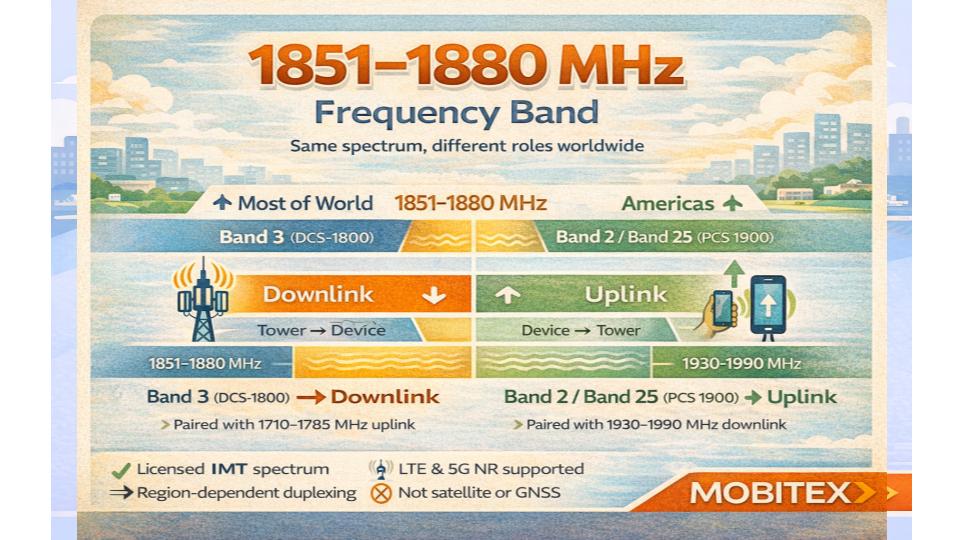
Key uses of this band include: Frequency 1851-1880 MHz has regional allocation differences. EUROPE/ASIA/AFRICA: Band 3 (DCS-1800) downlink – base stations transmit, paired with 1710-1785 MHz uplink. AMERICAS: Band 2/25 (PCS 1900) uplink – mobile devices transmit, paired with 1930-1990 MHz downlink. Same frequencies, opposite directions. Both support 2G/3G/4G/5G. Critical to understand regional context for regulatory compliance and device compatibility..
DCS-1800 / Band 3 downlink upper portion (Europe, Asia, Africa, Middle East). NOTE: In Americas (US/Canada/Latin America), this same frequency range is used as Band 2/25 UPLINK (1850-1910 MHz UL paired with 1930-1990 MHz DL). Regional allocation differences are critical for regulatory compliance.
🔍 Explore the full RF Spectrum database
📡 Band & Geometry key
| Field | Value |
|---|---|
| Wavelength (m) | 0.1602311373597 |
| Waveforms | BPSK(1), BOC(1,1), MBOC – per system specs |
| Antenna Form Factor (Typical) | BS: panel/sector; UE: internal PIFA/monopole |
| Band Family | DCS-1800 (Band 3 downlink 1805-1880 MHz) |
| Band | L‑Band |
| Primary Common Name | DCS-1800 / Band 3 Downlink (Europe/Asia/Africa); Band 2 Uplink in Americas |
| FSPL @ 1 km [dB] | 97.89 |
| FSPL @ 10 km [dB] | 117.89 |
| Fresnel Radius @ 1 km (m) | 6.329 |
| Band Group | 1800 MHz Cellular (DCS / Band 3) |
| Tax Band Family | Cellular (DCS-1800 / IMT uplink) |
| Tax Band Class | 1851 to 1880 MHz Cellular (DCS-1800 / IMT uplink) (Mobitex) |
🧩 Applications & Usage
| Field | Value |
|---|---|
| Primary Application | Regional cellular: Band 3 (DCS-1800) base station downlink in Europe/Asia/Africa; Band 2/25 (PCS 1900) mobile device uplink in Americas. Same frequencies, opposite transmission directions. |
| Lower Neighbor Use | Band 3 Downlink (1805–1850 MHz) |
| Upper Neighbor Use | AWS Downlink (2110–2180 MHz) |
| Typical Services Devices | Base stations: macro/micro/small cells; UE: GSM/LTE/5G smartphones (Band 3 receive) |
| Market Common Devices | Base stations (transmit); LTE/5G smartphones, IoT modules (receive) |
| Refarming Use | DCS-1800 being refarmed for LTE/5G NR |
| Device Ecosystem Size | Very large – billions of Band 3 devices globally |
| Device Hotspots (MHz) | 1865 (center of upper Band 3 DL) |
| Device Category | Cellular base stations (eNodeB, gNB transmit); UE (smartphones, tablets receive) |
| Typical Use Cases | Mobile broadband downlink (2G/3G/4G/5G), voice services, video streaming, IoT |
| Modulation (Device) | QPSK/16QAM/64QAM/256QAM (uplink varies by system/config) |
| Channel Width (Device) [kHz] | GSM: 200 kHz; LTE: 1400-20000 kHz; NR: 5000-100000 kHz |
| Device Region Profiles | Band 3 (DCS-1800 DL): Europe, Asia-Pacific, Middle East, Africa, parts of Latin America. Band 2 (PCS 1900 UL): United States, Canada, Mexico, Caribbean, parts of Latin America. International phones support both bands. |
| Per-Region EIRP Or Duty (Device) | Base station: 43-49 dBm (macro); regional power variations |
| Allocation Relevance (Device) | High relevance globally – one of the most important cellular bands. Band 3 devices for Europe/Asia/Africa downlink reception. Band 2 devices for Americas uplink transmission. Multi-band devices support both. |
| Adjacent-Band Collision Risks (Device) | Adjacent channel interference; guard band prevents uplink interference |
| Example Devices Or Skus | International phones support both: iPhone 15 (Band 2 & 3), Samsung Galaxy S24 (Band 2 & 3), Pixel 8 (Band 2 & 3). Regional devices may support only local band (Band 3 in Europe/Asia, Band 2 in Americas). |
| Common Protocols | DCS-1800, UMTS-1800, LTE Band 3, 5G NR n3 |
🗒️ Notes
| Field | Value |
|---|---|
| Receiver Selectivity Notes | UE receiver adjacent channel selectivity (ACS): ≥33 dB (LTE Band 3); blocking per 3GPP TS 36.101 |
| Interference Notes | Regional allocation differences create unique interference scenarios. Band 3 regions: out-of-band emissions from base stations. Band 2 regions: emissions from mobile devices. Cross-border areas between different allocation regions require special coordination. |
| Compatibility Risk Notes | 0 |
| Notes | DCS-1800 / Band 3 downlink upper portion (Europe, Asia, Africa, Middle East). NOTE: In Americas (US/Canada/Latin America), this same frequency range is used as Band 2/25 UPLINK (1850-1910 MHz UL paired with 1930-1990 MHz DL). Regional allocation differences are critical for regulatory compliance. |
| Propagation Notes | Good indoor penetration at 1.8 GHz; better than higher frequencies |
⚙️ Technical Rules
| Field | Value |
|---|---|
| Lower Band Frequency Limit | 1851 |
| Upper Band Frequency Limit | 1880 |
| EIRP Indoor Limits | Base station: 24-37 dBm (small cells); UE receives (no UE transmit in DL) |
| EIRP Outdoor Limits | Base station: 43-49 dBm (macro cells); 61 dBm EIRP with antenna gain |
| PSD Limit | Not applicable – receive-only band |
| Emission Mask Class | receive-only band (no transmitters) |
| Guardband Minimum [kHz] | N/A – receive-only band |
| Typical Bandwidths | 12.5 kHz–5 MHz (system‑dependent) |
| Autocalculated Bandlimits | 0 |
| Typical Bandwidths (Estimated) | 12.5 kHz–5 MHz (system‑dependent) |
| Max EIRP [dBm] | Base station: 43-49 dBm (macro); regional power variations |
| Power Source Or Duty Profile (Typical) | BS: continuous AC; UE: battery (3-5 days typical) |
| Channelization Plan | 3GPP channel raster per national IMT band plan (FDD); paired with 1930–1995 MHz downlink where allocated |
| Channelization | GSM: 200 kHz channels; LTE: 1.4-20 MHz; 5G NR: flexible numerology 5-100 MHz |
| Guard Band Requirement | 1785-1805 MHz guard band between uplink and downlink |
| OOB Emission Limit [dBm/MHz] | Strict OOBE < –60 dBm/MHz to protect adjacent channels |
| Spurious Emission Limit (dBm) | ≤ −60 dBm/MHz (strict protection standard) |
| RX Blocking Min [dBm] | UE blocking: -43 dBm (in-band); -15 dBm (out-of-band) per 3GPP |
| Duplexing | FDD downlink (Base → UE) |
| Duplexing Information | Downlink (space‑to‑Earth) |
| Uplink Pairing | Paired with 1710–1785 MHz uplink (Band 3); duplex gap 1785-1805 MHz |
| Downlink Pairing | |
| Paired Band Info | Paired downlink typically 1930–1995 MHz (PCS/Band 3), region-dependent |
| Max EIRP [dBm] | N/A – receive-only band |
| Channelization Block Size | Operator carriers (kHz–MHz) |
| 3GPP Band Number | |
| Example 3GPP Bands | Band 3 (DCS-1800: DL 1805-1880, UL 1710-1785 MHz) |
| LTE Uplink Bands | Paired with Band 3 UL (1710-1785 MHz) |
| LTE Downlink Bands | Band 3 (1805-1880 MHz DL) – upper portion |
| NR Uplink Bands | Paired with n3 UL (1710-1785 MHz) |
| NR Downlink Bands | n3 (1805-1880 MHz DL) – upper portion |
| Guard Bands | Band-edge emission masks and adjacent-block coordination apply (region-specific) |
| Protocol Or Standard | 3GPP GSM/UMTS/LTE/5G NR (uplink), region-dependent deployments |
🌎 Country Overrides
| Field | Value |
|---|---|
| Tax Service Category | Mobile (IMT) |
| Tax License Type | Licensed IMT spectrum (DCS-1800 / Band 3 uplink), region-specific allocations |
| Tax Regions | Widely used for cellular uplink in many regions (PCS/IMT); exact blocks vary by country and operator |
| ITU Region 1 (Europe, Africa, Middle East (west of Persian Gulf), Western Russia & Mongolia) | Mobile / Fixed |
| ITU Region 2 (North America, South America, Central America, Caribbean, Greenland, Eastern Pacific Islands (Americas region)) | Mobile / Fixed |
| ITU Region 3 (Asia, Australia, Pacific Islands, Oceania, Indian Subcontinent, East Asia & Southeast Asia) | Mobile / Fixed |
| License Type | Licensed / auctioned (region‑specific) |
| Primary Application | Regional cellular: Band 3 (DCS-1800) base station downlink in Europe/Asia/Africa; Band 2/25 (PCS 1900) mobile device uplink in Americas. Same frequencies, opposite transmission directions. |
| Primary Services | Mobile broadband downlink, voice services, IoT |
| Spurious Emission [dBm] | ≤ −60 dBm/MHz (strict protection standard) |
| Lower Neighbor Use | Band 3 Downlink (1805–1850 MHz) |
| Upper Neighbor Use | AWS Downlink (2110–2180 MHz) |
| Licensing Model | Licensed (MNOs); Band 3 widely deployed outside North America |
| Typical Services Devices | Base stations: macro/micro/small cells; UE: GSM/LTE/5G smartphones (Band 3 receive) |
| US FCC Alloc | MOBILE (primary); FIXED – PCS bands (Band 3 not widely deployed in US)– |
| CA IC Alloc | MOBILE (primary); FIXED – DCS-1800– |
| UK Ofcom Alloc | MOBILE (primary) – DCS-1800– |
| US Ref | 3GPP TS 36.101 (Band 3); ETSI EN 301 502 (DCS-1800) |
| Typical Bandwidths | 12.5 kHz–5 MHz (system‑dependent) |
| Market Licensing Model | Licensed spectrum – mobile operators. Band 3 regions (Europe/Asia/Africa): DCS-1800 downlink licenses. Band 2 regions (Americas): PCS 1900 uplink licenses. License terms and allocations vary by country and regulatory authority. |
| Market Common Devices | Base stations (transmit); LTE/5G smartphones, IoT modules (receive) |
| Fresnel Radius (1st, 1 km) [m] | 6.329 |
| Typical Bandwidths (Estimated) | 12.5 kHz–5 MHz (system‑dependent) |
| Auction Status | Auctioned in various countries; some legacy GSM assignments |
| Refarming Use | DCS-1800 being refarmed for LTE/5G NR |
| Typical Site Spacing km | N/A – space segment with global footprint. / N/A – space segment with global footprint. |
| Device Ecosystem Size | Very large – billions of Band 3 devices globally |
| Traffic Load Share | High – Band 3 carries significant mobile data traffic |
| Device Hotspots (MHz) | 1865 (center of upper Band 3 DL) |
| Device Category | Cellular base stations (eNodeB, gNB transmit); UE (smartphones, tablets receive) |
| Typical Use Cases | Mobile broadband downlink (2G/3G/4G/5G), voice services, video streaming, IoT |
| Typical Center Frequencies [MHz] | 1865 (center of 1851-1880 range) |
| Rule Part (Fcc Or Region) | ETSI EN 301 502 (Europe); regional variations |
| Modulation (Device) | QPSK/16QAM/64QAM/256QAM (uplink varies by system/config) |
| Channel Width (Device) [kHz] | GSM: 200 kHz; LTE: 1400-20000 kHz; NR: 5000-100000 kHz |
| Device Region Profiles | Band 3 (DCS-1800 DL): Europe, Asia-Pacific, Middle East, Africa, parts of Latin America. Band 2 (PCS 1900 UL): United States, Canada, Mexico, Caribbean, parts of Latin America. International phones support both bands. |
| Per-Region EIRP Or Duty (Device) | Base station: 43-49 dBm (macro); regional power variations |
| Allocation Relevance (Device) | High relevance globally – one of the most important cellular bands. Band 3 devices for Europe/Asia/Africa downlink reception. Band 2 devices for Americas uplink transmission. Multi-band devices support both. |
| Adjacent-Band Collision Risks (Device) | Adjacent channel interference; guard band prevents uplink interference |
| Example Devices Or Skus | International phones support both: iPhone 15 (Band 2 & 3), Samsung Galaxy S24 (Band 2 & 3), Pixel 8 (Band 2 & 3). Regional devices may support only local band (Band 3 in Europe/Asia, Band 2 in Americas). |
| Antenna Form Factor (Typical) | BS: panel/sector; UE: internal PIFA/monopole |
| Power Source Or Duty Profile (Typical) | BS: continuous AC; UE: battery (3-5 days typical) |
🛡️ Regulatory & Neighbors
| Field | Value |
|---|---|
| Lower Band Frequency Limit | 1851 |
| Upper Band Frequency Limit | 1880 |
| Rx Blocking Min dBm | UE blocking: -43 dBm (in-band); -15 dBm (out-of-band) per 3GPP |
| Lower Neighbor Use | Band 3 Downlink (1805–1850 MHz) |
| Upper Neighbor Use | AWS Downlink (2110–2180 MHz) |
| Lower Neighbor Band | Mobile Downlink (Band 3) |
| Lower Neighbor Range | 1805–1850 MHz |
| Upper Neighbor Label | AWS / Band 66 Downlink |
| Upper Neighbor Range | 2110–2180 MHz |
| Adjacent-Band Collision Risks (Device) | Adjacent channel interference; guard band prevents uplink interference |
| Real-World Range (Indoor/Outdoor) | Urban: 0.5-2 km; Suburban: 2-10 km; Rural: up to 35 km |
| US FCC Alloc | MOBILE (primary); FIXED – PCS bands (Band 3 not widely deployed in US)MOBILE (primary); FIXED – PCS bands (Band 3 not widely deployed in US) |
| CA IC Alloc | MOBILE (primary); FIXED – DCS-1800MOBILE (primary); FIXED – DCS-1800 |
| UK Ofcom Alloc | MOBILE (primary) – DCS-1800MOBILE (primary) – DCS-1800 |
| Regulatory References | US: 3GPP TS 36.101 (Band 3); ETSI EN 301 502 (DCS-1800); CA: 3GPP TS 36.101 (Band 3); ISED Canada SRSP; UK: Ofcom IR 2000; 3GPP TS 36.101 (Band 3); ETSI EN 301 502 |
| Global Harmonization | REGIONAL DIFFERENCES: Europe/Asia/Africa use as Band 3 downlink (1805-1880 DL, paired with 1710-1785 UL). Americas use as Band 2/25 uplink (1850-1910 UL, paired with 1930-1990 DL). NOT harmonized globally – same frequencies serve opposite directions in different regions. |
| Crossborder Coordination | Critical between regions using different allocations. Europe/Asia (Band 3 DL) borders with Americas (Band 2 UL) require careful coordination due to opposite transmission directions. Also important within Band 3 regions for operator coordination. |
| Sharing Mechanism | Licensed exclusive use per operator |
| Auction Status | Auctioned in various countries; some legacy GSM assignments |
| Guard Or Pair | FDD uplink; paired with 1930–1995 MHz downlink (PCS/Band 3), region-dependent |
📈 Market & Measurements
| Field | Value |
|---|---|
| Noise Floor | Thermal noise floor ~-174 dBm/Hz + device noise figure |
| Interference Cases | Adjacent channel interference between operators; guard band at 1785-1805 MHz prevents uplink interference |
| Lower Neighbor Range | 1805–1850 MHz |
| Upper Neighbor Range | 2110–2180 MHz |
| Interference Notes | Regional allocation differences create unique interference scenarios. Band 3 regions: out-of-band emissions from base stations. Band 2 regions: emissions from mobile devices. Cross-border areas between different allocation regions require special coordination. |
| Market Licensing Model | Licensed spectrum – mobile operators. Band 3 regions (Europe/Asia/Africa): DCS-1800 downlink licenses. Band 2 regions (Americas): PCS 1900 uplink licenses. License terms and allocations vary by country and regulatory authority. |
| Market Commercial Value | Very high – Band 3 widely deployed cellular downlink globally |
| Market Common Devices | Base stations (transmit); LTE/5G smartphones, IoT modules (receive) |
| Market Deployment Density | Very high in Europe/Asia/Africa – dense cellular deployments |
| Noise Floor (Estimated) | Thermal noise floor ~-174 dBm/Hz + device noise figure |
| Market Commercial Value (Estimated) | Very high – Band 3 widely deployed cellular downlink globally |
| Ecosystem Maturity | Mature – Band 3 deployed since 1990s/2000s |
| Indoor Penetration | Good – 1.8 GHz provides better penetration than 2.6 GHz+ |
| Known Interference | Adjacent channel interference between operators |
| Device Ecosystem Size | Very large – billions of Band 3 devices globally |
| Real-World Range (Indoor/Outdoor) | Urban: 0.5-2 km; Suburban: 2-10 km; Rural: up to 35 km |
| Antenna Form Factor (Typical) | BS: panel/sector; UE: internal PIFA/monopole |
| Ecosystem Maturity | Mature – Band 3 deployed since 1990s/2000s |
| Device Ecosystem Size | Very large – billions of Band 3 devices globally |
| Chipset Availability | Universal support from major vendors: Qualcomm, MediaTek, Samsung, Apple. Modern chipsets support both Band 2 (Americas) and Band 3 (Europe/Asia/Africa) to enable global roaming. |
| Operator Deployments | Band 3 (Europe/Asia/Africa): hundreds of operators in 150+ countries. Band 2 (Americas): AT&T, Verizon, T-Mobile, Rogers, Telcel, etc. Same frequencies support different operators regionally. |
| Technology Generations Deployed | GSM (2G, legacy), UMTS (3G, legacy), LTE (4G), 5G NR (where refarmed), region-dependent |
| Roaming Support | International roaming requires multi-band support. Travelers from Band 3 regions (Europe/Asia) to Band 2 regions (Americas) and vice versa need phones supporting both bands. Most modern smartphones are multi-band capable. |
| Traffic Load Share | High – Band 3 carries significant mobile data traffic |
| Indoor Penetration | Good – 1.8 GHz provides better penetration than 2.6 GHz+ |
| Known Interference | Adjacent channel interference between operators |
| Occupancy | Very high – dense cellular deployments in Europe, Asia, Africa |
| Occupancy Bucket Pct | Very High (>80%) – heavily utilized Band 3 downlink |
| Latency Profile | LTE: 10-20 ms round-trip; 5G NR: <10 ms |
| Common Channels Or Profiles | GSM: 200 kHz; LTE: 5/10/15/20 MHz; 5G NR: flexible |
| Security Features | SIM/USIM authentication with encrypted air interface (GSM/LTE/NR), operator-configured |
| Lbt Or Fhss Requirement | N/A – licensed exclusive use |
| Popularity (Installed Base) | Very high – billions of Band 3 devices globally |
| Coexistence Tips | Coordinate with adjacent operators; manage out-of-band emissions |
| Latency Class | LTE: 10-20 ms; 5G NR: <10 ms |
| Device Hotspots (Scoped && Tagged) | Band 3 DL carriers; operator-specific assignments |