Frequency
1780 MHz
Range
1755–1780 MHz
Band Group
AWS-3
🌐 Summary
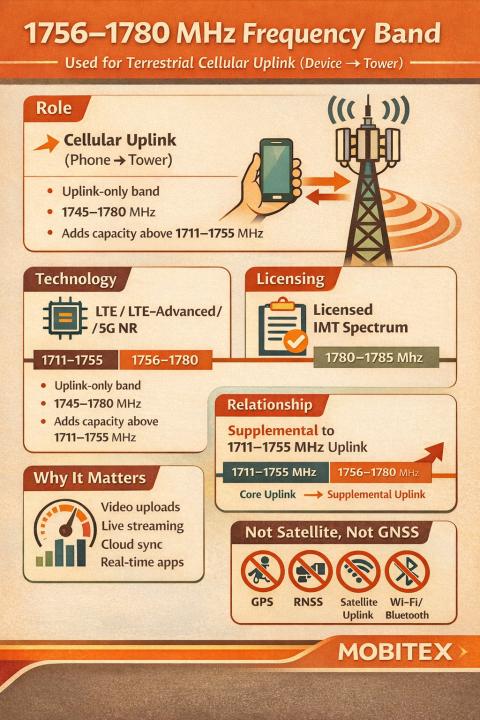
The 1780 MHz allocation is part of the AWS-3 spectrum. This range is used worldwide for critical applications that keep our communications and infrastructure running smoothly. On this page we highlight how each band is applied in real systems, from regulatory assignments to everyday devices. Our goal is to make spectrum data clear and practical for engineers, regulators, and enthusiasts alike.
Key uses of this band include: 1780 MHz marks the upper edge of the terrestrial mobile FDD uplink allocation (end of AWS‑3 uplink). This frequency acts as a transition/guard point where emissions must meet strict out‑of‑band limits to protect adjacent services and paired downlink spectrum..
Core GNSS navigation band; critical for global PNT services.
🔍 Explore the full RF Spectrum database
📡 Band & Geometry key
| Field | Value |
|---|---|
| Wavelength (m) | 0.16842272921348 |
| Waveforms | BPSK(1), BOC(1,1), MBOC – per system specs |
| Antenna Form Factor (Typical) | Internal PIFA/monopole/slot (smartphone); external monopole/whip (IoT/M2M); panel/patch (CPE/fixed wireless) |
| Band Family | L‑Band MSS Downlink (1626.5–1660.5 MHz) |
| Band | L‑Band |
| Primary Common Name | Mobile Uplink Upper Edge / Transition |
| FSPL @ 1 km [dB] | 97.46 |
| FSPL @ 10 km [dB] | 117.46 |
| Fresnel Radius @ 1 km (m) | 6.489 |
| Band Group | AWS-3 |
| Tax Band Family | Cellular (AWS-3 / IMT uplink) |
| Tax Band Class | 1756 to 1780 MHz Cellular (AWS-3 / IMT uplink) (Mobitex) |
🧩 Applications & Usage
| Field | Value |
|---|---|
| Primary Application | Upper‑edge guard of terrestrial mobile FDD uplink (AWS‑3 end) |
| Lower Neighbor Use | Mobile uplink (1710–1780 MHz) |
| Upper Neighbor Use | Region‑specific assignments above 1780 MHz; paired downlink at 2155–2180 MHz |
| Typical Services Devices | LTE Band 66 / 5G n66 smartphones, tablets, cellular modems, IoT devices, CBRS-adjacent equipment |
| Market Common Devices | LTE/5G smartphones, tablets, cellular modems, IoT modules, private LTE/5G equipment (Band 66 capable) |
| Refarming Use | Cleared from federal use via spectrum sharing agreements and relocation |
| Device Ecosystem Size | Very large – most modern LTE/5G devices support Band 66 |
| Device Hotspots (MHz) | 1770, 1775 (common carrier center frequencies for AWS-3) |
| Device Category | Cellular UE (smartphones, tablets, IoT modules, mobile hotspots, private network devices) |
| Typical Use Cases | Mobile uplink edge/transition; guard band protection for adjacent services |
| Modulation (Device) | LTE: SC-FDMA (uplink); 5G NR: CP-OFDM or DFT-s-OFDM (uplink) |
| Channel Width (Device) [kHz] | LTE: 5000-20000 kHz; NR: 10000-100000 kHz (flexible numerology) |
| Device Region Profiles | Americas (primary), some Asia-Pacific; not widely deployed in Europe |
| Per-Region EIRP Or Duty (Device) | N/A – receivers only; no transmit EIRP or duty cycle. |
| Allocation Relevance (Device) | High – primary uplink band for LTE/5G Band 66 devices |
| Adjacent-Band Collision Risks (Device) | High risk from adjacent MSS (≤1559 MHz) and out‑of‑band cellular/ISM emitters; use SAW/ceramic filters, LNA linearity, and tight front‑end selectivity. |
| Example Devices Or Skus | u‑blox M10/M9 series, Broadcom BCM47765, Qualcomm multi‑GNSS chipsets, Trimble/Septentrio receivers, timing modules (OCXO‑disciplined). |
| Common Protocols | 3GPP LTE (Band 66), 5G NR (n66) – uplink SC-FDMA/CP-OFDM |
🗒️ Notes
| Field | Value |
|---|---|
| Receiver Selectivity Notes | High selectivity (≥60 dB rejection across 1559–1610 MHz) |
| Interference Notes | Guard band coordination at 1780 MHz edge; federal incumbent protection in some areas; adjacent band emission limits |
| Compatibility Risk Notes | 0 |
| Notes | Core GNSS navigation band; critical for global PNT services. |
| Propagation Notes | Free-space propagation dominated; global satellite visibility required |
⚙️ Technical Rules
| Field | Value |
|---|---|
| Lower Band Frequency Limit | 1755 |
| Upper Band Frequency Limit | 1780 |
| EIRP Indoor Limits | UE: +23 dBm typical with edge guard coordination |
| EIRP Outdoor Limits | UE: +23 dBm typical with enhanced filtering at band edge |
| PSD Limit | Not applicable – receive-only band |
| Emission Mask Class | FCC Part 27 AWS emission mask (uplink) |
| Guardband Minimum [kHz] | N/A – receive-only band |
| Typical Bandwidths | 12.5 kHz–5 MHz (system‑dependent) |
| Autocalculated Bandlimits | 0 |
| Typical Bandwidths (Estimated) | 12.5 kHz–5 MHz (system‑dependent) |
| Max EIRP [dBm] | N/A – receivers only; no transmit EIRP or duty cycle. |
| Power Source Or Duty Profile (Typical) | Receiver‑side only; duty driven by application (tracking vs. timing holdover). |
| Channelization Plan | LTE: Fixed RB structure (180 kHz subcarriers, 15 kHz spacing); NR: Flexible (15/30/60 kHz SCS) |
| Channelization | LTE: 5, 10, 15, 20 MHz channels (SC-FDMA uplink); 5G NR: flexible numerology, 10-100 MHz (CP-OFDM) |
| Guard Band Requirement | 1 MHz at lower edge; coordination at 1780 MHz upper edge |
| OOB Emission Limit [dBm/MHz] | -13 dBm/MHz (FCC Part 27 AWS uplink limits) |
| Spurious Emission Limit (dBm) | -13 dBm/MHz (general spurious emission limits per FCC Part 27) |
| RX Blocking Min [dBm] | N/A – passive receiver |
| Duplexing | FDD uplink – edge guard |
| Duplexing Information | Downlink (space‑to‑Earth) |
| Uplink Pairing | Paired with 2155–2180 MHz downlink (AWS-3 / Band 66 upper portion) |
| Downlink Pairing | |
| Paired Band Info | Paired with 2155-2180 MHz downlink; 95 MHz duplex spacing; part of Band 66 FDD pair |
| Max EIRP [dBm] | N/A – receive-only band |
| Channelization Block Size | Operator carriers (kHz–MHz) |
| 3GPP Band Number | |
| Example 3GPP Bands | Band 66 (AWS-3 extended: 1710-1780 UL, 2110-2200 DL) |
| LTE Uplink Bands | Band 66 (1710-1780 MHz) |
| LTE Downlink Bands | Paired with DL Band 66 (2110-2200 MHz) |
| NR Uplink Bands | n66 (AWS-3/extended AWS) |
| NR Downlink Bands | Paired with n66 downlink (2110-2200 MHz) |
| Guard Bands | 1755-1756 MHz (lower edge), 1780-1785 MHz (upper edge to guard band) |
| Protocol Or Standard | 3GPP LTE (Rel-10+, Band 66), 3GPP 5G NR (Rel-15+, n66) |
🌎 Country Overrides
| Field | Value |
|---|---|
| Tax Service Category | Mobile (IMT) |
| Tax License Type | Licensed IMT spectrum with regional coordination and federal sharing where applicable |
| Tax Regions | Widely used for IMT uplink in many regions; subject to federal/military sharing in some countries |
| ITU Region 1 (Europe, Africa, Middle East (west of Persian Gulf), Western Russia & Mongolia) | Mobile / Fixed |
| ITU Region 2 (North America, South America, Central America, Caribbean, Greenland, Eastern Pacific Islands (Americas region)) | Mobile / Fixed |
| ITU Region 3 (Asia, Australia, Pacific Islands, Oceania, Indian Subcontinent, East Asia & Southeast Asia) | Mobile / Fixed |
| License Type | Licensed – edge protections apply |
| Primary Application | Upper‑edge guard of terrestrial mobile FDD uplink (AWS‑3 end) |
| Primary Services | Mobile broadband, IoT, private cellular |
| Spurious Emission [dBm] | -13 dBm/MHz (general spurious emission limits per FCC Part 27) |
| Lower Neighbor Use | Mobile uplink (1710–1780 MHz) |
| Upper Neighbor Use | Region‑specific assignments above 1780 MHz; paired downlink at 2155–2180 MHz |
| Licensing Model | Licensed (mobile network operators via spectrum auctions; AWS-3 band with federal sharing provisions) |
| Typical Services Devices | LTE Band 66 / 5G n66 smartphones, tablets, cellular modems, IoT devices, CBRS-adjacent equipment |
| US FCC Alloc | MOBILE (primary); FIXED (AWS-3 uplink, shared with federal systems in some regions)– |
| CA IC Alloc | MOBILE (primary); FIXED (IMT uplink, regional coordination)– |
| UK Ofcom Alloc | MOBILE (primary); FIXED (IMT uplink where allocated)– |
| US Ref | 47 CFR Part 27 (AWS-3); 3GPP TS 36.101 (Band 66); ITU-R M.1457 |
| Typical Bandwidths | 12.5 kHz–5 MHz (system‑dependent) |
| Market Licensing Model | Licensed spectrum – mobile network operators via FCC auctions (AWS-3); some federal coordination |
| Market Common Devices | LTE/5G smartphones, tablets, cellular modems, IoT modules, private LTE/5G equipment (Band 66 capable) |
| Fresnel Radius (1st, 1 km) [m] | 6.489 |
| Typical Bandwidths (Estimated) | 12.5 kHz–5 MHz (system‑dependent) |
| Auction Status | Auctioned (FCC Auction 97, 2014-2015); AWS-3 licenses issued |
| Refarming Use | Cleared from federal use via spectrum sharing agreements and relocation |
| Typical Site Spacing km | N/A – space segment with global footprint. / N/A – space segment with global footprint. |
| Device Ecosystem Size | Very large – most modern LTE/5G devices support Band 66 |
| Traffic Load Share | Moderate to high – important capacity band for LTE/5G uplink |
| Device Hotspots (MHz) | 1770, 1775 (common carrier center frequencies for AWS-3) |
| Device Category | Cellular UE (smartphones, tablets, IoT modules, mobile hotspots, private network devices) |
| Typical Use Cases | Mobile uplink edge/transition; guard band protection for adjacent services |
| Typical Center Frequencies [MHz] | 1561.098, 1575.42, 1602 |
| Rule Part (Fcc Or Region) | FCC Part 27 Subpart L (AWS); regional variations in other countries |
| Modulation (Device) | LTE: SC-FDMA (uplink); 5G NR: CP-OFDM or DFT-s-OFDM (uplink) |
| Channel Width (Device) [kHz] | LTE: 5000-20000 kHz; NR: 10000-100000 kHz (flexible numerology) |
| Device Region Profiles | Americas (primary), some Asia-Pacific; not widely deployed in Europe |
| Per-Region EIRP Or Duty (Device) | N/A – receivers only; no transmit EIRP or duty cycle. |
| Allocation Relevance (Device) | High – primary uplink band for LTE/5G Band 66 devices |
| Adjacent-Band Collision Risks (Device) | High risk from adjacent MSS (≤1559 MHz) and out‑of‑band cellular/ISM emitters; use SAW/ceramic filters, LNA linearity, and tight front‑end selectivity. |
| Example Devices Or Skus | u‑blox M10/M9 series, Broadcom BCM47765, Qualcomm multi‑GNSS chipsets, Trimble/Septentrio receivers, timing modules (OCXO‑disciplined). |
| Antenna Form Factor (Typical) | Internal PIFA/monopole/slot (smartphone); external monopole/whip (IoT/M2M); panel/patch (CPE/fixed wireless) |
| Power Source Or Duty Profile (Typical) | Receiver‑side only; duty driven by application (tracking vs. timing holdover). |
🛡️ Regulatory & Neighbors
| Field | Value |
|---|---|
| Lower Band Frequency Limit | 1755 |
| Upper Band Frequency Limit | 1780 |
| Rx Blocking Min dBm | N/A – passive receiver |
| Lower Neighbor Use | Mobile uplink (1710–1780 MHz) |
| Upper Neighbor Use | Region‑specific assignments above 1780 MHz; paired downlink at 2155–2180 MHz |
| Lower Neighbor Band | Mobile Uplink (FDD) |
| Lower Neighbor Range | 1710–1780 MHz |
| Upper Neighbor Label | Next allocations / AWS‑3 DL (paired) |
| Upper Neighbor Range | 1780+ MHz (varies) / 2155–2180 MHz (paired) |
| Adjacent-Band Collision Risks (Device) | High risk from adjacent MSS (≤1559 MHz) and out‑of‑band cellular/ISM emitters; use SAW/ceramic filters, LNA linearity, and tight front‑end selectivity. |
| Real-World Range (Indoor/Outdoor) | Outdoor sky view: global coverage; indoor: limited – assisted GNSS or repeaters required. |
| US FCC Alloc | MOBILE (primary); FIXED (AWS-3 uplink, shared with federal systems in some regions)MOBILE (primary); FIXED (AWS-3 uplink, shared with federal systems in some regions) |
| CA IC Alloc | MOBILE (primary); FIXED (IMT uplink, regional coordination)MOBILE (primary); FIXED (IMT uplink, regional coordination) |
| UK Ofcom Alloc | MOBILE (primary); FIXED (IMT uplink where allocated)MOBILE (primary); FIXED (IMT uplink where allocated) |
| Regulatory References | US: 47 CFR Part 27 (AWS-3); 3GPP TS 36.101 (Band 66); ITU-R M.1457; CA: ISED Canada SRSP-520; 3GPP TS 36.101 (Band 66); UK: ITU-R M.1457; 3GPP TS 36.101 (regional implementations vary) |
| Global Harmonization | Partial – Band 66 deployed in Americas and some Asia-Pacific; not fully global like Band 1 |
| Crossborder Coordination | None required – international GNSS spectrum coordination under ITU-R |
| Sharing Mechanism | Geographic exclusion zones near federal sites; power coordination; interference protection criteria |
| Auction Status | Auctioned (FCC Auction 97, 2014-2015); AWS-3 licenses issued |
| Guard Or Pair | Paired (FDD uplink) |
📈 Market & Measurements
| Field | Value |
|---|---|
| Noise Floor | Satellite downlink (space-to-Earth); GEO/MEO/LEO systems |
| Interference Cases | Adjacent channel interference with AWS-1 (below); coordination with paired downlink at 2155-2180 MHz |
| Lower Neighbor Range | 1710–1780 MHz |
| Upper Neighbor Range | 1780+ MHz (varies) / 2155–2180 MHz (paired) |
| Interference Notes | Guard band coordination at 1780 MHz edge; federal incumbent protection in some areas; adjacent band emission limits |
| Market Licensing Model | Licensed spectrum – mobile network operators via FCC auctions (AWS-3); some federal coordination |
| Market Commercial Value | High – ubiquitous GNSS receiver ecosystem; critical PNT infrastructure |
| Market Common Devices | LTE/5G smartphones, tablets, cellular modems, IoT modules, private LTE/5G equipment (Band 66 capable) |
| Market Deployment Density | High – dense urban/suburban cellular deployments; macro, small cell, and private networks |
| Noise Floor (Estimated) | Satellite downlink (space-to-Earth); GEO/MEO/LEO systems |
| Market Commercial Value (Estimated) | High – ubiquitous GNSS receiver ecosystem; critical PNT infrastructure |
| Ecosystem Maturity | Mature – widespread Band 66 device ecosystem (AWS-3 extension) |
| Indoor Penetration | Weak; GNSS signals ~−130 dBm require outdoor or assisted GNSS |
| Known Interference | Federal systems (in shared regions); adjacent band coordination at edges; satellite MSS (historical) |
| Device Ecosystem Size | Very large – most modern LTE/5G devices support Band 66 |
| Real-World Range (Indoor/Outdoor) | Outdoor sky view: global coverage; indoor: limited – assisted GNSS or repeaters required. |
| Antenna Form Factor (Typical) | Internal PIFA/monopole/slot (smartphone); external monopole/whip (IoT/M2M); panel/patch (CPE/fixed wireless) |
| Ecosystem Maturity | Mature – widespread Band 66 device ecosystem (AWS-3 extension) |
| Device Ecosystem Size | Very large – most modern LTE/5G devices support Band 66 |
| Chipset Availability | Universal – all major chipset vendors (Qualcomm, MediaTek, Samsung, Apple modems, etc.) |
| Operator Deployments | Major US carriers (T-Mobile, AT&T, Verizon); growing international adoption |
| Technology Generations Deployed | 4G LTE (Band 66), 5G NR (n66) |
| Roaming Support | Universal cross-system compatibility via multi-GNSS receivers |
| Traffic Load Share | Moderate to high – important capacity band for LTE/5G uplink |
| Indoor Penetration | Weak; GNSS signals ~−130 dBm require outdoor or assisted GNSS |
| Known Interference | Federal systems (in shared regions); adjacent band coordination at edges; satellite MSS (historical) |
| Occupancy | >95% utilization – global GNSS receivers |
| Occupancy Bucket Pct | >95% global utilization (GNSS receivers ubiquitous) |
| Latency Profile | Deterministic; satellite signal propagation delay ~67 ms (20,200 km) |
| Common Channels Or Profiles | LTE: 5/10/15/20 MHz carriers; 5G NR: flexible bandwidth configurations |
| Security Features | Civil signals: Navigation message authentication (Galileo OSNMA), multi‑GNSS cross‑checks; Military: encrypted P(Y)/M‑code (not publicly specified). |
| Lbt Or Fhss Requirement | N/A – licensed exclusive use (no LBT/FHSS required) |
| Popularity (Installed Base) | Extremely high – billions of active receivers worldwide. |
| Coexistence Tips | Add pre‑selector/SAW filters; ensure antenna clear sky view; mitigate jammers/spoofers; multi‑GNSS fusion and carrier‑phase techniques (RTK/PPP) for resilience. |
| Latency Class | Initial TTFF: ~1–30 s (cold‑start); steady‑state navigation latency <1 s. |
| Device Hotspots (Scoped && Tagged) | AWS-3 carrier frequencies; Band 66 uplink |