Mobitex contains affiliate links and is a member of the Amazon Services LLC Associates Program. If you make a purchase using one of these links, we may receive compensation at no extra cost to you. This helps support our research, testing and writing.
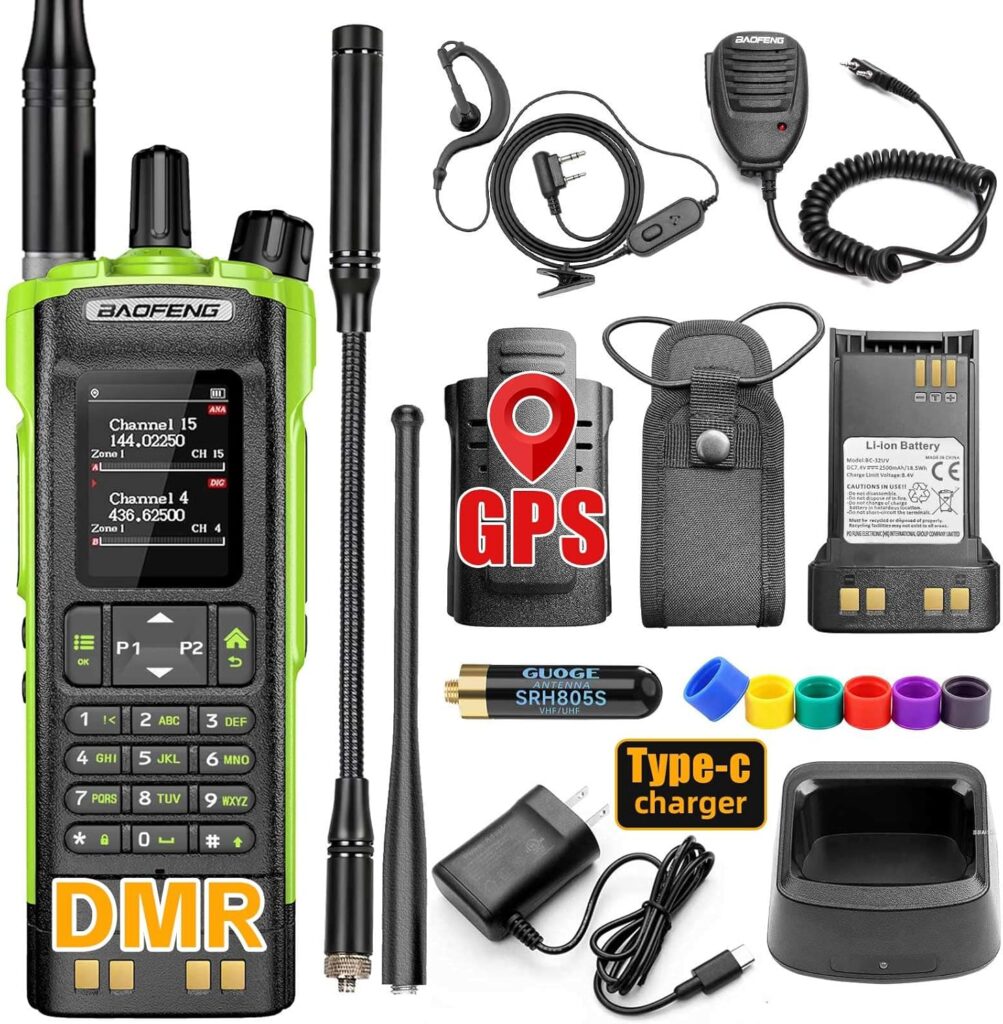
The Baofeng DM-32UV is the DMR (Digital Mobile Radio) variant of the UV-32 platform — the same chassis, same colour display, and same accessory ecosystem as the UV-32, with one critical addition: full Tier II DMR digital capability. It is Baofeng’s most feature-dense handheld to date, combining 10-watt dual-band output, GPS, digital APRS, DMR digital and analog modes, 50,000 contact capacity, and a wideband receive range that includes aviation, NOAA weather, and the 1.25-metre band, all in a single device priced around $100.
Baofeng DM-32UV
The Baofeng DM-32UV combines analog and DMR digital communication in a rugged handheld platform designed for amateur radio operators and outdoor communication.
- DMR digital + analog support
- Dual-band VHF/UHF operation
- Large color display
- Long battery runtime
It is also the largest ham radio DMR handheld currently on the market. That size is a legitimate operational consideration, and the article addresses it directly.
Licensing Requirement
Transmitting on the DM-32UV requires a valid amateur radio licence — an FCC Technician Class or higher in the United States, or an ISED Basic qualification in Canada. The radio also supports DMR Tier II, which enables access to commercial DMR repeater networks where amateur operators are permitted. Operating without a licence on any of its transmit frequencies is illegal.
Baofeng DM-32UV
A budget-friendly handheld radio that supports both traditional analog FM and modern DMR digital communication.
View on AmazonSpecifications
| Specification | Value |
|---|---|
| Model | DM-32UV (also listed as DM32) |
| Manufacturer | Baofeng Electronics (Fujian, China) |
| FCC ID | 2AJGM-DM32UV |
| Radio type | Dual-band DMR Tier I/II + analog FM transceiver |
| Licence required | Yes — amateur radio licence |
| TX frequency | VHF 136–174 MHz, UHF 400–520 MHz |
| RX frequency | VHF 136–174 MHz, UHF 400–520 MHz, Aviation AM 108–136 MHz, FM 65–108 MHz, NOAA weather |
| Output power | 10W (High) / Mid / Low — switchable |
| DMR standard | Tier I and Tier II |
| DMR time slots | Dual time slot (two simultaneous conversations on one frequency) |
| Analog mode | FM — fully compatible with existing analog repeaters and simplex |
| Auto mode detect | Yes — switches between DMR and analog automatically |
| Channel capacity | 4,000 channels |
| Zones | 256 |
| Contact capacity | 50,000 digital contacts |
| Battery capacity | 2,500 mAh lithium-ion |
| Battery life | Up to one full day typical use |
| Charging | USB-C direct |
| Display | 2.0-inch colour TFT LCD |
| GPS | Yes — GNSS multi-constellation |
| APRS | Yes — digital APRS position reporting (genuine APRS.fi compatible) |
| Encryption | ARC4 / AES-128 / AES-256 |
| Text messaging | Yes — DMR digital SMS |
| Call recording | Yes |
| Emergency alarm | Yes |
| NOAA weather receive | Yes |
| Aviation band receive | Yes (AM, 108–136 MHz) |
| Bluetooth programming | Via BT-A1D adapter (sold separately) and OLA app |
| PC programming | USB-C cable + Baofeng CPS software (Windows) |
| CHIRP compatible | No |
| On-radio programming | Yes — full DMR and analog parameter editing from keypad |
| Accessory connector | 2-pin Kenwood K-type |
| Waterproof rating | Not rated — no IP certification |
| Weight | Approximately 350 g with battery |
| Colours | Black, olive green, khaki, transparent |
Baofeng DM-32UV
A versatile handheld radio supporting both DMR digital communication and analog FM operation, ideal for users transitioning into digital radio systems.
Key Features
DMR Tier II with Dual Time Slots
DMR (Digital Mobile Radio) is an open digital standard originally developed for commercial radio but widely adopted by the amateur community. Tier II is the repeater-capable tier — it allows the DM-32UV to access DMR repeater networks including BrandMeister, DMR-MARC, and local club repeaters. Dual time slot operation means a single 12.5 kHz channel carries two independent conversations simultaneously, doubling channel efficiency compared to analog FM.
For operators new to DMR: the key setup task is building a codeplug — a structured configuration file that specifies which talk groups, time slots, colour codes, and frequencies the radio monitors. The DM-32UV’s CPS software handles this, and once the codeplug is uploaded the radio operates simply. The learning curve is in the codeplug, not the radio.
Analog and DMR Auto-Detect
The DM-32UV automatically identifies whether an incoming signal is DMR digital or analog FM and switches modes accordingly. This is directly practical for operators active in areas where some repeaters have been upgraded to DMR and others remain analog — the radio handles both without manual mode switching.
GPS and Digital APRS
The built-in GNSS receiver feeds into genuine APRS (Automatic Packet Reporting System) position reporting. Unlike some radios that claim APRS but only share position within a private group, the DM-32UV posts to the public APRS network and is trackable on APRS.fi. This matters for emergency communications, public service events, and outdoor coordination. APRS is supported in both DMR digital and analog modes.
50,000 Contact Database
The contact capacity allows loading the full global DMR ID database — every registered DMR operator worldwide — directly into the radio. When a station transmits on a linked repeater or hotspot, the DM-32UV displays the operator’s callsign and name rather than just their ID number. This is a significant quality-of-life feature for operators active on BrandMeister and similar networks.
On-Radio Programming
Adding a repeater or modifying a channel from the keypad — without connecting to a computer — is fully supported and described by independent reviewers as genuinely convenient in the field. Most DMR radios require a computer connection for any codeplug changes; the DM-32UV allows direct on-radio editing.
Wideband Receive
The receive range extends to FM broadcast (65–108 MHz), aviation AM band (108–136 MHz), and NOAA weather channels, in addition to the standard VHF/UHF amateur transmit bands. Aviation band reception requires Menu 48 to be enabled first — it does not activate automatically out of the box.
Baofeng DM-32UV
The Baofeng DM-32UV combines analog and DMR digital communication in a rugged handheld platform designed for amateur radio operators and outdoor communication.
- DMR digital + analog support
- Dual-band VHF/UHF operation
- Large color display
- Long battery runtime
What Customers Think
Customer feedback is drawn from the Baofeng official review, RadioRanked composite scoring, Offgrid.technology field review, RadioGuru (Italian), besthamradio.com, Bushcraft USA forum, and Amazon verified purchaser reviews.
What Customers Praise
Audio quality in both modes is the most consistently praised attribute. Reviewers who have used the DM-32UV on DMR repeaters and hotspots describe the digital audio as clean and clear, with good signal reports from contacts. One Amazon buyer reported positive audio feedback from a station 10 miles away via repeater on their first attempt. The RadioGuru review describes audio as “exceptionally clear with minimised background noise.”
The DMR codeplug experience is rated as easier than expected for a Baofeng product. One reviewer who owned a more expensive BTECH DMR-6X2 Pro described codeplug creation as simpler on the DM-32UV and subsequently replaced the BTECH as their daily DMR radio. Hotspot compatibility with Pi-Star and similar access points is confirmed by multiple reviewers.
10-watt output for an HT is noted positively by operators who need reliable performance through buildings and in difficult terrain. Most handheld radios at this price run 4–5 watts on UHF. The 10W output is a meaningful range and penetration advantage, particularly for weak-signal contacts.
APRS functionality receives specific positive commentary from operators who tested it against APRS.fi and confirmed the radio posts genuine public APRS positions — not just private group tracking. This is flagged as a differentiator from cheaper alternatives.
Value for the feature set is the overarching positive theme. Reviewers consistently note that GPS, APRS, DMR Tier II, 50,000 contacts, dual time slots, and 10W output at ~$100 would cost $250–400 on equivalent AnyTone hardware.
What Customers Criticise
Physical size is the most consistent complaint. At approximately 350 grams with battery, the DM-32UV is large and heavy for an HT. Besthamradio.com describes it as “the largest ham radio DMR capable unit I have ever seen.” Operators who carry a radio all day in a shirt pocket or clipped to a harness will find the bulk uncomfortable. It is better suited to a bag or vehicle mount than an everyday carry pocket radio.
No IP waterproof rating. The DM-32UV carries no IP certification. For outdoor use in rain or humid environments this is a real limitation. An operator wanting a DMR radio for backcountry or construction use should note the absence of any water resistance rating.
CHIRP incompatibility. DMR radios in general are not CHIRP-compatible due to the complexity of DMR codeplug structure, and the DM-32UV is no exception. The Baofeng CPS software must be used for all programming. The CPS is described as functional but lacking import/export capability — managing large codeplugs requires manual entry or third-party tools.
Spurious emissions — the same issue documented on the UV-32 — apply here. The DM-32UV shares the UV-32 chassis and RF architecture, and the spurious emission concerns documented by besthamradio.com on spectrum analyser testing for the UV-32 are applicable to the DM-32UV. For licensed amateur operators with compliance obligations, this is worth noting.
The belt clip adapter is described as less sturdy than it should be for a radio of this size and weight. RadioGuru specifically flags it as a weak point.
Overall Sentiment
The DM-32UV has a strong reputation among operators who approach it as an entry-level DMR radio rather than a primary daily-carry HT. Reviewers who came from more expensive DMR platforms describe it as a better value than alternatives at twice the price. Reviewers who expected a compact everyday radio were disappointed by the size. The correct framing — a feature-dense, high-power DMR radio with real GPS/APRS in a large package at a budget price — describes a product that delivers clearly on its promises for the right buyer.
DM-32UV vs UV-32: Key Differences
| Feature | DM-32UV | UV-32 |
|---|---|---|
| DMR digital mode | Yes — Tier I and II | No — analog only |
| Dual time slot | Yes | No |
| Contact database | 50,000 | Not applicable |
| Text messaging | Yes (DMR SMS) | No |
| APRS | Digital APRS (full) | GPS only (no APRS) |
| Call recording | Yes | No |
| AES encryption | Yes | No |
| CHIRP | No | No (UV-21Pro GPS profile workaround) |
| Price | ~$100 | ~$50 |
Who the DM-32UV Is Suited For
It is a strong fit for:
- Licensed amateur operators taking their first step into DMR who want full Tier II capability without paying AnyTone prices
- Operators active on BrandMeister or DMR-MARC networks who want APRS alongside DMR
- Emergency communications and public service event operators who need GPS tracking and high output power
- Operators comfortable with codeplug setup who want the best feature-per-dollar ratio in the entry-level DMR category
It is less suited for:
- Operators who want a compact everyday carry HT — the size and weight are genuine limitations
- Outdoor or wet-environment use where IP-rated waterproofing is required
- Operators who need CHIRP compatibility for quick programming
- Anyone who needs verified clean RF output — spurious emission performance is a documented concern shared with the UV-32 platform