Mobitex contains affiliate links and is a member of the Amazon Services LLC Associates Program. If you make a purchase using one of these links, we may receive compensation at no extra cost to you. This helps support our research, testing and writing.
The Baofeng UV-5R Mini and the TIDRADIO TD-H3 are the two most talked-about compact budget handhelds in the amateur radio market right now. Both cost under $40 for a single unit, both fit in a shirt pocket, both support CHIRP programming and USB-C charging, and both are aimed squarely at new licensees, hikers, preppers, and anyone who wants a capable go-bag radio without spending serious money.
They are also genuinely different radios that suit different buyers. Choosing between them comes down to four things: battery life, memory channels, programming preference, and which ecosystem you want to commit to.
Quick Comparison
- Ultra-budget friendly
- Huge accessory ecosystem
- Compact and lightweight
- Massive online community support
- USB-C charging support
- Bluetooth phone programming
- Modern interface and firmware
- Excellent value for features
Choose the TIDRadio H3 if you want a more polished handheld with modern charging and app-based programming.
Full Comparison Table
| Specification | Baofeng UV-5R Mini | TIDRADIO TD-H3 |
|---|---|---|
| Radio type | Amateur HT (ham radio) | Amateur HT / GMRS (ham and GMRS versions) |
| FCC ID (Ham) | 2AJGM-5RMINI | 2A4FBTD831 |
| TX frequency | VHF 136-174 MHz, UHF 400-480 MHz | VHF 136-174 MHz, UHF 400-470 MHz |
| RX frequency | FM 76-108 MHz, Airband 108-136 MHz, VHF 136-174 MHz, UHF 350-520 MHz, NOAA | AM 108-136 MHz, FM 50-108 MHz, VHF 136-174 MHz + 174-350 MHz, UHF 400-470 MHz + 470-600 MHz, NOAA |
| Output power | 5W / 2W (Hi/Lo); measured ~3.8W actual | 5W nominal; TIDRADIO does not publish measured output |
| Memory channels | 999 | 199 |
| Channel spacing | 25 kHz / 12.5 kHz | 25 kHz / 12.5 kHz |
| Battery capacity | 1800 mAh | 2500 mAh |
| Battery life (standby) | Not published | 48+ hours claimed |
| Charging | USB-C (battery direct) | USB-C (battery direct); desktop dock available |
| Charge time | Not published | 3 hours (USB-C); 5-7 hours (dock) |
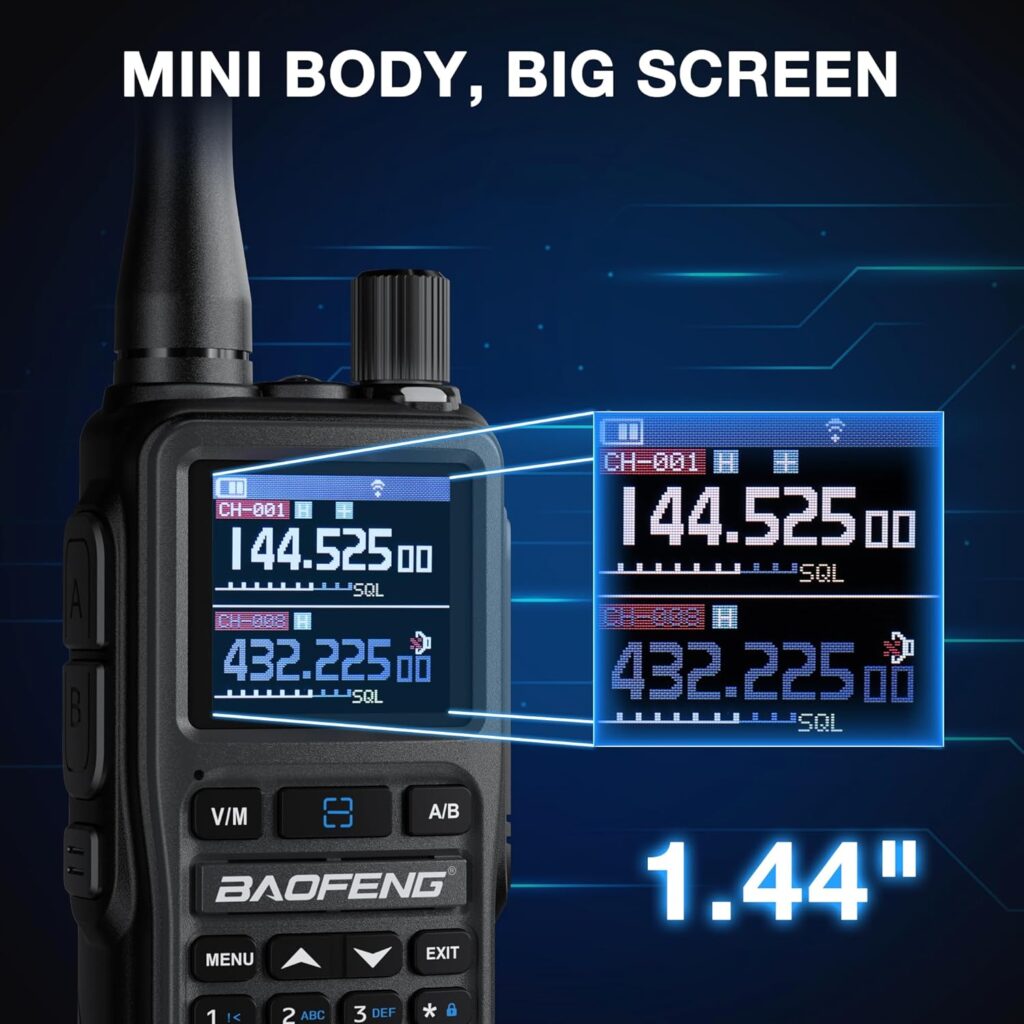
| Display | 1.44-inch colour LCD | 1.44-inch colour LCD |
| Dimensions (no antenna) | 108 × 52 × 37 mm | Not published by manufacturer |
| Weight (with battery) | 200 g / 7.1 oz | Not published by manufacturer |
| Accessory connector | 2-pin Kenwood K-type | 2-pin Kenwood K-type |
| CHIRP compatible | Yes | Yes (via standard USB-C cable — no special cable needed) |
| Bluetooth programming | Yes (OLA Radio app, iOS/Android) | Yes (ODmaster app/web, iOS/Android) |
| USB-C cable programming | Yes (requires programming cable, not standard USB-C) | Yes (standard USB-C cable works directly) |
| PC software | CPS (Baofeng) | CPS (TIDRADIO) + ODmaster web |
| App ecosystem | OLA Radio (Baofeng) | ODmaster (TIDRADIO) — also supports web programming offline |
| Dual PTT | Yes | Yes |
| VOX | Yes | Yes |
| NOAA receive | Yes (no auto-alert) | Yes (no auto-alert) |
| Airband receive (AM) | Yes (limited — off-frequency and poor sensitivity reported) | Yes (requires Menu 48 enabled; functional) |
| FM broadcast receive | Yes | Yes |
| Frequency copy (one-key clone) | Yes | Yes |
| DTMF | Yes | Yes |
| DTMF Kill/Stun code | No | Yes |
| Repeater capable | Yes | Yes |
| Mode switching (Ham/GMRS/Unlocked) | No — frequency range fixed to amateur bands | Yes — switchable between Ham, GMRS, and Normal (unlocked) modes |
| Open-source / third-party firmware | No | Yes (nicsure experimental firmware available) |
| Flashlight | Yes | Yes (φ8 enhanced flashlight) |
| Stopwatch | Yes | No |
| Waterproof rating | None | None |
| Colours available | Quartz, Amber, Grey | Black, Green, Crystal (transparent) |
| Warranty | Not stated | 180-day quality guarantee |
Choose the TIDRadio H3 if you want a more polished handheld with modern charging and easier programming.
| Feature | UV-5R Mini | TIDRadio H3 |
|---|---|---|
| Programming | Traditional cable | Bluetooth app + cable |
| Charging | Dock charger | USB-C |
| Community Support | Massive | Growing rapidly |
| Best For | Lowest-cost entry point | Modern everyday usability |
Where They Differ
Battery: H3 Wins by a Large Margin
The H3’s 2500 mAh battery is 39% larger than the UV-5R Mini’s 1800 mAh pack. TIDRADIO claims 48+ hours of standby and a 3-hour full charge via USB-C. Independent users report the standby claim is roughly accurate. The UV-5R Mini’s 1800 mAh pack will get through a full day of moderate use, but it is the weaker battery of the two in a direct comparison.
If you are building a go-bag or emergency kit where recharging may not be possible for extended periods, this difference matters.
Memory Channels: UV-5R Mini Wins Decisively
The UV-5R Mini has 999 memory channels. The H3 has 199. For most casual users 199 is more than enough, but for operators who travel between regions and carry large repeater databases, or who use channel banks for different activities — hunting, events, ARES/RACES — the UV-5R Mini’s storage capacity is a genuine practical advantage.
Programming: H3 is Significantly Easier
This is the H3’s strongest practical advantage over the UV-5R Mini and most other radios at any price.
The H3 can be programmed via CHIRP using a standard USB-C cable — no special programming cable required. The UV-5R Mini also supports CHIRP, but requires a separate programming cable (sold separately). For a new licensee who doesn’t yet own a programming cable, this is a meaningful friction difference.
The H3 also supports USB-C cable programming natively for the TIDRADIO ODmaster software, and the ODmaster web interface works on both Windows and Mac, unlike most Baofeng CPS software which is Windows-only. ODmaster also supports offline programming after a one-time sync — useful if you want to prepare channel configurations away from a network.
The Baofeng OLA Radio app works well for Bluetooth programming on the UV-5R Mini. Both apps are broadly functional; the H3’s ecosystem is slightly more mature and flexible.
Mode Flexibility: H3 Wins
The H3 can be switched between locked Ham mode, locked GMRS mode, or “Normal” unlocked mode that allows transmission across a broader frequency range. This matters for operators who hold both an amateur and a GMRS licence, or who want one radio that can serve both purposes. Switching modes completely wipes the radio’s memory, so a backup of the channel configuration before switching is essential.
The UV-5R Mini’s frequency range is fixed within the amateur VHF/UHF bands. It cannot be switched to GMRS or unlocked mode.
RF Performance: H3 Has a Cleaner Signal
Based on spectrum analyser testing reported by independent reviewers, the H3 produces a notably cleaner transmitted signal than most budget Baofeng-platform radios. WorldwideDX forum testing found the H3 compliant with FCC spurious emissions limits — unusual in this class. The UV-5R Mini’s measured actual output was approximately 3.8W on both bands (below the rated 5W), and the stock antenna has poor SWR on both bands. Replacing the stock antenna on either radio is recommended; this matters more for the UV-5R Mini than the H3.
Airband Reception: Both Have Limitations
Both radios receive the aviation AM band (108-136 MHz). On the H3, airband reception requires enabling Menu 48 to activate AM decoding — it doesn’t work out of the box but functions correctly once enabled. On the UV-5R Mini, users report off-frequency reception and poor sensitivity on airband, with the frequency stepping locked to 8.33 kHz and not user-adjustable. The H3 is the better airband receiver of the two.
Quality Control: Both Have Reports of Failures
Both radios are budget Chinese-manufactured handhelds and both have documented quality control complaints. WorldwideDX users reported dead-on-arrival units in H3 two-packs. UV-5R Mini users have reported CHIRP-related memory issues resolvable via the app reset function. Neither radio should be relied on as a primary mission-critical communication device without a tested backup.
What Customers Say
UV-5R Mini users consistently praise the compact size, USB-C charging, CHIRP support, solid PTT button feel, and clean interface. The most common criticisms are the below-rated power output, poor stock antenna SWR, limited airband performance, and the requirement for a separate programming cable for PC programming. One RadioReference forum member who compared both radios directly noted the UV-5R Mini is approximately 15% smaller than the H3 variants.
H3 users consistently praise the programming flexibility (especially USB-C CHIRP without a special cable), the large battery, audio quality, and overall value. The most common criticisms are small buttons that can be difficult to press quickly, no waterproofing, only 199 channels, and quality control inconsistency — some users receiving dead units in multi-packs. The H3’s battery is specifically praised as one of the better-attaching batteries in this class.
Go with the TIDRadio H3 if you want modern charging, easier programming, and a more polished experience out of the box.
Who Should Buy Which
Choose the UV-5R Mini if:
- You need more than 199 memory channels
- Small physical size and light weight are the priority
- You are already in the Baofeng ecosystem with existing accessories
- You only need amateur radio bands and do not need GMRS or mode switching
Choose the TIDRADIO H3 if:
- Battery life is a priority — especially for go-bags, emergency prep, or multi-day outdoor use
- Programming ease matters — particularly no-cable CHIRP via standard USB-C
- You want cleaner RF output and better stock airband performance
- You hold both amateur and GMRS licences and want one radio that covers both
- You want the option to run third-party open-source firmware
Neither radio is right if:
- You need IP-rated waterproofing for genuine outdoor wet conditions — look at the Retevis RB48 (IP67) or DeWalt DXFRS800 (IP67) instead
- You need verified, documented transmit power specifications from the manufacturer
- You are deploying in a mission-critical environment where QC failures are unacceptable
Package Contents (Standard Single Unit)
| Item | UV-5R Mini | TIDRADIO H3 |
|---|---|---|
| Radio | 1 | 1 |
| Battery | 1800 mAh, USB-C | 2500 mAh, USB-C |
| Antenna | Standard (poor SWR — replace) | Standard 6.1-inch; 15.12-inch 771 in full kit |
| Earpiece | 1 | 1 (full kit) |
| Belt clip | 1 | 1 |
| Charging cable | USB-C | USB-C (also used for programming) |
| Desktop charger | Not included | Included in full kit |
| Programming cable | Sold separately | Not needed — standard USB-C works |
Important Licensing Note
Both radios are amateur radio transceivers. Transmitting on either radio requires a valid amateur radio licence – an FCC Technician Class or higher in the United States, or an ISED Basic qualification in Canada. Both radios can also be purchased or purchased in a GMRS version where applicable. Receiving on any frequency requires no licence. Operating either radio without a licence on amateur frequencies is illegal.