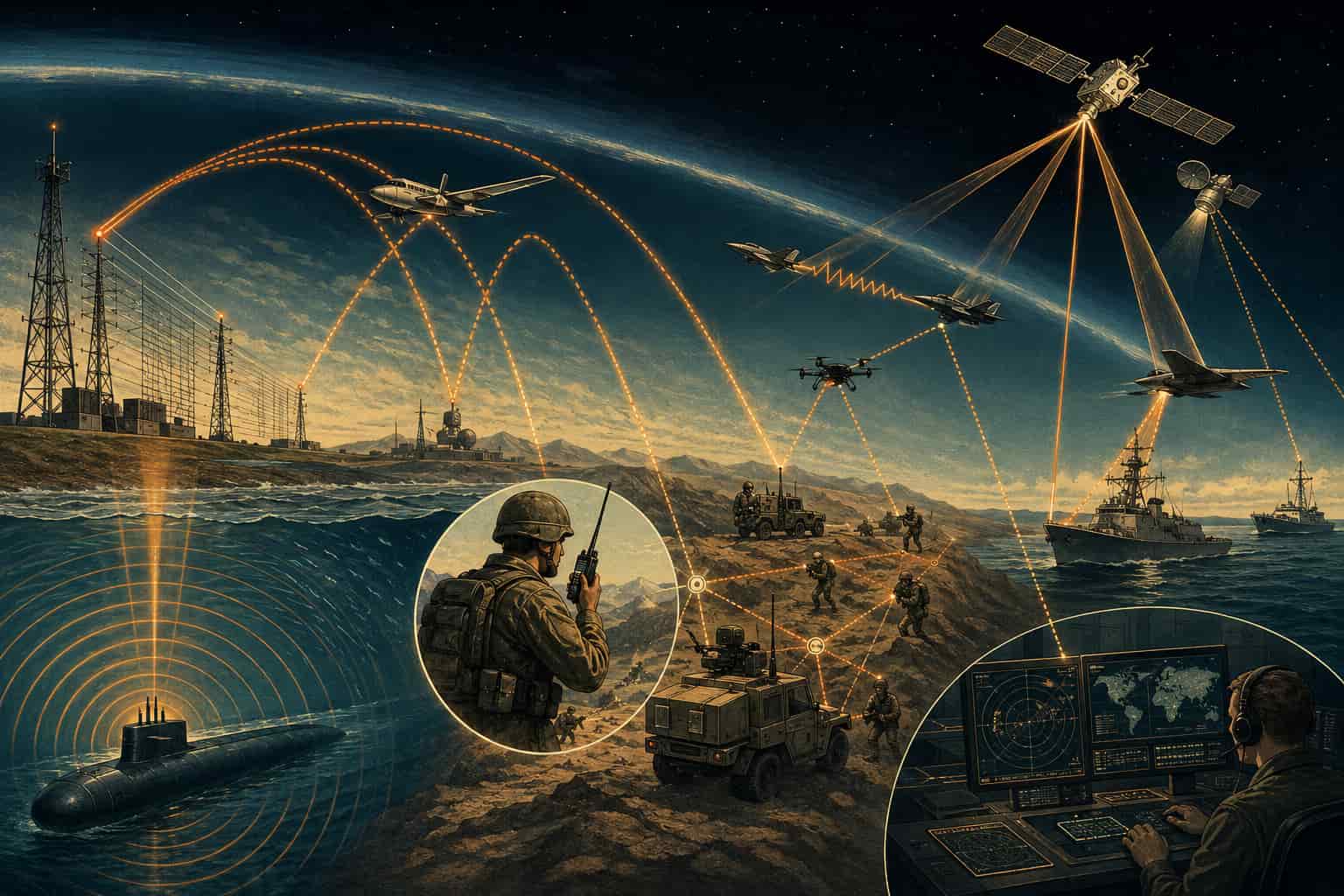
Modern military forces operate across nearly the entire usable radio spectrum — from frequencies so low they penetrate seawater to reach submarines, to frequencies so high they can only travel in straight lines between satellites and terminals. Each band is chosen for specific physical reasons. Understanding those reasons explains why militaries use so many different radios, and why no single frequency band can do everything.
This article covers every major band used in military communications, from the lowest frequencies to the highest, with the specific systems and purposes each supports.
Why Band Selection Matters
Radio waves at different frequencies behave differently in the physical world. Lower frequencies travel farther, penetrate obstacles and seawater, and can bounce off the ionosphere to reach beyond the horizon — but they carry little data and require enormous antennas. Higher frequencies carry large amounts of data and support precise targeting and imaging — but they travel in straight lines, cannot penetrate much, and require line-of-sight between transmitter and receiver.
Military planners must match the physics of each band to the operational requirement. A submarine deep underwater cannot receive X-band radar signals. A soldier in a valley cannot use satellite frequencies that require a clear sky view. A bomber pilot needs a data link that cannot be jammed. No single frequency does all of these things.
ELF — Extremely Low Frequency (3 Hz to 3 kHz)
Military use: Submarine strategic communications
ELF signals are so long — their wavelengths measure hundreds of kilometres — that they penetrate seawater to depths of tens to hundreds of metres. This makes ELF the only reliable way to reach submarines operating at depth without requiring them to surface or raise an antenna.
The US Navy operated the Seafarer/Project ELF system in Michigan and Wisconsin, transmitting at approximately 76 Hz. The signals could reach deeply submerged submarines anywhere in the world. The data rate was extraordinarily low — transmitting a three-letter code group took roughly 15 minutes — but that was sufficient for the primary operational purpose: transmitting an Emergency Action Message (EAM), the order that would authorise a nuclear launch.
The transmitting antennas for ELF systems are enormous. The US system used buried cables hundreds of kilometres long as the antenna. Russia operated a similar system called ZEVS at approximately 82 Hz. ELF is receive-only from a submarine’s perspective — their antennas are far too small to transmit at these frequencies.
VLF — Very Low Frequency (3 kHz to 30 kHz)
Military use: Primary submarine broadcast, nuclear command and control
VLF penetrates seawater to depths of approximately 10 to 20 metres, allowing submarines operating near the surface — or trailing a wire antenna at shallow depth — to receive messages without surfacing. VLF carries significantly more data than ELF, though data rates are still very low by modern standards (typically 50 to 200 bits per second).
The US Navy’s VLF broadcast network transmits continuously from shore stations including NAA (Cutler, Maine, 24 kHz), NWC (Jim Creek, Washington, 24.8 kHz), NPM (Lualualei, Hawaii, 21.4 kHz), and NML (LaMoure, North Dakota, 25.2 kHz). These stations run transmit powers of hundreds of kilowatts and use antenna systems that cover square kilometres of terrain.
VLF is the primary medium for the Submarine Broadcast System (SBS), which transmits a continuous two-hour rotating cycle of prioritised messages to all submarines simultaneously. This includes Emergency Action Messages, operational orders, and navigation data. Like ELF, VLF communication is essentially one-way — shore to submarine — because a submarine’s antenna is far too small to radiate efficiently at these frequencies.
Russia, France, the UK, India, and China all operate comparable VLF shore transmission systems for submarine communications.
LF — Low Frequency (30 kHz to 300 kHz)
Military use: Navigation, timing, some submarine communications
LF is used primarily for navigation systems rather than voice or data communication. LORAN (Long Range Navigation) operated in the LF band around 100 kHz, providing position fixing to ships and aircraft. Most LORAN systems have been decommissioned as GPS took over navigation, though some nations maintain LF transmitters as GPS backup systems given GPS vulnerability to jamming.
LF also supplements VLF for submarine communications in some systems. Military time and frequency standards broadcast in LF bands allow precise synchronisation of systems across forces.
MF — Medium Frequency (300 kHz to 3 MHz)
Military use: Maritime communications, distress signals, some coastal operations
MF is the band of AM broadcast radio. Military use is primarily maritime — ship-to-shore and ship-to-ship medium-range communications, distress signalling, and direction-finding. The international maritime distress frequency of 500 kHz (now supplemented by DSC on 2187.5 kHz) operates in this band. Ground wave propagation allows MF signals to follow the Earth’s surface for several hundred kilometres over water, making it useful for coastal and near-ocean operations.
HF — High Frequency (3 MHz to 30 MHz)
Military use: Long-range voice and data communications, over-the-horizon operations, strategic command nets
HF is the workhorse of long-range military communications that does not rely on satellites. HF signals bounce off the ionosphere — the electrically charged upper atmosphere — and return to Earth thousands of kilometres away. This allows HF radio to communicate around the globe without any fixed infrastructure, which is why it remains irreplaceable in military communications despite satellite alternatives.
The US Air Force High Frequency Global Communications System (HFGCS) operates on multiple frequencies including 4724, 6739, 8992, 11175, 13200, 15016, 17175, and 23337 kHz. These frequencies are used for command and control of nuclear forces, aircraft en route communications, and emergency broadcasts. The 8992 kHz and 11175 kHz frequencies are particularly well-known as primary HFGCS nets monitored by aircraft and command posts worldwide.
HF also supports Over-the-Horizon Radar (OTHR), which exploits the same ionospheric bounce to detect aircraft and ships thousands of kilometres away. Australia’s Jindalee Operational Radar Network (JORN) and the US AN/FPS-118 OTH-B system both operate in HF.
The key limitations of HF are its vulnerability to ionospheric disturbances (solar storms can disrupt or black out HF propagation for hours), its susceptibility to direction-finding, and its relatively low bandwidth. Modern military HF radios address the interception risk through single sideband (SSB) modulation, frequency management systems that automatically select the best propagating frequency, and encryption.
VHF Low Band — 30 to 88 MHz
Military use: Primary ground tactical communications (SINCGARS), combat net radio
The VHF low band is the primary tactical communications band for ground forces in NATO armies and most allied militaries. The Single Channel Ground and Airborne Radio System (SINCGARS), the US Army’s primary combat net radio since the 1980s, operates on any of 2,320 channels between 30 and 87.975 MHz in 25 kHz steps.
SINCGARS replaced Vietnam-era radios (AN/PRC-25, AN/PRC-77) and introduced two critical capabilities: frequency hopping and integrated encryption. In frequency-hopping mode, SINCGARS changes frequency approximately 111 times per second across the tactical VHF band according to a pseudo-random sequence shared with allied radios. This makes the signal extremely difficult to jam (any jammer must cover the entire band simultaneously) and nearly impossible to direction-find (the signal dwell time on any channel is too brief).
VHF low band has useful properties for ground operations: signals follow terrain better than higher frequencies, penetrate vegetation, and do not require precise antenna pointing. Line-of-sight range is typically 5 to 15 km for manpack radios and up to 40 km with vehicle-mounted power amplifiers.
SINCGARS has been continuously modernised through the System Improvement Program (SIP) and Advanced SIP (ASIP) variants, adding GPS integration, packet data networking, and forward error correction. In March 2022, the US Army awarded a contract valued at up to $6.1 billion for further SINCGARS modernisation, with Thales and L3Harris competing for task orders through 2032.
VHF High Band — 100 to 174 MHz
Military use: Aircraft communications, air traffic control, maritime operations
Military aviation uses AM voice in the 118 to 137 MHz range for air traffic control and non-tactical aircraft communications — the same band as civil aviation. The range 136 to 174 MHz is used for a variety of tactical, government, and maritime voice communications.
The Band 225 to 328 MHz is specifically reserved for military aviation use in the US frequency allocation, supporting UHF aircraft communications (discussed below). The overlapping VHF high band and lower UHF band represents a critical air-ground communications zone.
UHF Military Aviation Band — 225 to 400 MHz
Military use: Air-ground tactical communications, HAVE QUICK anti-jam air-to-air
Military aircraft in NATO operate in the 225 to 400 MHz UHF band for tactical voice communications — the equivalent of SINCGARS for air forces. The HAVE QUICK system uses frequency hopping across this band to provide anti-jam, anti-intercept air-to-air and air-to-ground communications for combat aircraft.
Guard frequencies in this band (243.0 MHz is the military UHF emergency/guard frequency, equivalent to the civil 121.5 MHz) are monitored by all military aircraft.
UHF Tactical and Data Band — 380 to 512 MHz
Military use: Intra-squad radios, battlefield sensors, tactical data links, UAV control
The lower UHF band supports several distinct military applications. Personal Role Radios (PRR) — small intra-squad radios used at the individual soldier level — operate in the 396 to 400 MHz range in the UK and similar allocations elsewhere, providing very short range (several hundred metres) encrypted voice for fire team coordination.
Battlefield sensor systems including the Remotely Monitored Battlefield Sensor System (REMBASS) use channelised frequencies in the 138 to 153 MHz range for sensor data relay. UAV (drone) command and control links increasingly use UHF and adjacent bands for beyond-line-of-sight operations via relay platforms.
L-Band and Link 16 — 960 to 1215 MHz
Military use: Tactical data links, IFF, TACAN navigation
The 960 to 1215 MHz band is one of the most densely used in military operations. It contains several critical systems that share the spectrum:
Link 16 / JTIDS / MIDS is NATO’s primary tactical data link, operating on 51 discrete frequencies between 969 and 1206 MHz using frequency hopping and Time Division Multiple Access (TDMA). Link 16 allows aircraft, ships, and ground forces to share their tactical picture — radar tracks, target data, electronic warfare information, and situational awareness — in near real time. A single network can support hundreds of participants simultaneously. Data rates range from 31.6 kbps to 115.2 kbps depending on waveform configuration. Link 16 is jam-resistant, encrypted at both the message and transmission layers, and is the primary means by which NATO forces share the common operating picture in combat. Ukraine received access to Link 16 from NATO partners in June 2025.
IFF (Identification Friend or Foe) uses 1030 MHz for interrogations and 1090 MHz for replies. Every military aircraft transmits a coded response to IFF interrogations, allowing ground radar operators, ship systems, and other aircraft to distinguish friendly from hostile contacts. The same 1090 MHz frequency carries ADS-B, the civil aviation automatic position broadcasting system.
TACAN (Tactical Air Navigation) uses frequencies across 962 to 1213 MHz for aircraft navigation, providing bearing and distance to ground beacons. TACAN is the military equivalent of the civil DME/VOR system and is co-located with many civil navigation aids.
S-Band — 2 to 4 GHz
Military use: Radar (weather, ground surveillance, certain air search), some SATCOM
S-band radar is used for medium-range air surveillance and weather detection. The US Navy’s AN/SPS-49 long-range air search radar operates in S-band. Ground surveillance radars and battlefield radars also occupy this band. The relatively large wavelength allows S-band to penetrate moderate rain and clutter, making it useful in weather-degraded environments.
C-Band — 4 to 8 GHz
Military use: Fire control radar, data links, some SATCOM uplinks
C-band is used for fire control radars and certain data link systems. It is less common in communications than adjacent bands but important in radar applications.
X-Band — 8 to 12 GHz
Military use: Fire control radar, synthetic aperture radar (SAR), weather radar, precision weapons guidance, wideband SATCOM
X-band is one of the most important military radar bands. Its combination of resolution and range makes it suitable for precision fire control and targeting. Synthetic aperture radar (SAR) systems that produce high-resolution ground images from airborne and space-based platforms predominantly use X-band. The US Air Force’s Joint STARS ground surveillance aircraft and many precision-guided munition seekers operate here.
The Wideband Global SATCOM (WGS) system uses X-band downlinks (7.25 to 7.75 GHz) alongside Ka-band for high-capacity satellite communications serving deployed forces.
Ku-Band — 12 to 18 GHz
Military use: Satellite communications, ISR data downlinks, some precision weapons
Ku-band is widely used for military satellite downlinks and tactical SATCOM terminals. Its smaller antenna size compared to lower bands makes it practical for vehicle-mounted and man-portable terminals. Much of the military’s commercial satellite lease capacity operates in Ku-band.
Ka-Band — 26.5 to 40 GHz
Military use: High-bandwidth SATCOM, ISR downlinks, WGS
Ka-band provides very high data rates for satellite communications. The Wideband Global SATCOM (WGS) system uses Ka-band for its highest capacity connections, supporting video teleconferencing, intelligence downlinks, and high-speed data for headquarters. The tradeoff is rain fade sensitivity — Ka-band signals are significantly attenuated by heavy rain.
EHF — Extremely High Frequency (30 to 300 GHz)
Military use: Protected strategic SATCOM (AEHF/Milstar), low probability of intercept communications, millimetre-wave radar
EHF is home to the most secure and survivable military satellite communications systems. The Advanced Extremely High Frequency (AEHF) satellite constellation — operated by the US Space Force — transmits at 44 GHz (uplink) and 20 GHz (downlink), providing protected communications for nuclear command and control, strategic forces, and the most sensitive military networks. AEHF replaced the older Milstar system and provides data rates from 75 bits per second to 8 megabits per second.
EHF’s key military advantage is its resistance to jamming and interception. The extremely narrow beams possible at these frequencies make the signal very difficult to detect or disrupt. The AEHF system is specifically described by the US Space Force as providing “survivable, global, secure, protected, and jam-resistant communications” — language that reflects its designed role in nuclear conflict scenarios where all other communication systems may be degraded or destroyed.
The Electronic Warfare Dimension
Every frequency band is also a target. Military forces invest heavily in electronic warfare — jamming enemy communications and protecting their own. The bands described above are all contested. SINCGARS uses frequency hopping to avoid jamming in the VHF band. Link 16 uses frequency hopping and spread spectrum to protect data links. AEHF uses narrow spot beams and EHF physics to reduce interception risk. HAVE QUICK hops across UHF to frustrate airborne jamming platforms.
The contest between jamming and anti-jamming drives continuous frequency band evolution. As adversaries develop more sophisticated jamming at lower frequencies, military communications push higher — toward EHF and eventually laser communications that operate outside the radio spectrum entirely.
Quick Reference Table
| Band | Frequency Range | Primary Military Uses |
|---|---|---|
| ELF | 3 Hz – 3 kHz | Deep submarine strategic communications |
| VLF | 3 – 30 kHz | Submarine broadcast, nuclear command (HFGCS) |
| LF | 30 – 300 kHz | Navigation, timing, GPS backup |
| MF | 300 kHz – 3 MHz | Maritime distress, ship-to-shore |
| HF | 3 – 30 MHz | Long-range voice/data, HFGCS, OTH radar |
| VHF Low | 30 – 88 MHz | SINCGARS tactical ground radio, combat net |
| VHF High | 100 – 174 MHz | Aircraft ATC, maritime, government comms |
| UHF Aviation | 225 – 400 MHz | Military aircraft comms, HAVE QUICK anti-jam |
| UHF Tactical | 380 – 512 MHz | Intra-squad radio, sensors, drone links |
| L-Band | 960 – 1215 MHz | Link 16 data link, IFF, TACAN navigation |
| S-Band | 2 – 4 GHz | Air surveillance radar, weather radar |
| C-Band | 4 – 8 GHz | Fire control radar, some data links |
| X-Band | 8 – 12 GHz | SAR, fire control, precision guidance, WGS |
| Ku-Band | 12 – 18 GHz | Tactical SATCOM, ISR downlinks |
| Ka-Band | 26.5 – 40 GHz | High-bandwidth SATCOM, WGS |
| EHF | 30 – 300 GHz | AEHF/Milstar protected strategic SATCOM |
Sources: GlobalSecurity.org; US Army FM 11-1 (SINCGARS Operations); SINCGARS Wikipedia; Link 16 STANAG 5516 documentation; AEHF US Space Force fact sheet; NATO CJCSI 6232.01F; Federation of American Scientists Nuclear Forces guide; NTIA Spectrum Management publications.