Mobitex contains affiliate links and is a member of the Amazon Services LLC Associates Program. If you make a purchase using one of these links, we may receive compensation at no extra cost to you. This helps support our research, testing and writing.
The Baofeng UV-32 is a tri-band amateur radio transceiver with built-in GPS, Bluetooth programming, and a 2-inch colour display. It targets licensed amateur radio operators, emergency preparedness enthusiasts, and outdoor users who want a feature-rich HT (handheld transceiver) at a budget price point.
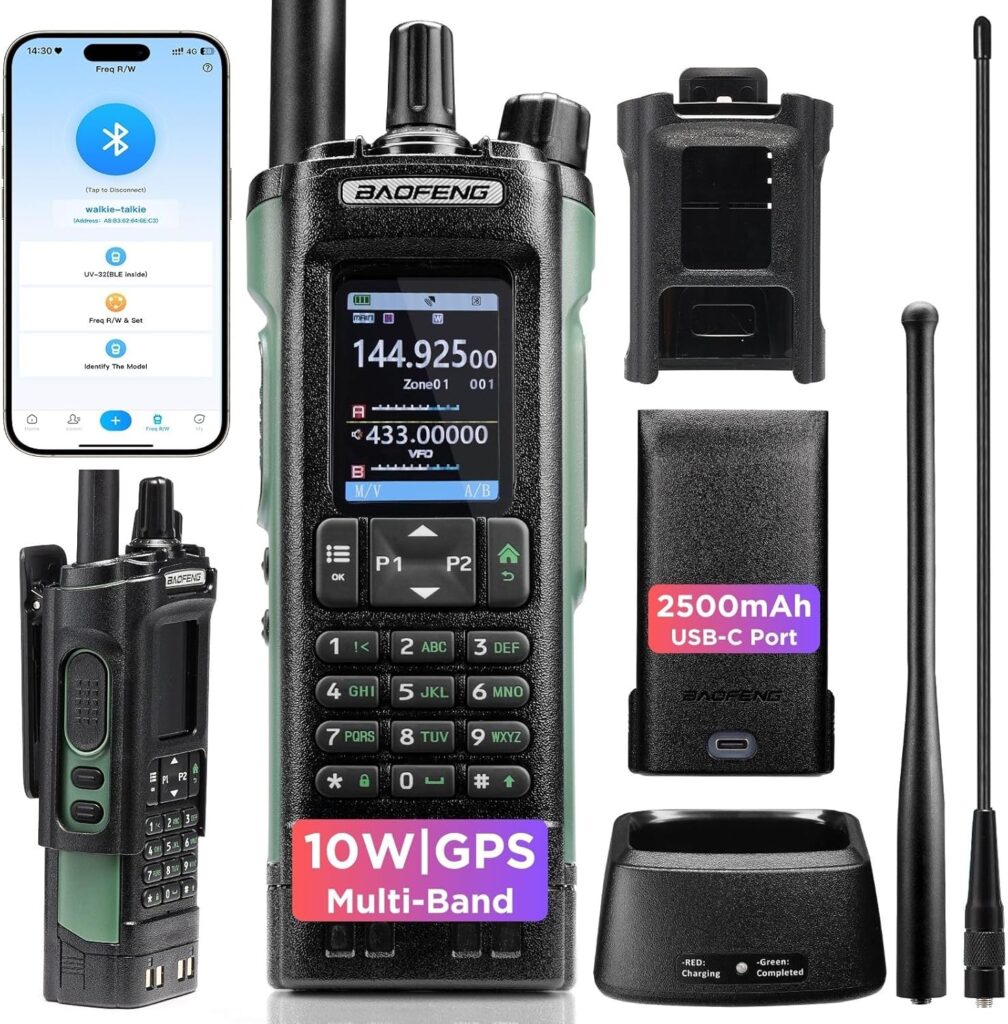
This is not an FRS, GMRS, or licence-free business radio. Transmitting on the UV-32 requires a valid amateur radio licence — an FCC Technician Class or higher in the United States, or an ISED Basic qualification in Canada. Receiving on any frequency is unrestricted.
The UV-32 sits at the premium end of Baofeng’s current lineup, sharing its chassis and firmware architecture with the DM-32UV DMR radio. It is a notably large radio for its class — not a pocket carry — and is aimed at users who prioritise capability and screen readability over compact size.
Licensing Requirement
Transmitting on the Baofeng UV-32 requires an amateur radio licence. The radio transmits on 136-174 MHz (VHF), 220-260 MHz (1.25m band), and 400-520 MHz (UHF) — all amateur radio allocations in North America. Operating without a licence on these frequencies is illegal in both the United States and Canada.
Receiving-only use requires no licence. The UV-32 can receive FM broadcast, AM aviation band, NOAA weather channels, and extended UHF/VHF ranges without a licence, making it useful as a scanner even for unlicensed users. But any transmission requires licensing.
The FCC ID for this model is 2AJGM-NA32UV.
Full Specifications
| Specification | Value |
|---|---|
| Model | UV-32 |
| Manufacturer | Fujian Baofeng Electronics Co., Ltd |
| FCC ID | 2AJGM-NA32UV |
| Radio Type | Amateur radio transceiver (HT) |
| Licence Required to Transmit | Yes — amateur radio licence |
| TX Frequency | 136-174 MHz, 220-260 MHz, 400-520 MHz |
| RX Frequency | VHF 136-174 MHz, 220-260 MHz; UHF 350-390 MHz, 400-520 MHz; AM 108-136 MHz; FM 65-108 MHz |
| Output Power | 10W (nominal); measured 5W/2m, 3W/70cm |
| Channel Capacity | 1,000 channels / 10 zones |
| Channel Spacing | 25.0 kHz / 12.5 kHz |
| Frequency Stability | ±2.5 ppm |
| Input Voltage | 7.4 V DC |
| Battery Capacity | 2,500 mAh (measured: 2,590 mAh) |
| Charging | USB-C direct; desktop charger dock included |
| Display | 2.0-inch colour LCD |
| Screen Brightness | 22.5 lux |
| Backlight Timeout | Adjustable 5-20 seconds |
| GPS | Yes — GNSS (multi-constellation) |
| Bluetooth | Yes — for app-based programming |
| Programming | Bluetooth app (iOS/Android); CPS software (PC); CHIRP (select via UV-21Pro GPS profile) |
| Accessory Connector | 2-pin Kenwood jack |
| Operating Temperature | -10°C to 60°C |
| Antenna Impedance | 50 Ω |
| Weight (actual) | 390 g |
| Dimensions | 182 × 67 × 41 mm / 7.2 × 2.6 × 1.6 inches |
| Belt Clip | Not included — fabric holster included |
| NOAA Weather Receive | Yes |
| FM Radio Receive | Yes (65-108 MHz) |
| Aviation Band Receive | Yes (AM 108-136 MHz) |
| Colours Available | Black, olive green, khaki, transparent |
Frequency Coverage
The UV-32 covers three amateur radio transmit bands and a wide receive spectrum.
Transmit bands:
The VHF 2-metre band (144-148 MHz within the 136-174 MHz TX range) and UHF 70-centimetre band (420-450 MHz within the 400-520 MHz TX range) are the two primary amateur radio bands used for local repeater operation, simplex communication, SOTA (Summits on the Air), and emergency communications. These are the most active bands for handheld amateur operation in North America.
The 1.25-metre band (220-260 MHz TX) is a less common amateur allocation, primarily active in North America. Coverage of this band is unusual for a radio at this price and distinguishes the UV-32 from most budget dual-band HTs.
Receive-only coverage:
Aviation AM band (108-136 MHz) allows listening to air traffic control and aircraft communications — useful near airports or for aviation enthusiasts. FM broadcast (65-108 MHz) covers commercial radio. NOAA weather channels provide automated severe weather alerts.
Key Features
GPS / GNSS Positioning
The UV-32 includes a built-in GNSS receiver — a multi-constellation positioning system that uses GPS, GLONASS, and other satellite systems for faster acquisition and better coverage under tree canopy compared to GPS-only receivers. The radio displays latitude, longitude, and altitude in real time, and allows the user to share their location or request a teammate’s coordinates.
One important note: the Baofeng product page and some third-party listings mention APRS (Automatic Packet Reporting System) capabilities. Independent testing confirms that APRS functions are available in the DM-32UV DMR variant but are absent from the UV-32’s menus and not documented in the UV-32’s official user manual. Buyers seeking APRS should verify this before purchasing, or consider the DM-32UV.
Bluetooth App Programming
The UV-32 can be programmed wirelessly via a companion smartphone app (search “walkie-talkie tool” on the Play Store, or “Radio Frequency Programmer” on the App Store). This is a genuine convenience for users who do not routinely work with PC-based radio programming software, and is particularly useful for travellers or users setting up the radio in the field. The Bluetooth connection is also supported by a dedicated wireless programming adapter (BT-A1D, sold separately) for older Baofeng models.
CPS and CHIRP Programming
PC programming via Baofeng’s CPS (Customer Programming Software) is available and described by users as more intuitive than typical Baofeng software, though it lacks import/export functions. CHIRP compatibility is available by selecting the UV-21Pro GPS profile — not the UV-32 profile, which does not exist in CHIRP’s model list.
2.0-Inch Colour Display
The colour screen shows frequency, channel name, signal strength, battery level, and GPS status in high contrast. The backlight timeout is adjustable up to 20 seconds directly from the radio without a computer. One hardware note: the speaker is mounted on the back of the radio, pointing away from the user, which means full audio fidelity requires an external speaker microphone — the included headset is effectively mandatory for practical use in the field.
1,000 Channels / 10 Zones
The channel capacity is competitive at this price point. Ten zones of 100 channels each allow logical organisation by repeater group, geographic area, or activity type — useful for hams who travel or participate in multiple networks.
One-Key Frequency Copy
A single button copies the frequency and all CTCSS/DCS codes from another radio in close proximity, streamlining setup when deploying multiple radios in the same environment.
Two-Knob Design
Unlike most Baofeng radios with a single top-mounted knob for volume/power, the UV-32 has two knobs: the right knob for power and volume, and a centre 360° rotating knob with detents for frequency tuning and menu navigation. Independent reviewers describe this as a genuine usability improvement over single-knob designs.
Large 2,500 mAh Battery
The battery is screw-fastened to the radio body rather than snap-in, which makes field battery swaps inconvenient. Testing by besthamradio.com measured the actual delivered capacity at 2,590 mAh — slightly above the rated figure, which is unusual and positive. For radios that frequently over-promise and under-deliver on battery capacity, the UV-32 is noted as an exception.
What Customers Think
Review data comes from two primary independent sources: a detailed hands-on evaluation by licensed amateur radio operator Herminio Cardona (N1PWN) published on Baofeng’s blog, and a technical RF performance review and ergonomic assessment by besthamradio.com, updated in 2025.
What Customers Praise
The colour display is consistently praised across both sources. Screen readability is rated “Very Good” by besthamradio.com, and the bright, high-contrast interface is noted as a significant improvement over older Baofeng displays. The adjustable backlight timeout is a practical touch.
Audio quality receives strong positive comment. N1PWN, who compared the UV-32 directly to the UV-25 and AR-152 (previously his recommended Baofeng models), describes the audio as noticeably improved. The max audio output was measured at 90.1 dB by besthamradio.com — louder than most competing budget HTs.
GNSS lock speed is noted as genuinely fast, including under moderate tree cover where GPS-only receivers struggle.
Bluetooth app programming is well-regarded by users who find it a convenient alternative to cable-based CPS programming. N1PWN specifically cites it as a feature that will appeal to users without a dedicated programming computer.
The two-knob design is noted positively. The centre frequency/navigation knob with detents is described as a welcome departure from single-knob Baofeng designs and is called out as a feature reviewers wish more radios had.
Battery delivers on its rating — unusual in the Baofeng range where rated and actual capacities often diverge significantly. The UV-32’s battery tested above its rated figure.
Build quality and feel are described as modern and solid, representing a step forward from the UV-5R heritage platform. N1PWN, who owns over a dozen Baofeng models, describes the UV-32/DM-32UV chassis as the company’s strongest aesthetically and mechanically.
Value for money on features is noted positively. Tri-band TX, GPS, Bluetooth programming, 1,000 channels, colour display, and aviation band receive at $49.99 is an unusual feature density for the price.
What Customers Criticise
Spurious emissions are the most serious technical criticism. Testing by besthamradio.com found five harmonic spikes above the FCC’s -60 dBc recommendation, with one spurious signal only 3 dB below the main transmission level. This means nearly half the radio’s transmitted power is being wasted on out-of-band emissions — robbing range, generating excess RF in the electronics, and shortening component lifespan. For a licensed amateur radio operator, high spurious emissions are a compliance concern.
Actual power output is well below the rated 10W. Measured output is 5W on 2 metres and 3W on 70cm — meaningfully less than the 10W claim on the packaging. For comparison, many genuinely 10W radios in this class achieve 8-10W measured. The UV-32 is closer to a medium-power HT than a true high-power one.
The stock antenna is poor. Testing showed -12 dB return loss at 2m and -17 dB at 70cm, with an SWR of approximately 2:1 on 2m. This significantly limits effective range. Independent reviewers and community forum users recommend replacing the stock antenna immediately with any aftermarket dual-band antenna — a Nagoya NA-771 or similar being a common inexpensive replacement.
No belt clip — the holster is cumbersome. The UV-32 ships with a fabric holster rather than a belt clip. There is no mounting point on the radio body for an aftermarket clip. The holster is described as slow to use and difficult to secure, which is a practical problem for any deployment where quick radio access matters.
The PTT button has a raised plastic ring around it that makes the button feel awkward during transmission, particularly in larger hands. The PTT is also positioned on the front panel rather than the side, which is a less natural placement for one-handed operation.
Battery requires a screwdriver to remove — the battery pack screws into the radio body. Swapping to a spare battery in the field requires carrying a screwdriver, which is an unusual and inconvenient design choice for a field radio.
The speaker faces backward. The speaker is on the rear of the radio, pointing away from the user. This effectively makes the included headset or an external speaker microphone a functional requirement rather than an optional accessory, as unassisted audio is directed away from the listener.
CHIRP requires a workaround. The UV-32 is not natively listed in CHIRP. It can be programmed by selecting the UV-21Pro GPS profile, but this is undocumented in the official manual and represents a friction point for CHIRP users.
VHF offset programming is non-standard — at least one user reports the manual provides only a UHF offset example, leaving VHF repeater offset programming undocumented and requiring a web search to resolve.
APRS claims in some listings are misleading. APRS is a feature of the DM-32UV DMR variant, not the UV-32. Buyers should not purchase the UV-32 on the basis of APRS capability claims without independent verification.
Overall Sentiment
The UV-32 divides opinion along experience lines. Buyers who are new to amateur radio or upgrading from older Baofeng UV-5R-era hardware are generally positive about the display, GPS, audio quality, and app programming experience. Technically experienced reviewers who perform RF measurements are more critical, particularly regarding spurious emissions, true power output, and antenna performance.
The besthamradio.com verdict — a performance score of D and a “would not recommend” conclusion — reflects the radio’s RF-level shortcomings. N1PWN’s more positive assessment, after extended real-world use on repeaters and a hotspot, reflects a different set of priorities where audio quality, GPS utility, and everyday usability are the primary measures. Both perspectives are legitimate and reflect the two audiences the UV-32 attracts.
Who the UV-32 Is Suited For
The UV-32 is a reasonable fit for:
- Licensed amateur radio operators looking for a budget tri-band HT with GPS and colour display
- Hams upgrading from UV-5R-era single-band or dual-band radios who want a more capable interface
- Emergency preparedness users who want GPS positioning integrated with radio capability
- Users who prefer Bluetooth app programming over PC-based workflows
- Buyers who understand the stock antenna will need replacement before meaningful field use
It is less suited for:
- Unlicensed users who want to transmit — a licence is required and operating without one is illegal
- Buyers who need a confirmed 10W radio — real-world output is closer to 5W on VHF
- Technically demanding users who require clean RF output (spurious emissions are a documented problem)
- Deployments requiring quick-access belt carry — no belt clip provision exists
- Users wanting APRS — the DM-32UV is the correct model for that capability
In the Box
| Item | Qty |
|---|---|
| UV-32 radio | 1 |
| 2,500 mAh battery | 1 |
| Antenna | 1 |
| Headset | 1 |
| Belt clip | — (not included) |
| Fabric holster with case | 1 |
| USB-C charger cable | 1 |
| Desktop charger base | 1 |
| User manual | 1 |
Related Models in the UV-32 Family
| Model | Key Difference |
|---|---|
| UV-32 | Analogue-only, GPS, Bluetooth — reviewed here |
| DM-32UV | Adds DMR digital mode and APRS; same chassis |
| UV-25 Plus | Same platform, 5,200 mAh battery, fall detection alert |
| UV-28 Plus | Same platform, smaller 1.77-inch display, 2,200 mAh battery |