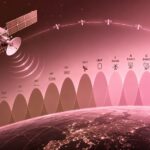
Few frequency ranges have generated as much money, as much regulatory complexity, or as much unexpected conflict as the C band. Depending on who is defining it, the C band runs from 4 to 8 GHz by the IEEE designation, or from 3.7 to 4.2 GHz downlink and 5.925 to 6.425 GHz uplink in satellite industry convention, or from 3.7 to 3.98 GHz in the FCC’s recent spectrum auction framing. All three definitions describe overlapping but distinct uses of the same region of spectrum — and understanding the C band means understanding all three at once.
The original satellite band
The first commercial communications satellite, Intelsat 1 — known as Early Bird — launched in 1965 and operated in the C band. Over the decades, C band evolved to accommodate growing demand and became a cornerstone of global telecommunications infrastructure, facilitating international communications, television broadcasting, and data transmission.
The reason C band dominated early satellite communications is physical. For satellite communications, the microwave frequencies of C band perform better under adverse weather conditions than the Ku band at 11.2 to 14.5 GHz. Rain fade — the collective name for signal attenuation caused by precipitation and atmospheric moisture — is substantially lower at C band frequencies. A tropical broadcaster in Southeast Asia or sub-Saharan Africa, where intense rainfall events are common, cannot rely on a Ku-band link the way a temperate-region operator can. C band was and remains the reliable choice for equatorial and tropical coverage.
Nearly all C-band communication satellites use 3.7 to 4.2 GHz for their downlinks and 5.925 to 6.425 GHz for their uplinks. The 2,225 MHz separation between uplink and downlink prevents the satellite’s own powerful transmitter from overloading its sensitive receiver. Large earth station dishes — typically 2 to 5 metres in diameter — are required at C band because the longer wavelengths demand larger apertures to achieve useful gain. This antenna size is both a disadvantage for consumer applications and an advantage for professional broadcast infrastructure, where dish size is not a constraint and pointing accuracy is straightforward to maintain.
For decades the C band carried most of the world’s international telephone traffic, television distribution, and news feeds. The domestic US satellite television market was built on C band, with large backyard dishes in the 1980s and early 1990s receiving hundreds of channels directly from transponders pointed at US viewers. Intelsat 511 alone carried 26 C-band transponders, and variants of this architecture have been the backbone of global communications since the 1970s.
The $81 billion reallocation
The C band’s physical properties that made it valuable for satellite communications — specifically its mid-band position between the spectrum’s low-frequency and high-frequency extremes — also made it attractive for 5G. Mid-band spectrum offers a combination of coverage range and capacity that neither low-band (better range, less capacity) nor millimetre wave (far more capacity, very limited range) can match alone.
In 2020, the FCC moved to make 280 megahertz of the 3.7 to 4.2 GHz band available for flexible terrestrial use by repacking existing satellite operations into the upper 200 megahertz of the band and reserving a 20 megahertz guard band, while conducting a public auction of the cleared spectrum.
The auction raised over $81 billion in winning bids — a record that remains the largest spectrum auction in US history — with total payments rising to $93.5 billion after including $12.6 billion in transition and relocation payments to incumbent satellite operators. Verizon spent $45.5 billion, AT&T spent $23.4 billion, and T-Mobile spent $9.3 billion. Satellite operators including Intelsat, SES, Telesat, Eutelsat, and Star One received relocation payments totalling up to $9.7 billion to compensate for clearing the lower portion of the band and repacking their operations into the upper 200 megahertz.
SES completed all Phase II C-band clearing requirements, launching five new satellites and repacking all C-band downlink services in the continental United States into the upper 200 megahertz of the band. The cleared lower portion — 3.7 to 3.98 GHz — became available to the winning bidders for 5G deployment, with clearing completed in most major markets by late 2023.
The aviation interference crisis
The transition did not go smoothly. Aircraft radar altimeters operate within 4.2 to 4.4 GHz — immediately adjacent to the upper edge of the C-band 5G deployment window at 3.7 to 3.98 GHz. Radar altimeters are safety-critical instruments that measure height above ground during approach and landing, and feed data into automatic landing systems, ground proximity warning systems, and weather radar displays.
In January 2022, the FAA came to an agreement with AT&T and Verizon for a voluntary delay and mitigations near airports, and released a list of 50 airports with buffer zones when 5G C-band service was activated. By the end of September 2023, the FAA, aviation sector, and wireless providers completed work to ensure that radio signals from newly activated wireless systems can coexist safely with flight operations until at least January 1, 2028. The resolution required a combination of voluntary power reduction by carriers near airports and altimeter retrofits across the commercial airline fleet — a significant, expensive, and largely unplanned consequence of the spectrum reallocation.
The fundamental interference mechanism involved both direct desensitisation of altimeter receivers by 5G fundamental emissions just below 4.2 GHz, and spurious emissions falling within the 4.2 to 4.4 GHz altimeter band itself. The controversy was not without precedent — aviation industry concerns about the 3.7 to 4.2 GHz allocation had been raised as early as 2015 during ITU discussions, but were not resolved before the auction proceeded.
What comes next
The FCC has proposed rules for a further auction of the upper C band — 3.98 to 4.2 GHz — targeting completion by 2027, with Congress mandating a minimum of 100 megahertz be cleared for competitive bidding under the One Big Beautiful Bill Act signed in 2025. This upper segment still carries active satellite services serving cable and broadcast customers in the United States, meaning a second, smaller version of the 2020 reallocation process is now underway.
Globally, the picture is different. Outside the United States, much of the 3.7 to 4.2 GHz band remains in satellite use. Countries without the same pressure from 5G spectrum demand, or with different mid-band holdings, have been slower to move satellite operations out of C band — meaning the international satellite industry continues to rely on the same frequencies that US wireless carriers are now deploying for 5G mobile broadband.
The C band’s story is ultimately about what happens when a frequency range chosen for one generation of technology becomes the most valuable asset for the next. Sixty years of satellite infrastructure, global broadcast distribution, and international telephony built on 3.7 to 4.2 GHz did not simply yield to 5G — it was bought out, relocated, and litigated over in a process that cost nearly $100 billion and nearly grounded commercial aviation in the process.