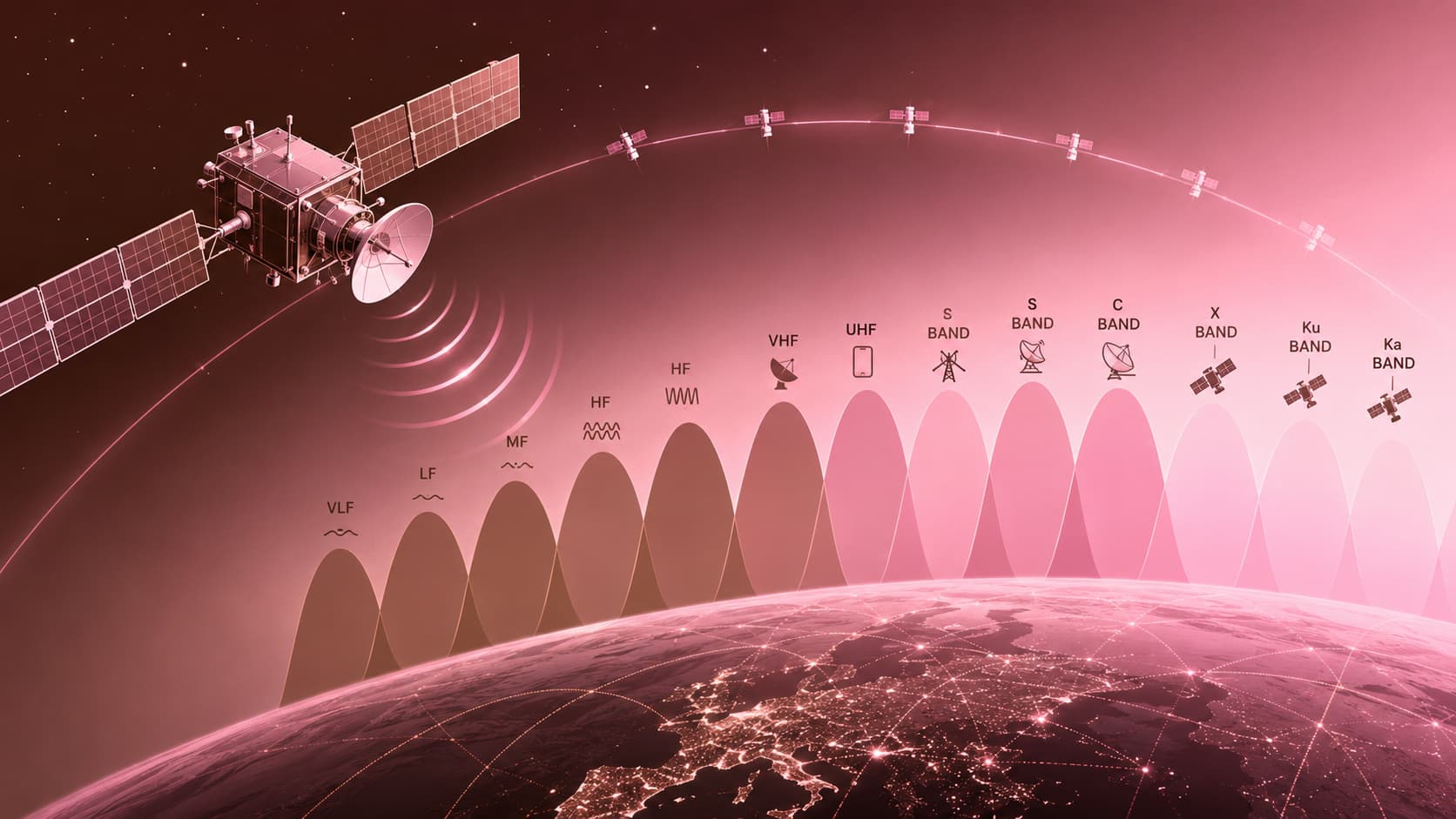
Low Earth Orbit (LEO) satellites, operating roughly 300 to 2,000 kilometers above the surface, depend entirely on radio frequency spectrum to communicate with ground stations, user terminals, and each other. Unlike geostationary satellites, which sit in a single fixed slot and can rely on long-established, narrowly defined bands, LEO constellations move rapidly across the sky and require spectrum that supports constant handoffs between satellites and ground assets. This has pushed LEO operators across a wide swath of the radio spectrum, from VHF up through millimeter wave frequencies. This guide breaks down the bands in use today, the specific frequency ranges allocated to each, and why different LEO applications gravitate toward different parts of the spectrum.
VHF and UHF: The Original LEO Bands
The earliest LEO communications systems relied on VHF and UHF because the hardware was simple, antennas were small relative to wavelength, and atmospheric attenuation was negligible.
137 to 138 MHz is allocated for space-to-Earth transmission and remains heavily used by weather satellites, amateur radio satellites, and many university cubesats. 148 to 150.05 MHz serves as the corresponding Earth-to-space uplink band. Orbcomm, one of the longest-running commercial LEO messaging constellations, built its entire network around VHF spectrum in this range.
UHF allocations around 400.15 to 401 MHz and 401 to 403 MHz support meteorological satellites and increasingly support LEO-based Internet of Things (IoT) constellations, which need only narrow bandwidth to relay small sensor payloads from remote assets like shipping containers, agricultural equipment, and pipeline monitors.
These bands remain attractive for low-power, low-data-rate applications today, even as higher frequencies have taken over for broadband traffic, because VHF and UHF signals penetrate foliage and building materials far better than microwave frequencies, and the ground equipment is inexpensive.
L-Band: Mobile Satellite Services
L-band, spanning roughly 1 to 2 GHz, became the home for the first generation of LEO voice and data constellations designed for handheld or vehicle-mounted terminals.
1,610 to 1,626.5 MHz is allocated for Mobile Satellite Service (MSS) and is the core operating band for Iridium, whose 66-satellite constellation provides global voice and data coverage using this spectrum for both uplink and downlink through time-division duplexing. 1,525 to 1,559 MHz and 1,626.5 to 1,660.5 MHz are additional MSS allocations used by various mobile satellite operators for downlink and uplink respectively.
L-band’s appeal for mobile satellite service comes from its forgiving propagation characteristics. Signals at these frequencies tolerate rain, foliage, and modest pointing inaccuracy far better than higher bands, which matters enormously when the receiving terminal is a handheld phone rather than a precisely steered dish.
S-Band: Telemetry, Tracking, and Direct-to-Device
S-band, covering roughly 2 to 4 GHz, plays two distinct roles in LEO systems.
2,025 to 2,110 MHz (Earth-to-space) and 2,200 to 2,290 MHz (space-to-Earth) are allocated for space operations and space research, making this the standard home for telemetry, tracking, and command (TT&C) links, the control channels operators use to monitor satellite health and issue commands regardless of what frequency the satellite uses for its actual payload traffic.
2,483.5 to 2,500 MHz is allocated for mobile satellite service downlink and has been used by Globalstar for its voice and data constellation. This same general region of S-band has drawn renewed attention recently as several operators pursue direct-to-device satellite connectivity, aiming to communicate directly with unmodified or lightly modified smartphones.
C-Band: Legacy Broad Coverage
C-band, traditionally 3.7 to 4.2 GHz for downlink and 5.925 to 6.425 GHz for uplink, has long been the workhorse of geostationary fixed satellite service, prized for its strong resistance to rain fade. Some LEO and medium Earth orbit systems have used adjacent or overlapping C-band allocations for feeder links and inter-satellite gateway connections, though C-band’s relatively limited available bandwidth compared to Ku and Ka has made it a secondary choice for the high-throughput broadband constellations now dominating LEO.
X-Band: Government and Military LEO
7.25 to 7.75 GHz for downlink and 7.9 to 8.4 GHz for uplink are allocated for government and military satellite communications. Many LEO Earth observation, reconnaissance, and defence communications satellites use X-band specifically because these allocations are protected for government use and carry less commercial interference than the heavily contested Ku and Ka bands. X-band also offers a useful middle ground between the wide bandwidth of higher frequencies and the resilience of lower ones, making it attractive for downlinking large volumes of imagery data from Earth observation satellites to dedicated ground stations.
Ku-Band: The First Broadband LEO Workhorse
Ku-band, generally 10.7 to 12.7 GHz for downlink and 14 to 14.5 GHz for uplink, became the first widely adopted band for broadband-focused LEO and medium Earth orbit constellations. OneWeb built its initial constellation around Ku-band user links, and SES’s O3b medium Earth orbit system likewise relies heavily on this range. Ku-band offers considerably more available bandwidth than L, S, or C band, enabling the multi-megabit broadband throughput that distinguishes modern satellite internet from older voice and messaging services, while remaining more tolerant of rain attenuation and pointing error than Ka-band or higher.
Ka-Band: The Backbone of Modern LEO Broadband
Ka-band, covering roughly 17.7 to 21.2 GHz for downlink and 27.5 to 30 GHz for uplink, is the primary spectrum underpinning today’s largest LEO broadband constellations, including SpaceX’s Starlink. Ka-band’s enormous available bandwidth, far exceeding what is available in Ku-band, is what allows a single satellite to serve thousands of simultaneous broadband users with throughput rivaling terrestrial fiber and cable connections.
The tradeoff is that Ka-band signals are considerably more vulnerable to rain fade and require tighter beam pointing accuracy, which is why Ka-band terminals use electronically steered phased array antennas capable of continuously tracking fast-moving LEO satellites rather than simple fixed dishes.
V-Band: The Next Frontier
V-band, generally 37.5 to 42.5 GHz for downlink and 47.2 to 50.2 GHz for uplink, represents the leading edge of spectrum now being allocated to next-generation LEO systems. SpaceX’s later-generation Starlink satellites and several proposed constellations have requested V-band allocations to support inter-satellite gateway links and additional user capacity as Ka-band spectrum becomes increasingly congested with multiple competing constellations.
V-band offers even more available bandwidth than Ka-band, but atmospheric absorption and rain attenuation are severe enough that V-band links typically require shorter hop distances, larger margin in the link budget, or use specifically for feeder links between satellites and gateway ground stations rather than direct connections to consumer terminals.
Optical Links: Beyond Radio Frequency
Many modern LEO constellations, including Starlink, also use laser-based optical inter-satellite links operating outside the radio frequency spectrum entirely, typically in the infrared range around 1,550 nanometers. These links carry enormous bandwidth between satellites without requiring spectrum licensing, reducing dependence on ground-based gateway stations and reducing latency for traffic that would otherwise need to route through a terrestrial relay point.
Why the Spread Matters
No single frequency band could support the full range of LEO applications operating today. Lower frequencies remain essential for narrowband IoT and resilient mobile communications where terminal cost and signal robustness matter most. Middle frequencies like X-band serve government missions requiring protected, interference-resistant spectrum. Upper microwave and millimeter wave bands, Ku, Ka, and V, deliver the bandwidth that modern broadband constellations need to compete with terrestrial internet. As more constellations launch, congestion and interference coordination across all of these bands, particularly Ka-band, has become one of the defining regulatory challenges facing the satellite industry, driving renewed interest in optical links and higher, less crowded frequencies as a release valve for future growth.