The 38 MHz of spectrum between 136 and 174 MHz is one of the most densely occupied slices of the radio dial. Sitting at the upper edge of the Very High Frequency band, it serves an extraordinary range of users simultaneously — military forces, maritime operators, weather services, public safety agencies, commercial fleets, and satellite ground stations. No single authority owns it. No single waveform defines it. And that crowding is precisely what makes it both valuable and technically demanding to work with.
Where It Fits in the VHF Landscape
The ITU defines VHF as 30 to 300 MHz. Within that span, the 136–174 MHz segment is commonly called the VHF high band, and it sits immediately above the civil aviation airband (118–137 MHz) and below the Band III television allocation (174–230 MHz). Wavelengths across the band range from about 2.2 metres at 136 MHz down to roughly 1.7 metres at 174 MHz — long enough that antennas remain physically manageable, short enough that propagation is almost entirely line-of-sight (LOS) under normal conditions.
LOS propagation is the defining physical characteristic of this band. Signals travel in straight lines, obstructed by terrain, buildings, and the curvature of the Earth. The radio horizon extends slightly beyond the geometric horizon due to atmospheric refraction — roughly 4/3 of the geometric distance under standard conditions. A 10-metre mast provides a radio horizon of approximately 13 km; a shipboard antenna at 5 metres elevation reaches perhaps 9 km. Occasionally, tropospheric ducting caused by temperature inversions allows signals to travel hundreds of kilometres beyond the normal range, a phenomenon that both benefits and complicates operations in this band.
The band’s LOS behaviour makes it well suited for regional, medium-range communication where you want reliable coverage within a defined geographic area without the long-distance interference that HF brings. Atmospheric noise is lower than at HF, and equipment remains compact enough for vehicle mounting and handheld use.
Sub-Band Allocation Structure
The 38 MHz span is divided into distinct segments, each governed by national and international regulatory frameworks. In North America, the NTIA manages federal (including military) allocations while the FCC governs non-federal use. Internationally, the ITU Radio Regulations provide the framework, with national administrations adapting within those bounds.
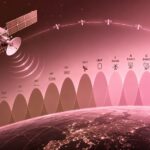
136–138 MHz is primarily a satellite downlink band. It was historically used by a range of meteorological and scientific satellites, and while much of that activity has migrated higher, the 137–138 MHz portion remains active for meteorological satellite downlinks and low data rate mobile satellite services.
138–144 MHz is reserved in the United States exclusively for federal government and military use. The US frequency table allocates this segment to fixed and mobile services under federal control, with no non-federal licensees permitted. This makes it a dedicated military communications segment, used for tactical land mobile, sensor data links, and base operations — away from civilian traffic entirely. The ITU footnotes acknowledge that some European administrations also permit maritime mobile and land mobile use here, so the specifics depend on jurisdiction.
144–148 MHz is the international 2-metre amateur radio allocation, shared in the US with the federal government on a secondary basis. It is heavily used by amateur radio operators worldwide for repeater networks, weak-signal work, and satellite communications. The band sees substantial activity and serves as an important interoperability layer in emergency communications.
148–150 MHz is used for satellite uplinks — the companion uplink band for satellites that downlink in the 137–138 MHz range, including weather and positioning satellites. The ITU also allocates the band to space operations and mobile satellite services on a primary basis.
150–156 MHz is the VHF business band, allocated internationally to the land mobile and fixed services. Public safety (police, fire, EMS), commercial fleets, utilities, and various government agencies operate here under national licensing frameworks. In North America, channels are narrowband FM (12.5 kHz), with 25 kHz legacy channels still present in some areas.
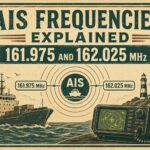
156–162 MHz is the international VHF maritime mobile band. This is globally harmonised spectrum, used by ships and coast stations worldwide on a channelised plan defined by the ITU. Channel 16 at 156.800 MHz is the universal maritime distress, safety, and calling channel — a vessel at sea is required to maintain a listening watch on it. Channel 70 at 156.525 MHz is reserved for Digital Selective Calling (DSC), the automated digital distress and identification system now mandatory on equipped vessels. AIS (Automatic Identification System) operates on channels 87B and 88B at 161.975 MHz and 162.025 MHz, broadcasting vessel position, identity, and track data continuously.
162–174 MHz in the United States is primarily federal government territory. The NOAA Weather Radio network broadcasts continuous meteorological and emergency information on seven frequencies between 162.400 and 162.550 MHz, covering the majority of the US population. Above that, the 162–174 MHz segment is used by federal agencies including the military for non-tactical and intra-base communications. The National Guard maintains designated emergency frequencies in this range, including 163.4875 MHz as a nationwide emergency channel and 163.5125 MHz for national disaster preparedness coordination by armed forces.
Military Use Across the Band
Military forces use the 136–174 MHz band across several distinct roles, and understanding the difference between them is important for any system operating in this space.
The 138–144 MHz and 148–150.8 MHz segments are the primary military-exclusive land mobile portions in the US. These are used for ground force communications, sensor data links, and intra-base operations that need to be isolated from civilian traffic. The REMBASS battlefield remote sensor system — which provides unattended ground sensor networks — operates in the 138–153 MHz range, channelised in 25 kHz steps from 138.025 MHz upward, with a repeater networking architecture. This illustrates a broader pattern: the military uses this band not just for voice, but for data links and remote sensing that benefit from the propagation characteristics and the regulatory isolation of the federal-only segments.
The 136–174 MHz band also appears as the upper extension of multi-band military radios. The AN/PRC-158 FALCON IV, for example, covers 30 MHz to 2.5 GHz and uses this band for VHF operations including airband AM, VHF marine, and tactical FM. Many modern military multiband radios cover 30–512 MHz as their core operating range, with 136–174 MHz as a middle tier between the SINCGARS tactical FM band below (30–88 MHz) and the NATO military UHF air band above (225–400 MHz). Encryption is used extensively throughout military operations in this range, with digital voice modes including P25 and proprietary waveforms common alongside legacy FM voice.
Aircraft also contribute to band activity. Some military aircraft — particularly F-16s and A-10s — use the 137–144 MHz portion for air-to-air communications, supplementing or replacing their primary UHF radios for certain missions. Helicopter and transport aircraft that work closely with ground forces often carry a VHF high band radio as standard equipment for interoperability with land mobile networks.
The 162–174 MHz federal segment sees military use for non-tactical intra-base operations — logistics, base administration, and coordination functions where tactical waveforms are not required. Use here is limited by regulation: tactical operations are directed to the 30–88 MHz SINCGARS band or the 225–400 MHz UHF band rather than the shared federal VHF high band.
Civilian and Commercial Operations
Outside the military and federal allocations, the VHF high band serves a very large civilian user base. Public safety organisations — police, fire, and emergency medical services — operate extensively in the 150–174 MHz range under national licensing regimes. In many regions this is the primary dispatch and tactical band for local and state government emergency services, with trunked P25 networks increasingly replacing legacy analogue systems.
Commercial and industrial users occupy the business band portion, covering applications from construction site coordination to utility crew dispatch to school bus tracking. The band’s LOS characteristics and reliable FM propagation make it well suited for regional fleet management where a single tall repeater site can cover an entire city or county.
Maritime operators are the other major civilian constituency. For any vessel equipped with VHF marine radio — which is mandatory for ships of a certain size in international waters and strongly recommended for all maritime operation — this band is essential infrastructure. The harmonised international channel plan means the same radio works in any ocean, and interoperability between vessels of different nations and types is built into the system design. The universal watch requirement on Channel 16 functions as a global safety net: any vessel, anywhere in the world, listening on 156.800 MHz can be reached by any other similarly equipped vessel or coast station.
Propagation, Interference, and Coexistence Challenges
The density of users in 136–174 MHz creates genuine coexistence challenges that any system designer or operator must account for.
The band has no ionospheric propagation under normal conditions — unlike HF, signals do not reflect off the ionosphere for long-distance coverage. This is largely a feature rather than a bug: it means interference from distant stations is bounded under normal conditions. However, tropospheric ducting events, which occur when temperature inversions trap radio energy in a low-altitude duct, can produce unexpected long-range propagation. During ducting, signals from hundreds of kilometres away can appear at normal signal strength, causing interference on frequencies that are normally geographically separated. Coastal and maritime environments are particularly susceptible to ducting along the water surface.
FM broadcast stations at 87.5–108 MHz are a significant interference source for receivers in this band. While the FM broadcast band sits 28 MHz below the bottom of the 136–174 MHz range, high-power FM transmitters — some running tens of kilowatts — produce intermodulation products and harmonics that can desensitise or overload wideband receivers. This is a particular concern for SDR-based monitoring systems and receive-only scanner applications. Bandpass filtering at the receiver front end is essentially mandatory in any urban environment with nearby FM broadcast infrastructure.
Digital television broadcast in the Band III allocation immediately above (174–230 MHz) similarly contributes strong out-of-band signals, particularly in regions that have transitioned from analogue to DVB-T or ATSC. The transition has generally improved the situation compared to high-power analogue TV, but strong DTV signals still represent a receiver blocking threat for systems tuned to 136–174 MHz.
Cellular and LTE infrastructure, while operating at much higher frequencies, can also be a source of intermodulation products in crowded RF environments, particularly when multiple high-power transmitters are co-located on the same structure as receiving systems.
Equipment and Technology
Radios covering 136–174 MHz are among the most widely produced RF equipment in the world. The VHF high band is the standard operating range for commercial two-way radios from manufacturers including Motorola, Kenwood, Icom, and Hytera. Most professional and commercial handheld and mobile radios in this band use narrowband FM (12.5 kHz channel spacing), with digital modes — DMR, P25, NXDN, and TETRA — increasingly common in both public safety and commercial applications.
The band is also the transmit range for one of the most widely distributed low-cost handheld radios in the world: the Baofeng UV-5R and its many variants, which cover 136–174 MHz alongside UHF. The proliferation of these inexpensive radios — used by civilians, emergency services in developing countries, and, as documented in the conflict in Ukraine, by military forces on both sides — has made VHF high band activity difficult to predict and monitor in conflict zones. Ukrainian and Russian forces have been documented using Baofeng UV-5R radios on VHF land mobile frequencies for short-range tactical communication, a practical demonstration of how commercial availability shapes military spectrum use on the modern battlefield.
Military-grade equipment for this band includes the AN/PRC-152, AN/PRC-148 MBITR, and the broader L3Harris FALCON family, all of which cover 136–174 MHz as part of a wider multiband operating range. These radios add encryption, frequency hopping, and ECCM capability that commercial radios lack, but the underlying RF hardware must still coexist with all the other users sharing the band.
Why This Band Demands Attention Now
Several trends are increasing the engineering and operational importance of the 136–174 MHz band.
Military SDR modernisation continues to expand the number of systems that must operate across this band alongside others. Every wideband tactical radio, every SIGINT receiver, and every direction-finding system covering 30 MHz to 512 MHz or wider must handle this segment cleanly. Front-end filtering to isolate the military-exclusive sub-bands while rejecting FM broadcast, digital television, and cellular interference is a persistent design challenge, and the market for discrete bandpass filters covering this range — particularly ruggedised, connectorised designs rather than chip-scale SAW filters — remains underserved relative to demand.
Counter-UAS operations have brought renewed interest in VHF high band monitoring. While most commercial drones operate at 2.4 GHz and 5.8 GHz, some UAS platforms use sub-GHz control links, and the 136–174 MHz band is within the monitoring range of most passive RF detection systems. Any C-UAS sensor architecture that claims wideband coverage must handle this band without allowing its crowded occupancy to degrade sensitivity across adjacent bands.
Emergency communications interoperability is a growing policy priority in both the US and Canada. The integration of military, federal, and civilian emergency management communication during disasters and major incidents requires systems that can bridge across the different sub-band allocations within 136–174 MHz — from federal military channels down through NOAA weather, public safety, and marine distress frequencies. Understanding the band in its entirety, rather than treating individual sub-bands in isolation, is increasingly necessary for anyone designing or evaluating interoperability systems.
The 136–174 MHz band is not glamorous. It does not carry the strategic prestige of satellite communications or the technical novelty of millimetre-wave systems. But it is one of the most operationally indispensable segments of the radio spectrum — depended on daily by mariners in distress, soldiers in the field, first responders, meteorologists, and commercial operators worldwide. Any RF engineer or spectrum manager who does not understand its structure in detail is missing something fundamental.