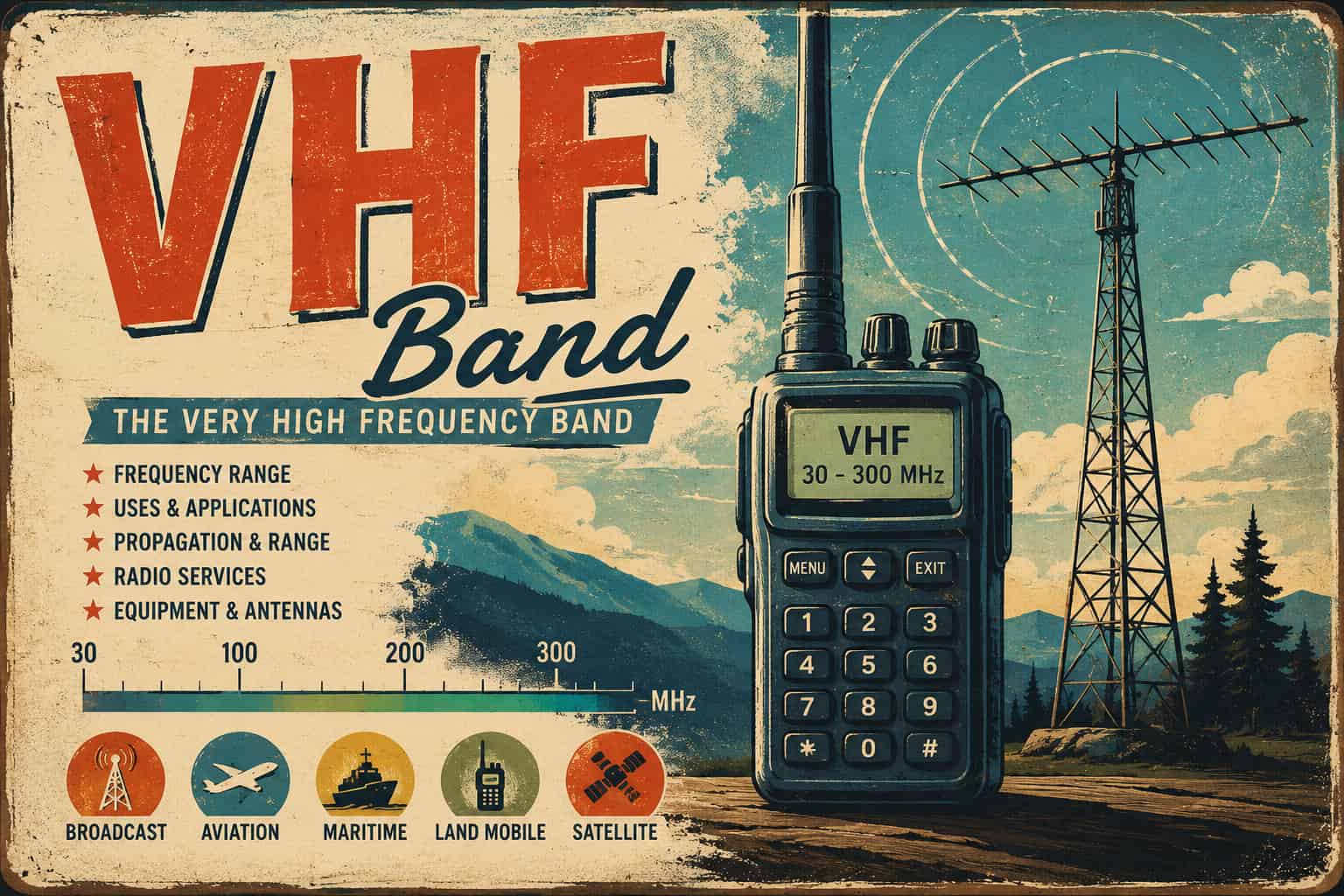
No frequency range has shaped everyday radio experience more directly than VHF. From 30 to 300 MHz, this single ITU designation encompasses FM radio, commercial television, civil aviation communications, maritime distress calling, military tactical radio, weather satellite downlinks, and two of amateur radio’s most active bands. Understanding VHF means understanding almost every wireless system that most people interact with across their lives — and the physics that makes those systems work.
What VHF actually is
The designation Very High Frequency was assigned by the ITU when the spectrum was first systematically organised in the mid-twentieth century. At the time, 30 MHz seemed genuinely high. Today, with allocations extending to hundreds of gigahertz, the label reads as historical context rather than a literal description. Wavelengths across the VHF band run from 10 metres at 30 MHz to 1 metre at 300 MHz — a tenfold range that spans from antenna structures comparable to a telegraph pole down to a convenient handheld whip.
Propagation: mostly line-of-sight, occasionally not
VHF propagation is dominated by line-of-sight paths. Unlike HF signals below 30 MHz, which routinely reflect off the ionosphere and travel thousands of kilometres, VHF signals generally pass through the ionosphere into space. A transmitter and receiver must have a clear geometric path between them, modified slightly by the curvature of the Earth and the refractive bending of the lower atmosphere, which extends the radio horizon a few per cent beyond the optical horizon.
That is the normal condition. The exceptions are what make VHF interesting from a propagation standpoint.
Sporadic E propagation occurs when the E layer of the ionosphere becomes heavily ionised in specific small, thin patches — sometimes called clouds — refracting VHF signals back to Earth over distances of 600 to 1,400 miles. This phenomenon peaks near the summer solstice in both hemispheres and can persist from a few minutes to several hours. At the lower end of the VHF band, near 50 MHz, sporadic E can produce worldwide contacts under the right conditions. At higher VHF frequencies it becomes increasingly rare, though 144 MHz openings do occur.
Tropospheric ducting is a separate mechanism that can extend VHF range to several hundred kilometres. The key to tropospheric propagation is refraction — the change in direction of a wave passing from one medium to another. Changes in the refractive index of the troposphere occur wherever there are differences in temperature, pressure, and water vapour content. Temperature inversions — warm air sitting above cold air — can trap VHF signals in ducts that carry them well beyond the normal horizon, a phenomenon familiar to FM listeners who occasionally receive distant stations on otherwise clear frequencies.
30 to 88 MHz: military tactical and the lower edge
The bottom of the VHF band, covered in detail in an earlier article in this series, is dominated by military tactical communications. SINCGARS — the US Army’s primary combat net radio — operates across 2,320 channels between 30 and 87.975 MHz in 25 kHz steps with frequency hopping at 111 hops per second. This sub-band also carries civilian land mobile systems in the 30 to 50 MHz range, used by rural public safety, agriculture, utilities, and transportation operators who value the band’s terrain-penetrating propagation over the more compact antennas available at higher frequencies.
88 to 108 MHz: FM broadcasting
FM broadcasting occupies 88 to 108 MHz in most of the world — 20 MHz of spectrum that carries thousands of commercial and non-commercial radio stations. The FM broadcast band was deliberately placed above the original television allocation after World War II to separate it from video signals and provide cleaner audio transmission. Stereo FM, RDS data, and HD Radio digital subcarriers all occupy this segment simultaneously through careful spectral engineering. The band’s propagation characteristics — primarily line-of-sight with some terrain diffraction — produce coverage areas of roughly 50 to 150 kilometres from a typical high-power transmitter, making it well-suited to metropolitan service areas.
108 to 137 MHz: the aviation band
The VHF airband runs from 108 to 137 MHz. The lowest segment, from 108 to 117.95 MHz, carries navigation signals exclusively — VOR beacons and ILS localizers on 200 narrowband channels spaced 50 kHz apart. The upper 19 MHz, from 118 to 136.975 MHz, carries amplitude-modulated voice communications for air traffic control, with 760 channels at 25 kHz spacing, narrowed to 8.33 kHz in European airspace to accommodate growing traffic density.
The use of AM rather than FM in the airband is deliberate. AM allows multiple transmissions on the same frequency to be partially resolved by a receiver — if two stations transmit simultaneously, some content from both may be intelligible. FM’s capture effect, by contrast, suppresses the weaker signal entirely. In aviation, hearing a partial transmission that another aircraft is broadcasting on the frequency is safer than hearing nothing at all.
The civil emergency frequency is 121.5 MHz, known as Guard, monitored continuously by air traffic facilities, aircraft, and military installations worldwide. VHF data link systems including ACARS use select frequencies within the airband for digital position reporting and operational messaging.
137 to 174 MHz: land mobile, weather satellites, and maritime
This segment carries some of the most varied allocations in the VHF band. The 137 to 138 MHz range carries meteorological satellite downlinks — the APT (Automatic Picture Transmission) signals from NOAA polar-orbiting weather satellites that amateur and hobbyist receivers worldwide can capture with a simple antenna. The 144 to 148 MHz amateur 2-metre band sits within this segment, the most active VHF amateur allocation globally, supporting FM repeater networks, digital voice, weak-signal SSB, and satellite operations.
The 150 to 174 MHz range hosts the core of civilian VHF high-band land mobile — public safety dispatch, utilities, forestry, transportation, and government field communications. The VHF maritime mobile band runs from 156 to 174 MHz, with Channel 16 at 156.800 MHz designated internationally as the distress, safety, and calling frequency, monitored by ships and coast stations worldwide. Channel 16 occupies the same conceptual role in the maritime world that 121.5 MHz does in aviation — a frequency that is never used for routine traffic and never left unmonitored.
174 to 300 MHz: television Band III and the military block
The 174 to 240 MHz segment is known internationally as Band III — historically used for VHF television channels and now carrying digital television broadcasts in countries that have not migrated entirely to UHF. In much of Europe, Africa, and Asia, DVB-T digital television continues to use Band III frequencies. In North America, the analogue VHF television channels 7 through 13 occupied this range, with the DTV transition moving most broadcasters to UHF.
Above 225 MHz, the spectrum enters the military aviation block — the 225 to 400 MHz reservation covered in depth in earlier articles in this series, carrying SINCGARS airborne complements, HAVE QUICK frequency-hopping voice nets, tactical data links, and the UHF SATCOM infrastructure that forms the backbone of NATO communications.
Why VHF endures
The VHF band has been under pressure since spectrum became a commercial asset. Television has mostly migrated to UHF. Some public safety systems have moved to 700 and 800 MHz trunked networks. Satellite and cellular alternatives threaten maritime VHF for routine communications. Yet the band retains its central position in global radio for reasons that are fundamentally physical. VHF antennas are small enough to be practical on mobile and portable equipment. VHF propagation is predictable enough for reliable local coverage and irregular enough for occasional long-distance communication that no satellite link can replicate. And the infrastructure built around aviation, maritime, and military VHF — standardised internationally through decades of ITU coordination — cannot be replaced without consequences to safety systems that the world has depended on for generations. The 270 MHz from 30 to 300 carries more essential infrastructure per megahertz than almost anywhere else in the spectrum.