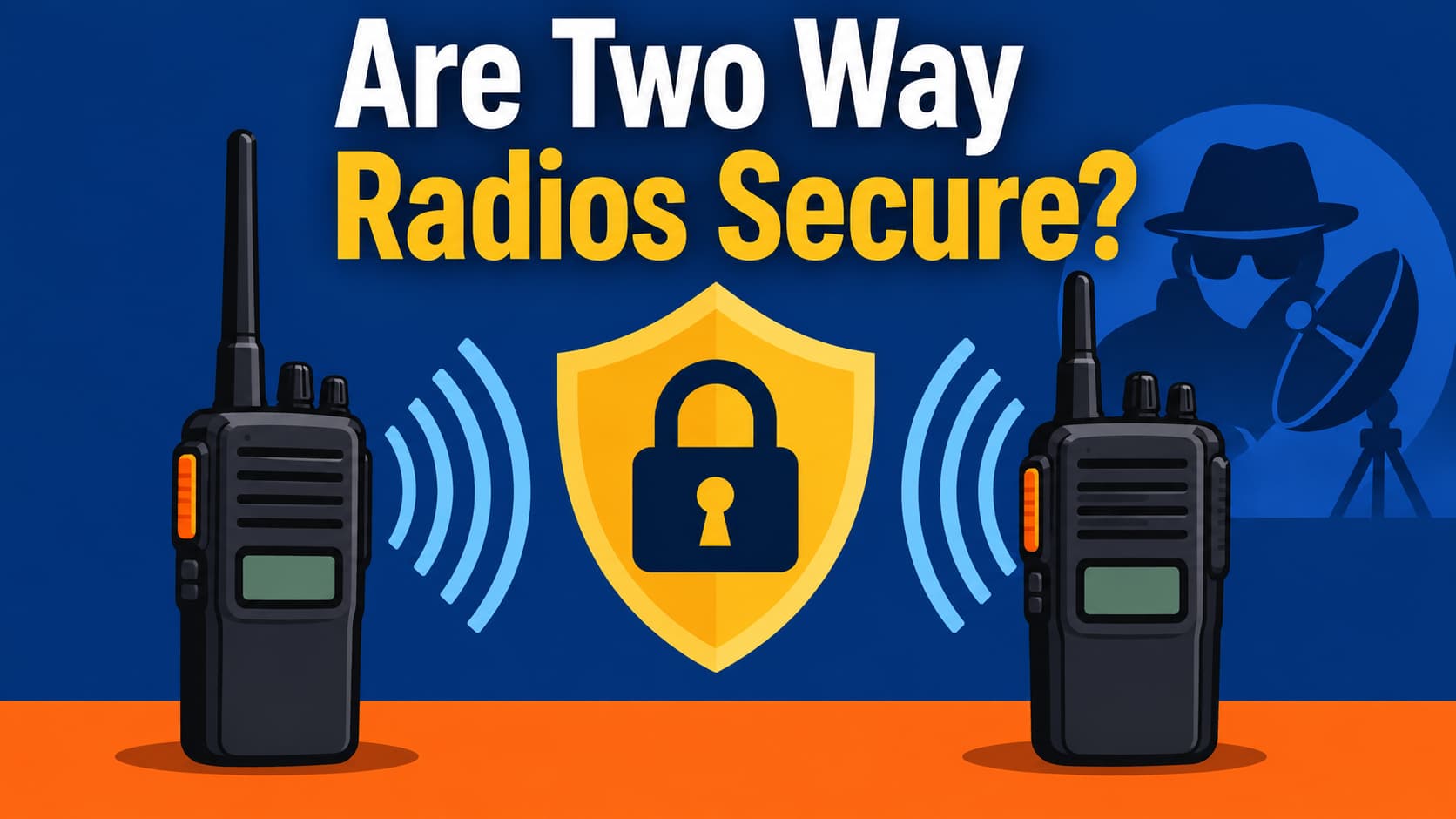
🔐 Many people assume two way radios are either:
- completely private,
- or completely insecure.
Neither is fully true.
The reality is more complicated, and understanding it requires separating:
- analog vs digital radio,
- encryption vs scrambling,
- legality vs capability,
- and casual listening vs professional interception.
As radios become more popular among:
- preparedness communities,
- off-road groups,
- businesses,
- and hobbyists,
questions about radio privacy and interception are becoming increasingly common.
If privacy matters, choose a radio that supports digital DMR operation and configurable privacy features. Always verify what type of encryption or scrambling the radio actually provides.
A practical entry-level DMR radio for users who want both analog and digital operation at an affordable price.
View Baofeng DM-1701 on AmazonA more modern DMR handheld for users who want a larger display, updated controls and more advanced digital-radio features.
View Baofeng DM-32 on Amazon📡 Most Traditional Radios Are Not Private
A standard analog two way radio transmission is usually easy to receive.
Anyone with:
- a scanner,
- another compatible radio,
- or an SDR (software-defined radio)
can potentially listen to nearby transmissions.
This is especially true for:
- FRS radios,
- GMRS radios,
- CB radio,
- and many analog VHF/UHF systems.
That does not mean someone across the country can hear you.
Radio interception is usually local and depends on:
- range,
- antenna quality,
- terrain,
- and frequency access.
But the important point is:
traditional analog radio communication is generally not secure.
The Baofeng DM-1701 is a practical starting point for users moving beyond basic analog radios. It supports DMR digital operation while retaining compatibility with conventional analog channels.
🚨 Privacy Codes Do Not Provide Real Security
One of the biggest misconceptions involves:
- CTCSS tones,
- DCS codes,
- and “privacy channels.”
Manufacturers often market these as:
- privacy features,
- secure channels,
- or interference reduction systems.
In reality, they do not encrypt audio.
They simply prevent radios from opening their speakers unless the correct tone is present.
The transmission itself remains fully receivable by anyone monitoring the frequency.
This surprises many new radio users.
📶 Digital Radios Changed the Landscape
Modern digital radio systems are more sophisticated.
Technologies like:
- Digital Mobile Radio,
- P25,
- NXDN,
- and TETRA
allow: - digital voice encoding,
- networked communication,
- and optional encryption.
Digital systems can be significantly harder to monitor casually compared to analog FM radio.
The Baofeng DM-32 is suited to users who expect digital operation to be a central part of how they use their radio. It combines DMR functionality with analog compatibility and a more modern interface.
- DMR digital operation for compatible simplex and repeater systems
- Analog compatibility for conventional FM channels
- Modern display and controls for easier navigation
- Programmable contacts and talk groups
- Privacy-oriented functions where supported and permitted
🔐 DMR Encryption Exists, But Not All Encryption Is Equal
Many DMR radios support some form of encryption.
However, there are major differences between:
- basic scrambling,
- proprietary obfuscation,
- and strong cryptographic encryption.
Some inexpensive radios advertise:
“encrypted radio”
when they actually use:
- weak XOR masking,
- simple scrambling,
- or vendor-specific obfuscation.
Professional public safety systems may use:
- AES encryption,
- hardware key management,
- and authenticated radio infrastructure.
Those systems are dramatically more secure.
The word “encryption” alone does not tell the whole story.
Configure channels, contacts, talk groups, color codes and supported privacy settings from a computer.
View DMR Programming CablesPrevent people standing nearby from hearing incoming messages through the radio’s built-in speaker.
View Radio Earpieces on Amazon🚔 Police Scanner Legality Is Often Misunderstood
Another area of confusion involves scanner laws.
In many places, listening to unencrypted radio traffic is legal.
This can include:
- aviation,
- marine,
- amateur radio,
- weather broadcasts,
- and some public service communications.
However, laws vary significantly by country and region regarding:
- mobile scanner use,
- intercepted communications,
- and encrypted systems.
In some jurisdictions:
- using scanner information during criminal activity,
- or monitoring restricted communications,
can create serious legal problems.
Many police and emergency systems have also moved toward encrypted digital radio specifically to reduce casual monitoring.
🛰️ Radio Security Depends on the Threat Model
The real question is:
secure against whom?
For example:
- a hiking group using a camping walkie talkie may only care about avoiding casual interference,
- while critical infrastructure operators may require strong encryption against sophisticated interception.
Different use cases require different security levels.
A secure walkie talkie for:
- construction crews,
- event staff,
- or overlanding groups
may look very different from: - military,
- law enforcement,
- or industrial security communication systems.
📡 SDRs Made Radio Monitoring More Accessible
Software-defined radios have changed the interception landscape significantly.
Low-cost SDR hardware now allows hobbyists to:
- monitor wide frequency ranges,
- visualize spectrum activity,
- and decode many radio protocols.
This has made radio monitoring more accessible than ever before.
At the same time, it has also increased awareness about:
- radio security,
- encryption,
- and operational privacy.
🔋 Simplicity Still Matters
Despite all modern digital technology, many organizations still use analog radio systems because they are:
- simple,
- reliable,
- low-latency,
- and interoperable.
In many real-world operations, reliability matters more than secrecy.
That is especially true during:
- emergencies,
- disasters,
- and infrastructure failures.
📻 The Biggest Misunderstanding
The biggest misconception is probably this:
radio communication is not automatically private, but it is not automatically insecure either.
Security depends on:
- technology,
- configuration,
- encryption implementation,
- and operational practices.
A basic analog radio offers little privacy.
A properly implemented encrypted digital system can be extremely difficult to intercept.
The difference between those two worlds is enormous.
For more on radio communication and propagation, see:
Radio communication sits at the intersection of physics, infrastructure, and cybersecurity, and that is exactly why questions about radio privacy continue to grow in the digital age.