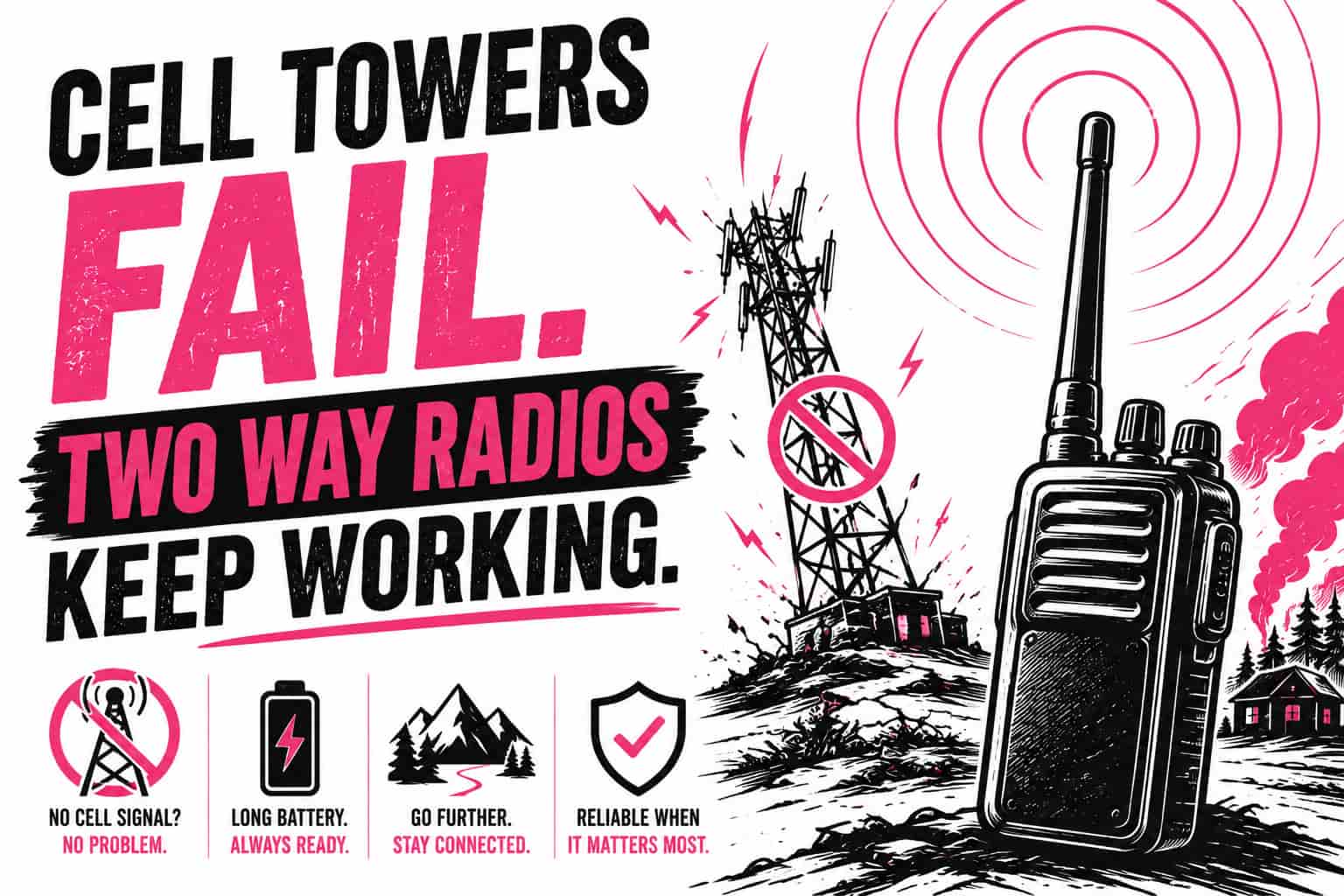
Modern communication feels invisible, until it suddenly disappears.
Most people assume their smartphones will always work. But during major storms, wildfires, power outages, natural disasters, and large public events, cellular networks can become overloaded or fail entirely. When that happens, one of the oldest communication technologies still standing is often the humble two way radio.
Unlike smartphones, two way radios do not depend on:
- cellular towers,
- internet infrastructure,
- subscription networks,
- or cloud services.
They communicate directly.
And that difference matters far more than most people realize.
🚨 Why Cell Networks Fail During Emergencies
Cellular systems are incredibly sophisticated, but they are also highly centralized.
A smartphone call depends on:
- nearby cell towers,
- fiber backhaul,
- switching infrastructure,
- power systems,
- authentication servers,
- and network capacity.
If enough parts of that system fail, communication collapses.
This happens more often than people think:
- hurricanes knocking out towers,
- wildfires damaging infrastructure,
- blackouts disabling backup systems,
- or large crowds overwhelming network capacity.
Even when towers remain online, congestion alone can make mobile communication nearly unusable.
Many people discovered this during:
- natural disasters,
- major sporting events,
- concerts,
- and emergency evacuations.
📻 Two Way Radios Work Differently
Two way radios use direct radio-frequency communication between devices.
There is no need for:
- a cellular provider,
- a SIM card,
- or internet connectivity.
If two radios are within communication range, they can talk instantly using push-to-talk transmission.
That simplicity is exactly why radios remain critical for:
- emergency responders,
- search and rescue teams,
- security staff,
- utility crews,
- and outdoor expeditions.
When infrastructure becomes unreliable, simpler systems often become more resilient.
🌎 Radios Excel in Off-Grid Environments
In remote regions, there may be little or no cellular coverage at all.
This is why:
- hikers,
- campers,
- overlanders,
- hunters,
- and marine operators
still rely heavily on radios.
A properly configured VHF or UHF radio system can provide reliable communication:
- in forests,
- mountains,
- deserts,
- lakes,
- and rural terrain.
In many cases, radios become the only practical communication option.
🛰️ Repeaters Extend Radio Coverage
One reason emergency organizations continue using radio systems is repeaters.
A repeater is a high-elevation radio station that:
- receives signals,
- amplifies them,
- and retransmits them over a much larger area.
With repeaters, handheld radios can communicate:
- across cities,
- mountain ranges,
- or entire regions.
This creates communication networks that remain operational even when public infrastructure struggles.
📶 Not All Radios Are Equal
The effectiveness of a radio system depends on:
- frequency band,
- antenna quality,
- terrain,
- transmit power,
- and repeater access.
VHF Radios
Often perform better:
- outdoors,
- over water,
- and in rural environments.
UHF Radios
Usually work better:
- inside buildings,
- in cities,
- and around dense obstacles.
Understanding the environment matters more than marketing range claims.
Learn more about the VHF Band and how radio propagation affects communication range.
🔋 Why Preparedness Is Driving Renewed Interest
Interest in two way radios has grown significantly in recent years.
People are increasingly concerned about:
- infrastructure resilience,
- emergency preparedness,
- grid instability,
- and communication reliability.
At the same time, affordable handheld radios have become widely available.
Modern radios now offer:
- long battery life,
- compact form factors,
- waterproof designs,
- digital modes,
- and wide-area repeater support.
For many users, radios are becoming a practical backup communication system rather than just a hobby device.
📡 The Bigger Lesson
The lesson is not that smartphones are bad.
Cellular networks are extraordinary engineering systems.
But they are optimized for convenience and scale, not necessarily resilience during infrastructure disruption.
Two way radios represent something different:
- direct communication,
- decentralized operation,
- and infrastructure independence.
And when systems fail, those qualities suddenly become extremely valuable.
For users interested in long-range communication options, see:
Sometimes the oldest technologies survive because they solve a problem modern systems still cannot fully replace.