Ten megahertz is not much room. Yet the 430 to 440 MHz band — universally known among radio operators as the 70-centimetre band, after its approximate wavelength — manages to fit in FM repeater networks, amateur satellites, Earth-Moon-Earth communication, earth exploration radar, high-powered scientific instruments, and an emerging conflict with commercial satellite operators that is still being resolved in regulatory proceedings. For a secondary allocation shared with radiolocation, it carries a remarkable amount of activity.
The allocation: primary versus secondary, and where it varies
The ITU amateur radio allocation is from 430 to 440 MHz, though some countries such as the United States allocate hams the broader 420 to 450 MHz range. Depending on the country, the band is shared with other radio services including government radar systems.
The allocation status varies critically by ITU region. In ITU Regions 2 and 3, the 430 to 440 MHz segment is allocated to the amateur service on a secondary basis — meaning no amateur station may cause harmful interference to, nor claim protection from, radiolocation stations authorised by other nations. In ITU Region 1, covering Europe, Africa, and northern Asia, the amateur service holds co-primary status alongside radiolocation, and the basic principle is equality of right to operate. That distinction matters practically: a European amateur operator has more standing to contest interference from a nearby radar than one in North America or the Asia-Pacific region.
Within the band, the 432 to 438 MHz sub-segment carries a further allocation to the earth exploration satellite service in the active sense — meaning spaceborne synthetic aperture radars and imaging satellites that illuminate the Earth with their own signals and receive the returns. This sub-segment is therefore contested between amateur use, radiolocation, and orbital sensing systems simultaneously.
What amateurs do with it
Amateurs use the 70-centimetre band for FM and digital voice communications through repeaters, as well as narrow-band modes for long-distance communications including Earth-Moon-Earth (EME) work. It is the lowest frequency ham band that can support amateur television transmissions in the United States.
The repeater infrastructure on 70cm is dense in populated regions. Australia alone has over 200 active 70cm repeaters, and the band supports both analogue FM and digital voice modes including D-Star, Yaesu Fusion, and DMR. Channel spacing in most national band plans is 25 kHz, with repeater offsets varying by country — Australia uses a 5 MHz offset for most repeaters, while the UK uses a −1.6 MHz offset, one of the more distinctive conventions in global band planning.
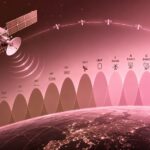
The 435 to 438 MHz sub-band is heavily used for amateur satellites. The OSCAR satellite programme has placed dozens of transponders in orbit over six decades, and the 435 to 438 MHz window functions as the de facto international amateur satellite downlink standard. A typical low-Earth orbit amateur satellite pass lasts six to eight minutes, during which the Doppler shift causes the received frequency to sweep across several kilohertz — a characteristic that experienced operators compensate for manually or with tracking software.
EME communication on 70cm uses the Moon as a passive reflector, with most activity concentrated around the 432 MHz centre frequency using digital modes such as JT65 and Q65, as well as CW. The 432.000 MHz EME calling frequency is globally coordinated. Round-trip path length to the Moon and back is roughly 800,000 kilometres, introducing approximately 2.4 seconds of signal delay and requiring stations with high-gain antennas and sensitive receivers.
The radiolocation incumbents
The primary radiolocation users in this band include high-powered scientific and military radar installations. The former Arecibo Observatory in Puerto Rico operated a 430 MHz incoherent scatter radar of immense power — one of the most sensitive instruments for studying the ionosphere, meteor trails, and near-Earth space. Similar installations at sites including Millstone Hill in Massachusetts and EISCAT facilities in Scandinavia use frequencies within or adjacent to this band for atmospheric research.
High-powered radars in the 420 to 450 MHz range are used in some countries to detect and track earth-orbiting satellites and space debris, including identification of potential hazards to the International Space Station. These systems operate at power levels that dwarf anything an amateur station can produce, and their geographic exclusion zones — enforced through footnotes in the US frequency allocation table — restrict amateur use within hundreds of kilometres of specific military sites.
The ISM layer and a new commercial threat
In ITU Region 1, the 433.050 to 434.790 MHz portion of the band carries an ISM (industrial, scientific, and medical) allocation that in practice hosts a large installed base of short-range devices: remote keyless entry systems, LoRa IoT sensors, temperature transmitters, and consumer remote controls. LPD433 licence-free hand-held radios are authorised for voice communications use in most of Europe within this ISM sub-band, creating a significant interference environment within the amateur allocation even before licensed secondary users are considered.
A more recent and more serious threat has emerged from commercial satellite operators. AST SpaceMobile has deployed satellites designated Bluebird 1 through 5, launched in September 2024, that use spectrum within the 430 to 440 MHz amateur band for telemetry, tracking, and command operations under an FCC authorisation invoking Article 4.4 of the ITU Radio Regulations — a provision that permits non-standard use provided no harmful interference is caused to services operating in accordance with the allocation table. ARRL filed formal opposition, arguing that TT&C operations across a constellation of up to 248 satellites requesting up to five channels of 256 kHz bandwidth each are capable of causing harmful interference to amateur communications including the 435 to 438 MHz satellite sub-band, and that AST has not demonstrated any need for spectrum beyond existing allocations.
The outcome of that proceeding will set a precedent for how secondary amateur allocations are treated as commercial low-Earth orbit constellations proliferate — a question with implications well beyond 70 centimetres.