📡
Frequency
147 MHz
Frequency
147 MHz
🧭
Range
146–148 MHz
Range
146–148 MHz
🧩
Band Group
VHF (30–300 MHz)
Band Group
VHF (30–300 MHz)
🌐 Summary
The 147 MHz allocation is part of the VHF (30–300 MHz) spectrum. This range is used worldwide for critical applications that keep our communications and infrastructure running smoothly. On this page we highlight how each band is applied in real systems, from regulatory assignments to everyday devices. Our goal is to make spectrum data clear and practical for engineers, regulators, and enthusiasts alike.
Key uses of this band include: 147 MHz: 2 m Amateur; Amateur radios, repeaters, satellites.
2‑meter amateur (Region 2 extension to 148 MHz); FM repeaters and simplex activity.
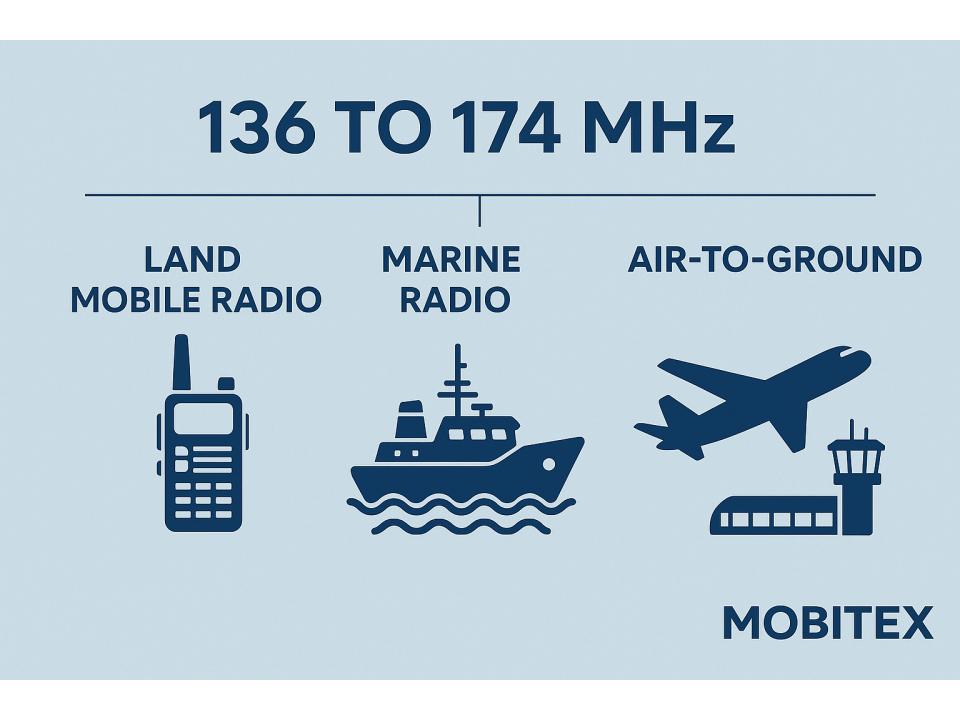
🔍 Explore the full RF Spectrum database
📡 Band & Geometry key
| Field | Value |
|---|---|
| Wavelength (m) | 2.041 |
| Waveforms | – |
| Antenna Form Factor (Typical) | ¼-wave ≈ 51.0 cm |
| Band Family | Amateur/CB |
| Band | 2 m Amateur (R2/R3); Land mobile (R1) |
| Primary Common Name | 2 m Amateur (R2/R3); Land mobile (R1) |
| FSPL @ 1 km [dB] | 75.786346694963 |
| FSPL @ 10 km [dB] | 95.786346694963 |
| Fresnel Radius @ 1 km (m) | 22.587034990451 |
| Band Group | VHF (30–300 MHz) |
| Tax Band Family | VHF |
| Tax Band Class | VHF Band |
🧩 Applications & Usage
| Field | Value |
|---|---|
| Primary Application | – |
| Lower Neighbor Use | 2 m Amateur Band (R1 core) |
| Upper Neighbor Use | Land mobile / Fixed (VHF high) |
| Typical Services Devices | 2 m Amateur |
| Market Common Devices | Amateur radios, repeaters, satellites |
| Refarming Use | No |
| Device Ecosystem Size | Medium |
| Device Hotspots (MHz) | 147 |
| Device Category | Specialized Industrial / Scientific Equipment |
| Typical Use Cases | – |
| Modulation (Device) | Varies by device |
| Channel Width (Device) [kHz] | Varies |
| Device Region Profiles | Varies by country / allocation |
| Per-Region EIRP Or Duty (Device) | Varies by regulation |
| Allocation Relevance (Device) | Medium |
| Adjacent-Band Collision Risks (Device) | Low–Moderate |
| Example Devices Or Skus | Specialized Industrial / Scientific Equipment |
| Common Protocols | Amateur (FM/SSB); APRS/Packet (regional); Analog FM (12.5 kHz); DMR; P25 (region); TETRA (region) |
🗒️ Notes
| Field | Value |
|---|---|
| Receiver Selectivity Notes | – |
| Interference Notes | Shared borders with MetSat/land mobile; satellite sub-bands |
| Compatibility Risk Notes | ≤10 MHz from Aeronautical VHF (Airband) |
| Notes | 2‑meter amateur (Region 2 extension to 148 MHz); FM repeaters and simplex activity. |
| Propagation Notes | Strong coverage, good indoor penetration |
⚙️ Technical Rules
| Field | Value |
|---|---|
| Lower Band Frequency Limit | 146 |
| Upper Band Frequency Limit | 148 |
| EIRP Indoor Limits | Licensed amateur |
| EIRP Outdoor Limits | Licensed amateur |
| PSD Limit | — |
| Emission Mask Class | Amateur service |
| Guardband Minimum [kHz] | 12.5 |
| Typical Bandwidths | 2.7 kHz SSB, 12.5 kHz FM |
| Autocalculated Bandlimits | No |
| Typical Bandwidths (Estimated) | 2.7 kHz SSB, 12.5 kHz FM |
| Max EIRP [dBm] | Varies by regulation |
| Power Source Or Duty Profile (Typical) | – |
| Channelization Plan | – |
| Channelization | – |
| Guard Band Requirement | – |
| OOB Emission Limit [dBm/MHz] | -13 (baseline) |
| Spurious Emission Limit (dBm) | -30 (baseline) |
| RX Blocking Min [dBm] | -15 (planning) |
| Duplexing | Half-duplex |
| Duplexing Information | Repeater offset ±600 kHz |
| Uplink Pairing | – |
| Downlink Pairing | – |
| Paired Band Info | – |
| Max EIRP [dBm] | – |
| Channelization Block Size | Varies (CW/SSB/Repeater splits) |
| 3GPP Band Number | |
| Example 3GPP Bands | – |
| LTE Uplink Bands | – |
| LTE Downlink Bands | – |
| NR Uplink Bands | – |
| NR Downlink Bands | – |
| Guard Bands | Voluntary |
| Protocol Or Standard | – |
🌎 Country Overrides
| Field | Value |
|---|---|
| Tax Service Category | Other / Various |
| Tax License Type | Licensed / Service-Specific |
| Tax Regions | Global / Varies |
| ITU Region 1 | Land mobile |
| ITU Region 2 | Amateur |
| ITU Region 3 | Amateur |
| License Type | Land mobile / Fixed service (licensed, often public safety/commercial) |
| Primary Application | – |
| Primary Services | – |
| Spurious Emission [dBm] | -30 (baseline) |
| Lower Neighbor Use | 2 m Amateur Band (R1 core) |
| Upper Neighbor Use | Land mobile / Fixed (VHF high) |
| Licensing Model | Licensed (Amateur) |
| Typical Services Devices | 2 m Amateur |
| US FCC Alloc | Amateur 2 m (Part 97)– |
| CA IC Alloc | Amateur 2 m– |
| UK Ofcom Alloc | Amateur 2 m (144–146 primary)– |
| US Ref | – |
| Typical Bandwidths | 2.7 kHz SSB, 12.5 kHz FM |
| Market Licensing Model | Licensed (Amateur) |
| Market Common Devices | Amateur radios, repeaters, satellites |
| Fresnel Radius (1st, 1 km) [m] | 22.587034990451 |
| Typical Bandwidths (Estimated) | 2.7 kHz SSB, 12.5 kHz FM |
| Auction Status | – |
| Refarming Use | No |
| Typical Site Spacing km | 5 / 30 |
| Device Ecosystem Size | Medium |
| Traffic Load Share | Coverage-heavy, low capacity share |
| Device Hotspots (MHz) | 147 |
| Device Category | Specialized Industrial / Scientific Equipment |
| Typical Use Cases | – |
| Typical Center Frequencies [MHz] | – |
| Rule Part (Fcc Or Region) | – |
| Modulation (Device) | Varies by device |
| Channel Width (Device) [kHz] | Varies |
| Device Region Profiles | Varies by country / allocation |
| Per-Region EIRP Or Duty (Device) | Varies by regulation |
| Allocation Relevance (Device) | Medium |
| Adjacent-Band Collision Risks (Device) | Low–Moderate |
| Example Devices Or Skus | Specialized Industrial / Scientific Equipment |
| Antenna Form Factor (Typical) | ¼-wave ≈ 51.0 cm |
| Power Source Or Duty Profile (Typical) | – |
🛡️ Regulatory & Neighbors
| Field | Value |
|---|---|
| Lower Band Frequency Limit | 146 |
| Upper Band Frequency Limit | 148 |
| Rx Blocking Min dBm | -15 (planning) |
| Lower Neighbor Use | 2 m Amateur Band (R1 core) |
| Upper Neighbor Use | Land mobile / Fixed (VHF high) |
| Lower Neighbor Band | 2 m Amateur Band (R1 core) |
| Lower Neighbor Range | 144.000–146.000 MHz |
| Upper Neighbor Label | Land mobile / Fixed (VHF high) |
| Upper Neighbor Range | 149.000–174.000 MHz |
| Adjacent-Band Collision Risks (Device) | Low–Moderate |
| Real-World Range (Indoor/Outdoor) | – |
| US FCC Alloc | Amateur 2 m (Part 97)Amateur 2 m (Part 97) |
| CA IC Alloc | Amateur 2 mAmateur 2 m |
| UK Ofcom Alloc | Amateur 2 m (144–146 primary)Amateur 2 m (144–146 primary) |
| Regulatory References | US: -; CA: -; UK: – |
| Global Harmonization | Regional |
| Crossborder Coordination | High |
| Sharing Mechanism | – |
| Auction Status | – |
| Guard Or Pair | – |
📈 Market & Measurements
| Field | Value |
|---|---|
| Noise Floor | -105 dBm (est.) |
| Interference Cases | – |
| Lower Neighbor Range | 144.000–146.000 MHz |
| Upper Neighbor Range | 149.000–174.000 MHz |
| Interference Notes | Shared borders with MetSat/land mobile; satellite sub-bands |
| Market Licensing Model | Licensed (Amateur) |
| Market Commercial Value | Specialized |
| Market Common Devices | Amateur radios, repeaters, satellites |
| Market Deployment Density | Medium urban repeaters |
| Noise Floor (Estimated) | -105 dBm (est.) |
| Market Commercial Value (Estimated) | Specialized |
| Ecosystem Maturity | Emerging |
| Indoor Penetration | Good |
| Known Interference | No major interference issues noted |
| Device Ecosystem Size | Medium |
| Real-World Range (Indoor/Outdoor) | – |
| Antenna Form Factor (Typical) | ¼-wave ≈ 51.0 cm |
| Ecosystem Maturity | Emerging |
| Device Ecosystem Size | Medium |
| Chipset Availability | Limited / TBD |
| Operator Deployments | Limited operators |
| Technology Generations Deployed | Multiple / TBD |
| Roaming Support | – |
| Traffic Load Share | Coverage-heavy, low capacity share |
| Indoor Penetration | Good |
| Known Interference | No major interference issues noted |
| Occupancy | Medium |
| Occupancy Bucket Pct | 10–30% |
| Latency Profile | – |
| Common Channels Or Profiles | – |
| Security Features | – |
| Lbt Or Fhss Requirement | – |
| Popularity (Installed Base) | – |
| Coexistence Tips | – |
| Latency Class | – |
| Device Hotspots (Scoped && Tagged) | – |