Mobitex contains affiliate links and is a member of the Amazon Services LLC Associates Program. If you make a purchase using one of these links, we may receive compensation at no extra cost to you. This helps support our research, testing and writing.
The Rocky Talkie Mountain Radio is a purpose-built FRS (Family Radio Service) two-way radio designed from the ground up for backcountry use. Founded in 2019 in Colorado by longtime friends and backcountry adventurers Bryce Jones and Alex Page, Rocky Talkie entered the radio market after the two founders could not find a radio that actually worked well in the mountains — reliable in cold temperatures, durable enough to survive real alpine conditions, light enough to carry without thinking about it, and simple enough to operate with gloves on.
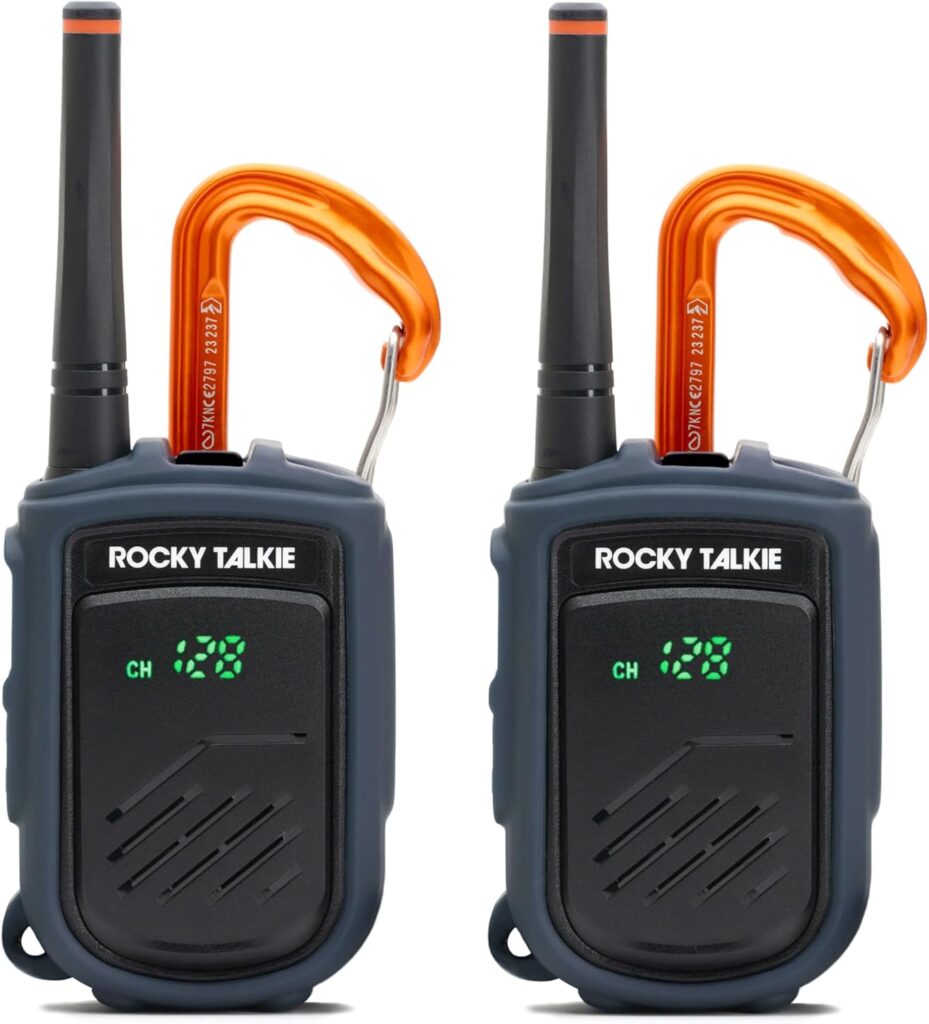
The Mountain Radio has become the company’s flagship product and has won multiple industry awards. It is consistently cited by OutdoorGearLab, GearJunkie, and Road Trail Run as among the best FRS radios available for backcountry, climbing, skiing, and wilderness use. At approximately $110 per unit, it sits at the premium end of the FRS category — but the comparison set it belongs to is not $30 blister-pack walkie-talkies. It competes with dedicated backcountry communication tools, and in that context the price is defensible.
Licensing
The Rocky Talkie Mountain Radio is an FRS radio. No licence is required to operate it in the United States or Canada. It transmits at 2 watts — the maximum power permitted for FRS use without a licence. It is interoperable with all other FRS-certified radios including Midland, Cobra, Motorola, and Retevis FRS models on the 22 standard FRS channels.
Rocky Talkie also produces the Expedition Radio — a 5-watt GMRS version that requires an FCC GMRS licence ($35, 10 years, covers immediate family). The Mountain Radio and Expedition Radio are interoperable.
Full Specifications
| Specification | Value |
|---|---|
| Model | Mountain Radio |
| Manufacturer | Rocky Talkie (Colorado, USA) |
| Radio service | FRS (Family Radio Service) |
| Licence required | No |
| Transmit power | 2 watts (FRS maximum) |
| Channels | 128 (22 standard FRS + additional privacy code combinations) |
| Standard FRS channels | 22 |
| Privacy codes | Yes — quick access via button hold |
| Power settings | High (H) and Low (L) per channel |
| Claimed max range | 35+ miles (line of sight, open terrain) |
| Typical backcountry range | 1 to 5 miles |
| Battery type | Rechargeable lithium-ion (1550–1800 mAh depending on production run) |
| Battery life (claimed) | 3 to 5 days typical use |
| Battery life (independent testing) | 4 to 5 days moderate use (40–70°F); shorter in extreme cold |
| Operating temperature | -20°F to 120°F (-29°C to 49°C) |
| Charging | USB-C direct charge |
| Battery replaceable | Yes — user-replaceable in field |
| Display | Shatterproof LED screen (channel number, battery %, lock icon) |
| Waterproof rating | IP56 (splash and snow resistant; not submersible) |
| Antenna | Fixed 3-inch (non-removable) |
| Attachment system | Integrated carabiner point + backup leash |
| Carabiner | Trango climbing-rated carabiner included |
| Weight (radio only) | 6.1 oz (173 g) |
| Weight (with leash) | 7.9 oz (224 g) |
| Dimensions | 6.5 × 2.5 × 1.6 inches (165 × 64 × 41 mm) |
| Housing | Thermoplastic with rubber protective covering |
| NOAA weather | No (Mountain Radio) |
| VOX | No |
| Keypad lock | Yes — hold channel forward 2 seconds |
| Scan | Yes — hold channel back 2 seconds |
| Waterproof hand mic | Optional accessory (sold separately) |
| FRS interoperability | Full — compatible with all standard FRS radios |
| Expedition Radio interoperability | Yes |
| Warranty | 3 years (personal use); 1 year (commercial use) |
| Origin | Designed, built, and tested in the Colorado Rockies |
- Designed for outdoor and alpine environments
- Heavy-duty protective housing
- Rechargeable long-life battery
- Simple glove-friendly controls
Key Features
Designed for the Backcountry — Not Adapted for It
Most FRS radios are designed for light commercial or recreational use and adapted for outdoors with a weather-resistant coating and a rugged-looking housing. The Mountain Radio was designed from the outset for alpine environments: cold temperatures, gloved hands, carabiner attachment to a harness or pack, and multi-day use without access to power. Every design decision reflects this focus. The five-button interface has no menu system to navigate. The shatterproof screen shows only what you need — channel and battery level. The attachment system uses a climbing-rated carabiner rather than a plastic belt clip.
Cold Weather Battery Performance
Lithium-ion batteries lose capacity rapidly in cold temperatures. Most radios that claim strong battery life in their specifications perform significantly worse below freezing. The Mountain Radio’s lithium-ion pack is specifically optimised for cold performance, and independent testing confirms that it performs well below 0°F — a temperature range where most consumer FRS radios either fail entirely or require frequent recharging.
TalkieWaves’ six-month multi-environment test found the battery lasted 4 to 5 days at moderate temperatures (40–70°F) and remained functional at temperatures well below freezing. The Believe in the Run review noted that after a camping trip where the radios were accidentally left on overnight, they still had charge remaining the next morning. OutdoorGearLab identified the Mountain Radio as one of the better-performing options for battery life in their comparative testing. Using the low-power channel setting extends battery life by approximately 20% compared to high-power channels.
Shatterproof LED Screen
Conventional radio displays are glass or thin plastic — vulnerable to the drops and impacts that are inevitable in any serious backcountry use. The Mountain Radio uses a shatterproof LED screen confirmed by multiple independent testers to survive drops that destroyed the screens of competing radios. Believe in the Run noted initial concern about the screen which was resolved after testing. OutdoorGearLab confirmed it as one of the radio’s strongest durability attributes.
Carabiner and Backup Leash System
The integrated carabiner attachment point, combined with a Trango climbing-rated carabiner included in the box, allows the radio to clip directly to a harness chest loop, backpack shoulder strap, or gear loop — the same attachment points climbers use for actual climbing hardware. A metal-reinforced backup leash connects the radio to a secondary anchor point, preventing loss if the carabiner is accidentally unclipped. This system is categorically more secure than any plastic belt clip on any conventional radio. For big wall climbing, ski mountaineering, and any activity where dropping a radio is operationally serious, the attachment system is a genuine design advantage.
Five-Button Interface
Power (hold 2 seconds), channel forward, channel back, PTT, and call. That is the entire operating interface. There is no volume knob to accidentally bump. There are no menus to navigate. Channel lock engages by holding the channel forward button for two seconds and disengages the same way. Every function is accessible with gloves on. The simplicity is deliberate and is consistently praised by reviewers as appropriate for the target use case.
USB-C Charging with Replaceable Battery
USB-C direct charging means the radio can be recharged from any USB-C power source — laptop, power bank, vehicle adapter, or solar panel. The battery is also user-replaceable in the field without tools, which addresses the one practical limitation of rechargeable-only radios for very long expeditions.
IP56 Water Resistance
IP56 means complete dust protection and resistance to water projected from any direction — heavy rain, snow, splashing, and direct water jets. It is not submersible — the Mountain Radio should not be dropped in water or used in whitewater. For the majority of backcountry conditions including rain, snow, and condensation, IP56 is adequate. Users who need full submersion protection should consider the Expedition Radio (IP67) or the Retevis RB48 (IP67).
What Customers Think
Customer feedback is drawn from OutdoorGearLab’s comparative testing, GearJunkie’s field review, Road Trail Run’s extended assessment, Believe in the Run, TalkieWaves’ six-month multi-environment test, the Rocky Talkie product page, and Amazon verified purchaser reviews.
What Customers Praise
Audio clarity is the most consistently praised attribute across every independent review source. OutdoorGearLab described calls as “clear, easy-to-understand every time.” GearJunkie noted audio quality noticeably cleaner than typical FRS radios, with less static. Road Trail Run confirmed “great range and strong reception.” The clarity is attributed to the 2-watt power ceiling — the Mountain Radio uses every watt FRS allows — combined with good antenna design and microphone hardware. Multiple reviewers who previously used budget FRS radios describe the Mountain Radio’s audio as a significant step forward.
Battery life in cold conditions stands out as a defining performance differentiator. Backcountry users who have destroyed or been let down by cheaper radios in freezing conditions describe the Mountain Radio as the first radio they have trusted in genuine alpine conditions. GearJunkie’s reviewer, testing in consistently below-freezing conditions, described the radios as “gladiators against poor treatment and environments.” Multiple reviews mention the battery lasting through multi-day expeditions without recharging, including a week-long ski expedition in Alaska documented by OutdoorGearLab’s testing team.
The carabiner and leash system receives praise from climbers, mountaineers, and any user who has lost a radio or had a belt clip fail. The attachment system is described as meaningfully more secure than any clip alternative, and the climbing-rated carabiner is noted as appropriate for the user base.
Simplicity of operation is valued highly by reviewers who use the radio in conditions where cognitive load is already high. The five-button interface, no menu navigation, and instant channel lock are consistently praised as correct design choices for the target environment. Road Trail Run described it as “totally tactile and easy to use.”
Build quality and durability is confirmed by multiple reviewers who describe the radio surviving drops, impacts, and harsh weather that would damage competing products. The thermoplastic housing and shatterproof screen are specifically mentioned. One Rocky Talkie product page review from a prescribed burn crew describes a radio being dropped into a fire — which the reviewer notes as a reason they appreciate the backup leash.
Range in mountainous terrain is described as among the best available for an FRS radio. OutdoorGearLab confirmed range comparable to top-performing FRS competitors in their comparison testing. Road Trail Run and Believe in the Run both report reliable communication at 1 to 3 miles in complex terrain with trees and rock faces.
The lightweight form factor is noted positively by trail runners, climbers, and backpackers for whom every ounce matters. At 6.1 oz, the Mountain Radio is lighter than most competing FRS radios while being more durable than all of them at the price point.
What Customers Criticise
The channel button can be accidentally bumped. Road Trail Run specifically flags this — the side channel buttons are easy to inadvertently change while the radio is clipped to a pack or harness, particularly when loading or adjusting gear. The fix is engaging the channel lock (hold forward 2 seconds), which the radio strongly encourages. But the lock step is an extra action that less experienced users may not know or remember to take. This is described consistently as a minor annoyance rather than a serious flaw.
No NOAA weather channels on the Mountain Radio. The Expedition Radio includes NOAA weather alerts; the Mountain Radio does not. For multi-day backcountry trips where weather monitoring is a safety consideration, this is a meaningful feature gap. Reviewers who need NOAA access should consider the Expedition Radio or supplement the Mountain Radio with a dedicated weather radio.
No VOX (voice-activated transmission). The Mountain Radio requires a deliberate PTT button press for every transmission. For some activities — particularly skiing or cycling where both hands are occupied — VOX would be preferable. The optional waterproof hand mic accessory partially addresses this by moving the PTT to a wired mic, but built-in VOX is absent.
The fixed antenna cannot be upgraded. Unlike the Expedition Radio, which accepts a longer 17cm antenna for extended range, the Mountain Radio’s antenna is non-removable. Range is what it is — no hardware upgrade path exists.
The price per unit is the most common purchase barrier. At $110 per radio, a pair costs $200. OutdoorGearLab acknowledges this directly while concluding the price is appropriate for what the radio delivers. Buyers comparing against $30 to $60 FRS radios need to understand they are comparing different categories of product — the Mountain Radio is genuinely more durable, more capable in cold, and better tested than anything at that price point. But for casual weekend use in mild weather, a cheaper FRS radio is a reasonable alternative.
The microphone captures background noise clearly — almost too well. OutdoorGearLab noted that gear noise (clanking carabiners, jacket rustling) can transmit alongside voice. This is an acceptable trade-off for microphone sensitivity in a high-noise outdoor environment, but users should be aware that the microphone is sensitive.
Overall Sentiment
The Rocky Talkie Mountain Radio has earned an unusually strong reputation in the backcountry community, and the consistency of positive feedback across independent review sources — OutdoorGearLab, GearJunkie, Road Trail Run, and GearJunkie — is notable. The radio has been adopted by climbers, mountaineers, search and rescue volunteers, backcountry skiers, trail runners, and prescribed burn crews, all of whom report it performing reliably in conditions that have killed cheaper radios. The core promise — a radio that actually works in the mountains, survives real conditions, and lasts for days — appears to be consistently delivered.
Rocky Talkie Mountain Radio vs Expedition Radio
| Feature | Mountain Radio | Expedition Radio |
|---|---|---|
| Radio service | FRS | GMRS |
| Licence required | No | Yes ($35, FCC GMRS) |
| Transmit power | 2W | 5W |
| Waterproof rating | IP56 | IP67 |
| NOAA weather | No | Yes |
| Repeater capable | No | Yes |
| Antenna | Fixed | Interchangeable (7.5cm + 17cm included) |
| Battery | 1550–1800 mAh | 1800 mAh |
| Battery life | 3–5 days | 4–6 days |
| Weight | 6.1 oz | Heavier |
| Price (single) | $109.95 | $179.95 |
The Mountain Radio is the right choice for users who do not want the complexity or cost of a GMRS licence, primarily use the radio at relatively short distances in complex terrain, and want the lightest possible option. The Expedition Radio is the right choice for users who need maximum range, NOAA weather monitoring, repeater network access, or full waterproofing for whitewater or submersion risk.
Who the Mountain Radio Is Suited For
The Mountain Radio is a strong fit for:
- Rock climbers and mountaineers who need a radio that clips to a harness and survives alpine conditions
- Backcountry skiers and ski mountaineers operating across multi-day trips in cold environments
- Trail runners and backpackers who need reliable communication with minimal weight and no configuration
- Wilderness guides and SAR teams who need a radio that works without setup and survives field abuse
- Any user whose primary concern is cold weather reliability and durability over a multi-day period
It is less suited for:
- Users who need NOAA weather monitoring — consider the Expedition Radio
- Users who want to access GMRS repeater networks for extended range
- Deployments near water where submersion is a real risk — the Expedition Radio (IP67) is more appropriate
- Buyers who need a large fleet at lower per-unit cost — the price per unit is high relative to standard FRS alternatives
Package Contents
| Item | Qty |
|---|---|
| Mountain Radio | 1 |
| Rechargeable lithium-ion battery | 1 |
| Trango climbing-rated carabiner | 1 |
| Metal-reinforced backup leash | 1 |
| USB-C charging cable | 1 |
| User manual | 1 |