One of the most common questions people ask before buying a handheld radio is simple:
📡 How far will it reach?
The answer is almost always more complicated than the number printed on the box.
Many consumer walkie talkies advertise ranges of:
- 20 miles,
- 30 miles,
- or even 50 miles.
In reality, most handheld two way radios rarely achieve those distances in normal everyday conditions. The true range of a radio depends far more on physics and environment than on marketing.
Radio Range Depends on Line of Sight
The biggest factor affecting two way radio range is line of sight.
Most VHF and UHF radios communicate using frequencies that travel primarily in straight lines. If hills, buildings, forests, or terrain block the signal path, range drops quickly.
In perfect conditions:
- two radios on mountain tops may communicate for dozens of miles,
- while the same radios in a dense city may struggle to reach a few kilometres.
This is why advertised range numbers can be misleading. Manufacturers often test radios:
- at high elevation,
- with clear open terrain,
- and with minimal interference.
That rarely reflects real-world use.
Urban vs Rural Range
In Cities
Buildings, concrete, metal structures, and electrical noise absorb and reflect radio signals.
Typical handheld radio range in urban environments:
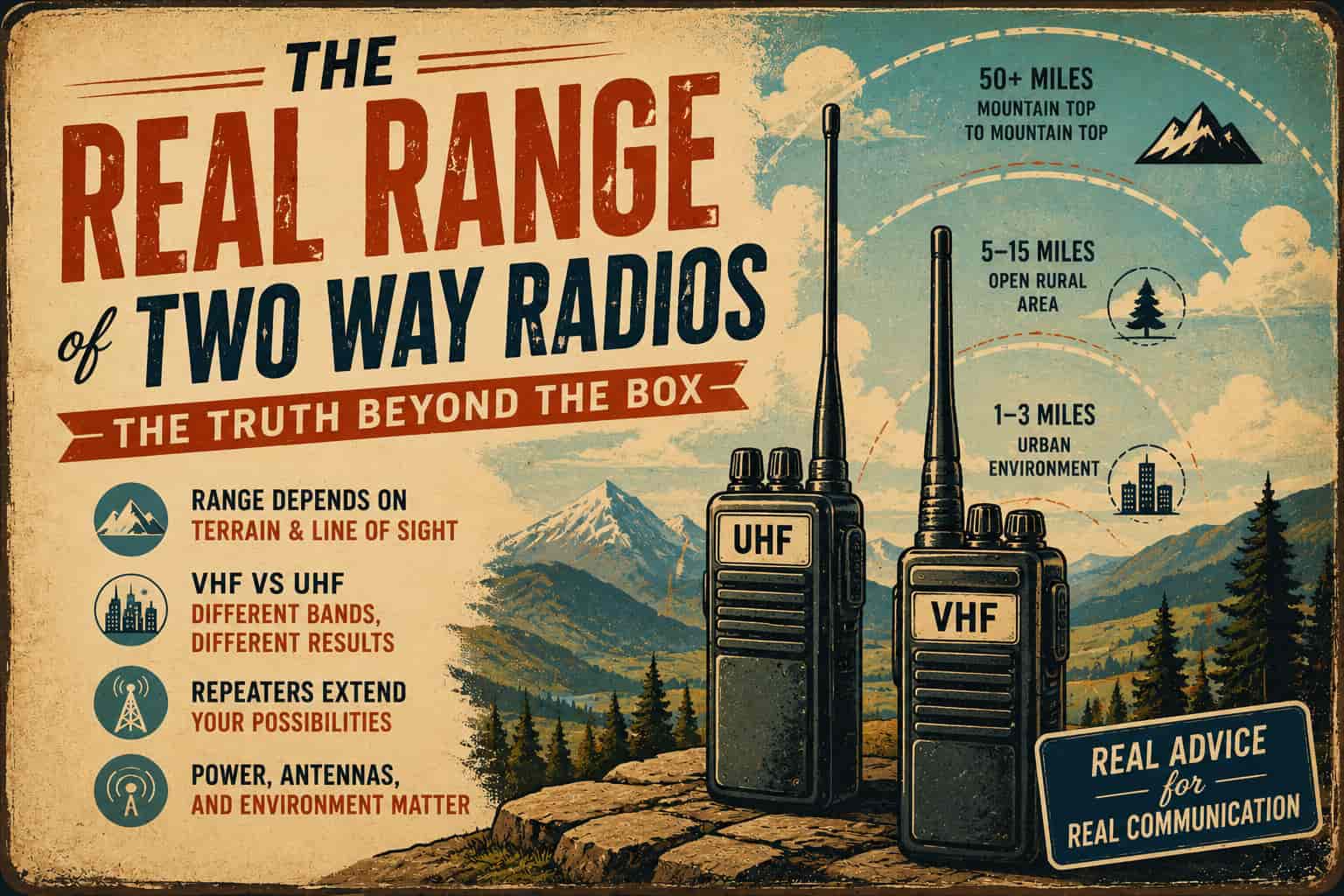
- 1 to 3 miles
- sometimes less indoors.
In Rural Areas
Open terrain dramatically improves propagation.
In countryside or desert environments:
- 5 to 15 miles is often realistic,
- especially with elevation advantage.
VHF vs UHF Range
The frequency band also matters.
VHF Radios
VHF signals generally travel farther outdoors and perform well in:
- forests,
- lakes,
- farms,
- and open terrain.
UHF Radios
UHF signals penetrate buildings better and are preferred in:
- cities,
- warehouses,
- schools,
- hospitals,
- and industrial sites.
Neither is universally “better.” The environment determines which performs best.
Learn more about the Radio frequency engineering characteristics of the VHF band and UHF communication systems.
Power Matters, But Less Than People Think
Many buyers assume:
more watts = massively more range.
But radio propagation does not work linearly.
Doubling transmitter power does not double communication distance.
A higher-powered radio may improve:
- signal reliability,
- penetration,
- and fringe coverage,
but terrain and antenna quality usually matter more.
A good antenna on a hill can outperform a high-power radio inside a building.
Repeaters Change Everything
The biggest range improvement often comes from using a repeater.
A repeater is a high-elevation radio system that:
- receives weak signals,
- retransmits them,
- and dramatically extends coverage.
With repeaters, handheld radios can communicate:
- across entire cities,
- mountain regions,
- or hundreds of kilometres through linked networks.
This is how:
- amateur radio systems,
- emergency responders,
- and commercial radio operators
achieve wide-area communication.
Weather Usually Is Not the Main Problem
Despite popular belief, rain and snow usually have only modest effects on VHF/UHF handheld radios.
Terrain is almost always more important than weather.
The biggest enemies of radio range are:
- hills,
- buildings,
- dense urban clutter,
- and poor antenna placement.
Handheld vs Vehicle Radios
Vehicle-mounted radios typically outperform handheld units because they use:
- larger antennas,
- better grounding,
- and higher transmit power.
A mobile radio installed in a truck can often communicate much farther than a handheld radio using the same frequency band.
So What Is a Realistic Range?
Typical real-world handheld radio expectations:
| Environment | Typical Range |
|---|---|
| Dense urban area | 1–3 miles |
| Suburban area | 3–8 miles |
| Open rural terrain | 5–15+ miles |
| Mountain top to mountain top | 20–50+ miles |
The key point:
the environment matters more than the number on the packaging.
Choosing a Long-Range Radio
If range matters, focus on:
- antenna quality,
- terrain,
- repeater compatibility,
- battery life,
- and radio durability.
Not just advertised mileage claims.
For recommendations, see these guides on:
Understanding the real limits of radio propagation helps separate realistic expectations from marketing hype, and ultimately helps you choose the right communication system for your environment.