🌊 Out on the water, communication is not just convenience.
It is survival equipment.
Every year, marine VHF radios help coordinate:
- rescues,
- distress calls,
- collision avoidance,
- weather alerts,
- and emergency response operations
across oceans, lakes, rivers, and coastal waterways.
Even in the age of smartphones and satellite internet, the marine VHF radio remains one of the most important safety systems on a boat.
And there is a reason the United States Coast Guard still depends heavily on them.
📡 What Is a Marine VHF Radio?
A marine VHF radio is a specialized two way radio system designed for:
- boat communication,
- maritime safety,
- and emergency coordination.
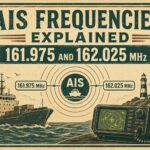
These radios operate in the marine VHF band, primarily around:
- 156–162 MHz.
Unlike mobile phones, marine radios communicate directly:
- boat-to-boat,
- boat-to-shore,
- and boat-to-rescue services.
They do not depend on:
- cellular towers,
- internet connectivity,
- or subscription infrastructure.
That independence is critical at sea.
🚨 Why Phones Are Not Enough on the Water
Many people assume a smartphone is sufficient for boating emergencies.
But marine environments create serious communication problems:
- limited cellular coverage,
- severe weather,
- battery drain,
- saltwater exposure,
- and long distances from shore.
Even near populated coastlines, cellular coverage can become unreliable surprisingly quickly.
A marine VHF radio is specifically engineered for these conditions.
Most units are:
- waterproof,
- high-powered,
- designed for outdoor visibility,
- and optimized for long-range open-water communication.
🛰️ Channel 16 Is the Global Distress Frequency
One reason marine radios save lives so effectively is standardized emergency monitoring.
Marine VHF radios use:
- Channel 16 (156.8 MHz)
as the international distress, safety, and calling frequency.
This channel is continuously monitored by:
- the Coast Guard,
- commercial vessels,
- marinas,
- and many nearby boats.
In an emergency, a distress call on Channel 16 can immediately alert:
- rescue authorities,
- nearby vessels,
- and maritime traffic in the area.
That creates a decentralized emergency communication system where help may come from multiple directions simultaneously.
🚤 Nearby Boats Often Become the First Responders
One overlooked advantage of marine radios:
the closest help is often another boat.
A VHF distress call can instantly reach:
- fishing boats,
- sailboats,
- ferries,
- harbor traffic,
- and nearby recreational vessels.
In many emergencies:
- another vessel arrives long before official rescue services.
This dramatically improves survival chances during:
- engine failures,
- fires,
- flooding,
- medical emergencies,
- or man-overboard incidents.
📶 Open Water Is Excellent for VHF Propagation
Marine VHF radio works especially well because water provides excellent radio propagation conditions.
With proper antennas, boat communication range can often reach:
- 20–30 miles,
- or much farther from elevated vessels or shore stations.
Large ships and coastal repeaters can extend coverage even more.
Learn more about the VHF Band and how radio propagation affects marine communication.
🚨 DSC Radios Add Digital Distress Signaling
Modern emergency marine radio systems increasingly use:
Digital Selective Calling technology.
A DSC radio can:
- automatically transmit distress alerts,
- include vessel identity,
- and often send GPS coordinates
with the press of a single emergency button.
This significantly speeds up rescue coordination.
Instead of relying only on voice communication, rescuers immediately receive:
- who is in trouble,
- and where they are located.
Many modern Coast Guard radio systems integrate directly with DSC distress networks.
🔋 Radios Continue Working When Other Systems Fail
Marine radios are valued because they are:
- simple,
- reliable,
- low-latency,
- and infrastructure-independent.
Even during:
- storms,
- power outages,
- or network disruptions,
VHF communication often remains operational.
That resilience is exactly why professional maritime operations still rely heavily on radio systems.
🌊 The Most Important Safety Device Many Boaters Underestimate
Many recreational boaters spend heavily on:
- navigation electronics,
- sonar,
- engines,
- and displays.
But one of the most important safety tools onboard may still be the radio.
A properly installed marine VHF radio can:
- summon help,
- coordinate rescues,
- receive weather alerts,
- avoid collisions,
- and maintain communication when other systems fail.
At sea, reliable communication is not optional.
It is part of the survival system itself.
For more on radio communication and propagation, see:
Long before smartphones existed, marine radios were saving lives on the water, and despite all modern communication technology, they still do.