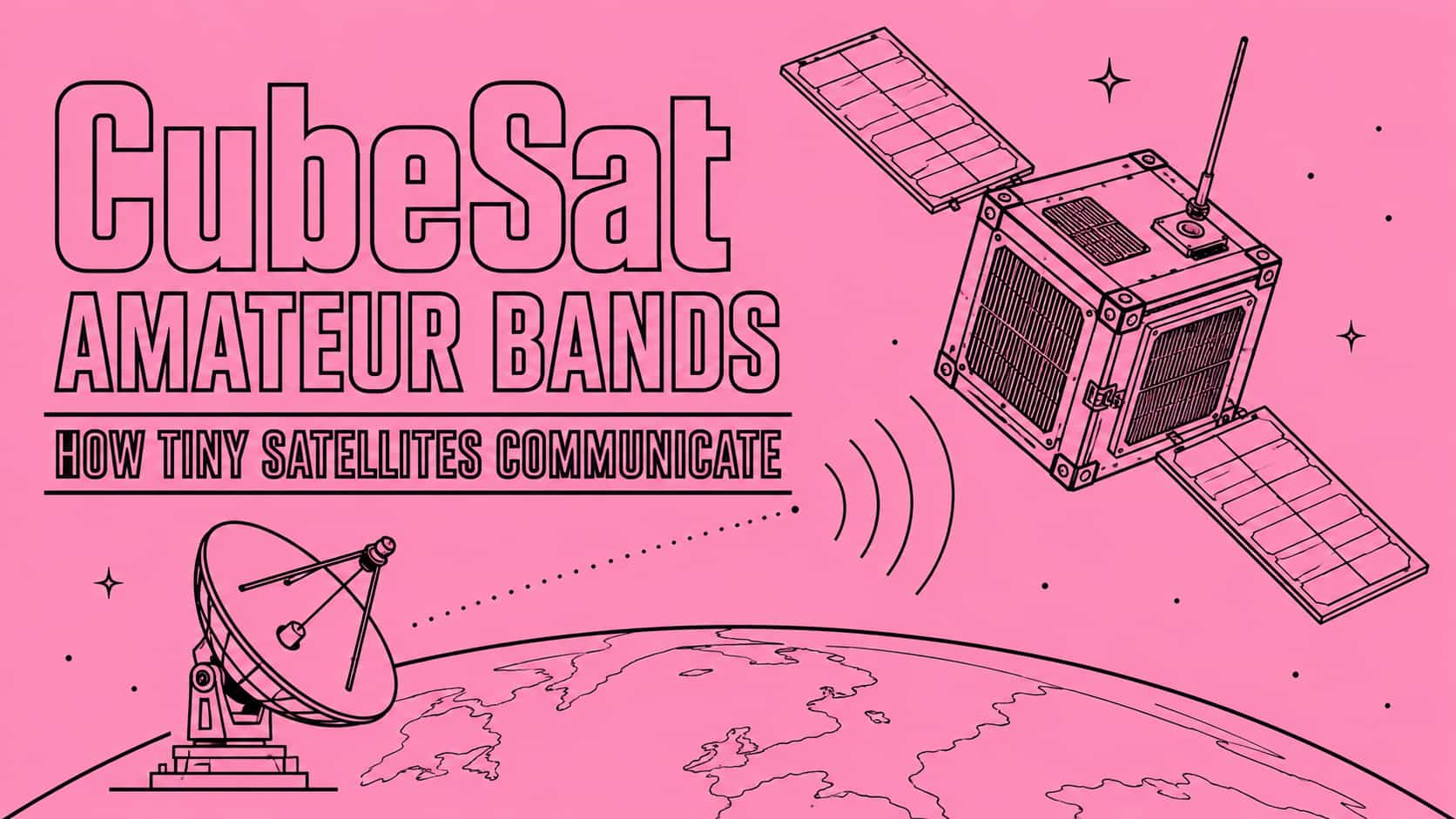
Tiny satellites no larger than a loaf of bread are now orbiting Earth by the hundreds. Universities launch them. Amateur radio groups build them. Startups test technology on them. Some weigh barely over a kilogram. Yet despite their size, they still face the same engineering problem every spacecraft has always faced:
How do you communicate with something moving 28,000 kilometres per hour hundreds of kilometres above Earth?
The answer lies in the amateur satellite bands, specialized portions of radio spectrum allocated internationally for non-commercial space communications. These bands quietly power one of the most important revolutions in modern space engineering: the rise of CubeSats.
What Is a CubeSat?
A CubeSat is a miniature satellite built around a standardized modular format.
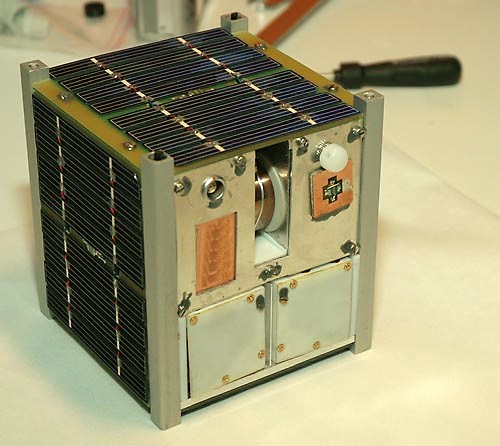
The original standard defined a “1U” CubeSat as:
- 10 × 10 × 10 cm
- About 1–2 kg
Larger versions stack units together:
| CubeSat Type | Approximate Size |
|---|---|
| 1U | 10 × 10 × 10 cm |
| 3U | 10 × 10 × 34 cm |
| 6U | 20 × 10 × 34 cm |
| 12U | Larger modular configurations |
CubeSats dramatically reduced the cost of space access.
Before CubeSats, satellites typically required:
- Large aerospace contractors
- Dedicated launches
- Multi-million-dollar budgets
CubeSats allowed universities and small organizations to launch spacecraft for tens or hundreds of thousands of dollars instead.
🌍 Why Amateur Radio Bands Matter
Most CubeSats cannot afford expensive commercial satellite communications systems.
Instead, many use amateur satellite allocations coordinated through the International Amateur Radio Union (IARU).
These bands allow:
- Telemetry downlinks
- Command uplinks
- Educational experiments
- Digital messaging
- Amateur radio payloads
Without these allocations, the CubeSat revolution would have developed much more slowly.
Common CubeSat Amateur Bands
VHF Amateur Satellite Band
| Frequency Range | Common Use |
|---|---|
| 145.8–146.0 MHz | Telemetry downlinks |
| 145 MHz region | APRS and packet systems |
VHF signals propagate well and are relatively easy to receive with modest antennas.
Many early CubeSats used VHF because of its simplicity and reliability.
UHF Amateur Satellite Band
| Frequency Range | Common Use |
|---|---|
| 435–438 MHz | CubeSat downlinks and uplinks |
This is probably the most heavily used CubeSat amateur allocation today.
Advantages include:
- Smaller antennas
- Better Doppler tolerance
- Compact satellite integration
- Mature amateur radio hardware ecosystem
Many CubeSat telemetry beacons operate around 437 MHz.
S-Band CubeSat Frequencies
| Frequency Range | Common Use |
|---|---|
| 2.4 GHz amateur satellite allocations | Higher-rate telemetry |
| 2.2–2.3 GHz | Experimental payloads |
As CubeSat missions became more sophisticated, VHF and UHF data rates became limiting.
S-band allows:
- Faster downloads
- Image transmission
- Scientific payload data
- SDR-based communications
The tradeoff is increased complexity and tighter antenna pointing requirements.
X-Band and Beyond
More advanced CubeSats increasingly use:
- X-band
- Ka-band
- Optical communications
These frequencies support much higher throughput but require:
- More power
- Better pointing accuracy
- More sophisticated RF systems
- Larger ground stations
For many educational CubeSats, amateur VHF/UHF remains the practical choice.
How CubeSats Actually Communicate
A CubeSat communication system is surprisingly simple in principle.
The satellite carries:
- A radio transceiver
- A small antenna
- A power amplifier
- A flight computer
Ground stations use directional antennas to track the satellite as it passes overhead.
Typical communication windows last:
- 5–15 minutes per orbit
Because most CubeSats operate in low Earth orbit (LEO), they move rapidly across the sky.
🌎 Ground Stations
CubeSat ground stations range from professional installations to hobbyist setups.
A typical amateur CubeSat station may include:
- Yagi antennas
- Azimuth/elevation rotators
- Low-noise amplifiers
- SDR receivers
- Tracking software
Many satellites are tracked by volunteer radio amateurs worldwide.
This distributed listening network became one of the defining characteristics of CubeSat culture.
📉 The Doppler Shift Problem
One major challenge is Doppler shift.
A CubeSat moving toward Earth compresses its transmitted frequency upward.
Moving away stretches it downward.
At UHF frequencies, the Doppler shift can be several kilohertz.
Ground stations therefore continuously retune during each satellite pass.
Modern SDR software automates much of this process.
Common CubeSat Modulation Modes
CubeSats use many digital radio protocols, including:
- AX.25 packet radio
- GMSK
- BPSK
- LoRa
- FSK telemetry
- SDR-based waveforms
Many educational satellites intentionally use simple protocols so amateur operators can decode telemetry.
Why Tiny Satellites Use Amateur Frequencies
The amateur allocations provide something enormously valuable:
Open infrastructure.
Universities and small teams can:
- Coordinate frequencies
- Use existing ground station ecosystems
- Receive community support
- Avoid expensive commercial licensing
This dramatically lowers barriers to entry.
A student-built CubeSat can communicate with Earth using hardware assembled from commercial amateur-radio components.
⚠️ Spectrum Congestion Is Becoming Serious
CubeSat growth has created increasing pressure on amateur satellite spectrum.
There are now:
- Hundreds of active CubeSats
- Thousands planned
- Growing commercial smallsat constellations
The problem is especially severe around:
- 435–438 MHz
- 145 MHz satellite segments
Collisions in frequency coordination are becoming more common.
Some critics argue that commercial operators increasingly exploit amateur allocations without contributing meaningfully to amateur radio experimentation.
Interference Challenges
CubeSat communications face several RF problems:
Weak Signal Levels
CubeSat transmitters are tiny.
Typical transmit powers may be:
- 100 mW
- 500 mW
- A few watts at most
Signals arriving at Earth can be extremely weak.
Urban RF Noise
Modern cities generate enormous RF noise floors from:
- Switching power supplies
- LED lighting
- Consumer electronics
- Cellular systems
Weak satellite signals can easily disappear into urban interference.
Antenna Constraints
CubeSats are physically tiny.
That limits:
- Antenna size
- Antenna gain
- Power budgets
Deployable antennas often become one of the most failure-prone spacecraft systems.
LoRa in Space
One of the most interesting recent developments is the use of LoRa modulation in CubeSats.
LoRa’s extreme sensitivity allows:
- Very low-power space links
- Small antennas
- Simpler ground stations
Several experimental satellites have successfully demonstrated LoRa telemetry from orbit.
This connects the CubeSat world with the same low-power networking ecosystem behind Meshtastic and LoRaWAN.
Educational Impact
CubeSats transformed aerospace education.
Students can now:
- Design spacecraft
- Build flight hardware
- Operate real satellites
- Analyze orbital telemetry
The entire lifecycle of a space mission became accessible at university scale.
That may ultimately matter more than the satellites themselves.
The Bigger Significance
CubeSat amateur bands represent something unusual in modern infrastructure:
An open-access pathway into space engineering.
Most modern communications systems are increasingly centralized:
- Cellular networks
- Satellite megaconstellations
- Cloud infrastructure
- Licensed spectrum
CubeSat amateur radio remains comparatively decentralized and accessible.
A small university lab, amateur radio group, or even a motivated hobbyist team can still build a spacecraft and communicate with it using globally shared spectrum.
That openness helped create an entire generation of aerospace engineers.
Tiny satellites communicating over obscure amateur radio frequencies may seem niche. But they quietly changed who gets to participate in space technology.