Meshtastic is one of the most interesting radio networking projects to emerge from the maker and SDR communities in years. At first glance it looks simple: small battery-powered devices sending text messages over LoRa radio. But underneath that simplicity is something much more significant, a decentralized long-range communications network that operates without cellular towers, internet infrastructure, or subscription fees.
The frequencies Meshtastic uses are central to how the system works. They determine range, legality, interference levels, antenna size, and even how resilient a network can become during disasters or infrastructure outages.
What Is Meshtastic?
Meshtastic is an open-source mesh networking platform built primarily on LoRa radio technology.
Each node acts as both:
- A radio transceiver
- A network relay
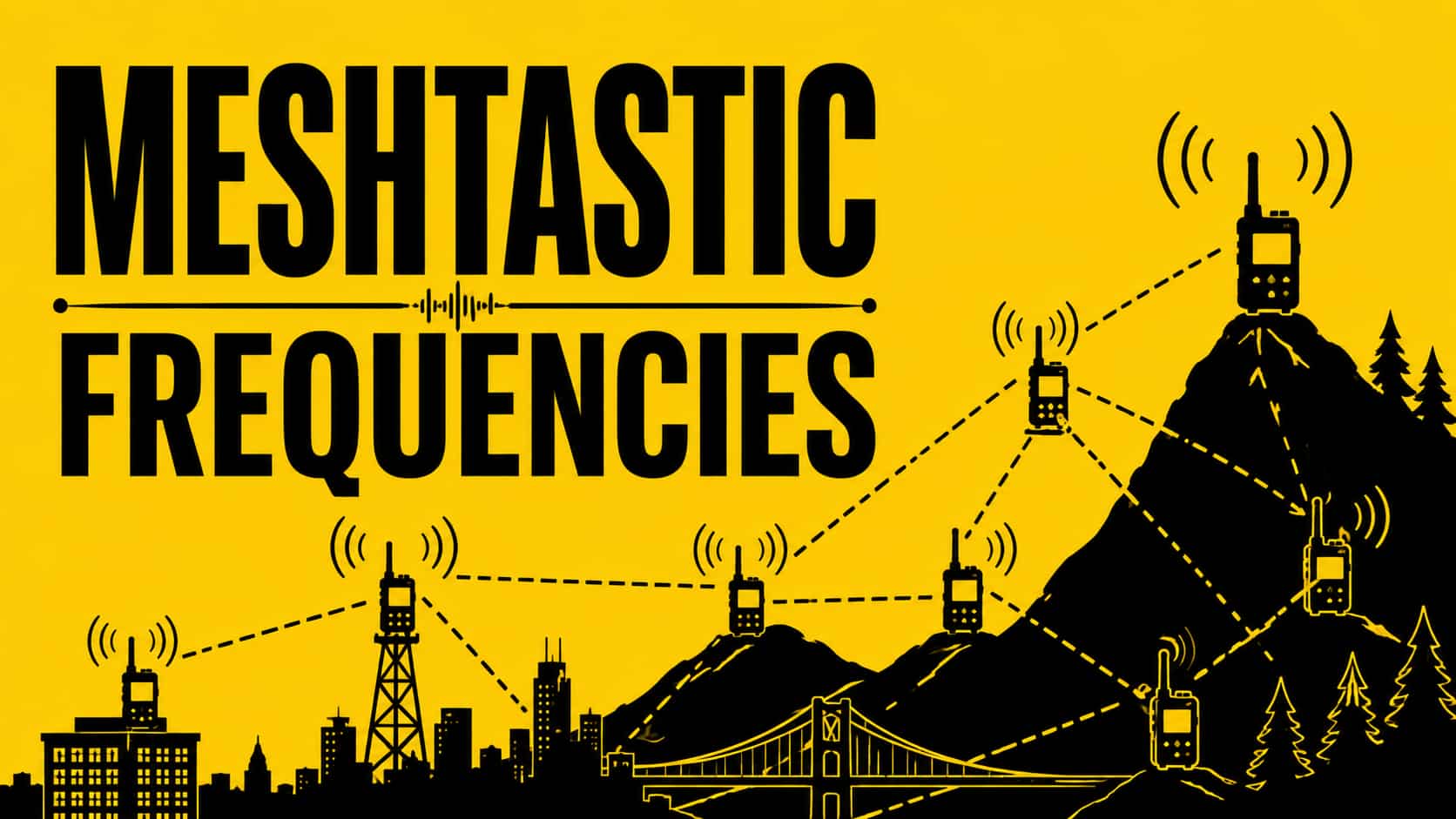
Instead of communicating through a central tower, nodes forward messages between each other across a distributed mesh.
A single node might only reach a few kilometres directly, but chained together across hills, rooftops, or cities, the network can cover extremely large areas.
The system supports:
- Text messaging
- GPS position sharing
- Telemetry
- Sensor data
- Emergency communications
Most Meshtastic devices pair with smartphones over Bluetooth, turning a phone into an off-grid messaging terminal.
🌍 Meshtastic Frequency Bands
Meshtastic operates in license-free ISM (Industrial, Scientific, and Medical) radio bands. The exact frequencies vary by region because different countries allocate different spectrum for low-power unlicensed devices.
The most common deployments today use the 915 MHz and 868 MHz bands, but globally the ecosystem is much more fragmented.
🌐 Meshtastic Frequencies by Country
| Country / Region | Common Meshtastic Frequencies | Notes |
|---|---|---|
| United States | 902–928 MHz | Most common Meshtastic deployment region |
| Canada | 902–928 MHz | Same ISM allocation as US |
| Mexico | 902–928 MHz | North American LoRa profile |
| Brazil | 902–928 MHz | Increasing LoRa adoption |
| Argentina | 902–928 MHz | Regional variations exist |
| Europe (most countries) | 863–870 MHz | EU868 profile |
| United Kingdom | 863–870 MHz | Post-Brexit still aligned with EU ISM usage |
| Germany | 863–870 MHz | Dense urban mesh experimentation |
| France | 863–870 MHz | Strict duty-cycle limits |
| Italy | 863–870 MHz | Common LoRaWAN coexistence |
| Spain | 863–870 MHz | EU868 deployments |
| Netherlands | 863–870 MHz | Strong hobbyist community |
| Sweden | 863–870 MHz | Long-range rural experiments |
| Norway | 863–870 MHz | Mountain relay deployments |
| Poland | 863–870 MHz | Growing mesh adoption |
| Ukraine | 863–870 MHz | High resilience interest |
| India | 865–867 MHz | Narrow ISM allocation |
| Japan | 920.8–927.8 MHz | Dedicated JP regional profile |
| South Korea | 920–923 MHz | Korean LoRa allocation |
| Taiwan | 920–925 MHz | TW profile |
| Thailand | 920–925 MHz | Rapidly growing community |
| Singapore | 920–925 MHz | SG_923 commonly used |
| Indonesia | 920–925 MHz | Often uses SG_923 profile |
| Malaysia | 919–923 MHz | Regional variations |
| Philippines | 915–918 MHz | Varies by implementation |
| Vietnam | 920–923 MHz | Emerging LoRa ecosystem |
| Australia | 915–928 MHz | AU915 profile |
| New Zealand | 915–928 MHz | Similar to Australia |
| China | 470–510 MHz | Very different from Western ISM allocations |
| Russia | 433 MHz / 868 MHz | Regional variation |
| Worldwide experimental use | 433 MHz | Longer wavelength, larger antennas |
Why These Frequencies Matter
The frequencies Meshtastic uses are a compromise between several competing factors:
- Range
- Antenna size
- Power consumption
- Data rate
- Obstacle penetration
- Legal transmit limits
Lower frequencies generally travel farther and penetrate buildings better, but require larger antennas and narrower bandwidths.
Higher frequencies allow smaller antennas and potentially higher throughput, but suffer greater attenuation.
The sub-GHz ISM bands hit a practical middle ground that makes long-range low-power networking possible.
LoRa Modulation
Meshtastic relies on LoRa (Long Range) modulation developed by Semtech.
LoRa uses chirp spread spectrum modulation, which spreads signals across bandwidth in a way that makes them:
- Extremely sensitive
- Resistant to noise
- Detectable below the noise floor
This is why tiny battery-powered devices with small antennas can sometimes communicate over tens or even hundreds of kilometres under ideal conditions.
The tradeoff is very low data rate.
Meshtastic is not designed for voice, video, or internet traffic. It is optimized for resilient low-bandwidth messaging.
Real-World Range
Meshtastic range depends heavily on terrain and antenna placement.
Typical Range Examples
| Environment | Approximate Range |
|---|---|
| Dense urban | 1–5 km |
| Suburban | 5–15 km |
| Rural line-of-sight | 20–80 km |
| Mountain-top relay | 100+ km possible |
Elevation matters enormously.
A Meshtastic node mounted on a tall building or mountain can dramatically extend mesh coverage.
This has led many hobbyists to deploy permanent solar-powered relay nodes on rooftops and hilltops.
Why Asia Is Becoming Important for Meshtastic
Asia has become one of the fastest-growing Meshtastic regions because several conditions align well with mesh networking:
- Dense cities
- Strong electronics ecosystems
- Technical hobbyist communities
- Disaster resilience concerns
- High-rise relay opportunities
Countries like Japan, Taiwan, Indonesia, and Thailand now have active Meshtastic communities.
China is especially interesting because its 470 MHz allocations produce different propagation characteristics than the 868/915 MHz systems common elsewhere.
The lower frequency provides:
- Better obstacle penetration
- Longer wavelength propagation
- Potentially longer urban range
- Larger antenna requirements
This makes Chinese Meshtastic hardware and tuning strategies noticeably different from Western deployments.
⚠️ Interference and Spectrum Congestion
Meshtastic shares spectrum with many other devices because the ISM bands are unlicensed.
Potential interference sources include:
- LoRaWAN networks
- ISM telemetry systems
- Remote sensors
- Smart meters
- Industrial monitoring equipment
- Other Meshtastic users
The 915 MHz ISM band in particular has become increasingly crowded.
Unlike licensed radio systems, no one controls who transmits.
That creates a classic tragedy-of-the-commons problem where network density eventually begins reducing reliability.
📉 Duty Cycle and Legal Limits
Most countries impose restrictions on ISM-band operation.
These may include:
- Maximum transmit power
- Duty cycle limits
- Channel bandwidth restrictions
- Spurious emission limits
European 868 MHz operation is especially constrained by duty-cycle rules, often limiting transmitters to 1% airtime or less.
That makes network design important. A dense mesh with excessive retransmissions can quickly approach legal transmission limits.
Urban RF Challenges
Cities create difficult RF environments for Meshtastic.
Challenges include:
- Multipath reflections
- Building attenuation
- RF noise
- Interference from nearby electronics
- Antenna placement limitations
Modern buildings with metalized glass often block sub-GHz signals surprisingly well.
Urban deployments therefore benefit heavily from elevated relay nodes.
🔒 Security and Encryption
Meshtastic supports encrypted messaging channels using AES encryption.
However, the network is not anonymous.
Metadata such as:
- Node IDs
- Timing
- RF direction
- Network topology
can still reveal useful information to observers.
Like many mesh systems, Meshtastic prioritizes resiliency and simplicity over sophisticated anonymity protections.
Emergency Communications
One reason Meshtastic gained significant attention is disaster resilience.
Traditional communications infrastructure is centralized:
- Cell towers
- Internet backbones
- Power grids
- Fibre networks
Mesh systems distribute communications across many independent nodes.
That creates resilience against:
- Power outages
- Infrastructure damage
- Remote-area isolation
- Network congestion
Meshtastic cannot replace public safety radio systems, but it can provide low-cost local communications during outages.
Meshtastic vs Traditional Amateur Radio
Meshtastic overlaps culturally with amateur radio, but differs technically and legally.
Amateur Radio
- Licensed operators
- Higher transmit powers
- Larger spectrum access
- Voice and digital modes
- Regulatory oversight
Meshtastic
- Unlicensed ISM operation
- Lower power
- Simpler hardware
- Smartphone-first design
- Encrypted operation permitted
That last point matters because encryption is prohibited on most amateur radio bands but allowed in ISM bands.
🌐 The Bigger Significance
Meshtastic is part of a broader shift in communications architecture.
For decades, wireless networking moved toward centralization:
- Cellular networks
- Cloud infrastructure
- Satellite internet
- Carrier-managed systems
Meshtastic moves in the opposite direction.
It demonstrates that modern radios are now cheap and efficient enough to support decentralized communications infrastructure built by users themselves.
The bandwidth is tiny compared to modern internet systems. But bandwidth is not always the point.
Sometimes resilience matters more than speed.
That is why small LoRa radios operating in obscure ISM bands have become one of the most important grassroots wireless experiments currently happening in the RF world.