Mobitex contains affiliate links and is a member of the Amazon Services LLC Associates Program. If you make a purchase using one of these links, we may receive compensation at no extra cost to you. This helps support our research, testing and writing.
The Baofeng UV-5G Pro and UV-5G Plus occupy an interesting position in the GMRS market. Both are upgrades to the original UV-5G, both sell for well under $50, and both are aimed at outdoor enthusiasts, preppers, and families who want more than a basic FRS walkie-talkie without paying for a dedicated amateur radio setup. But they take meaningfully different approaches to the upgrade, and choosing between them comes down to what you actually need from a handheld radio.
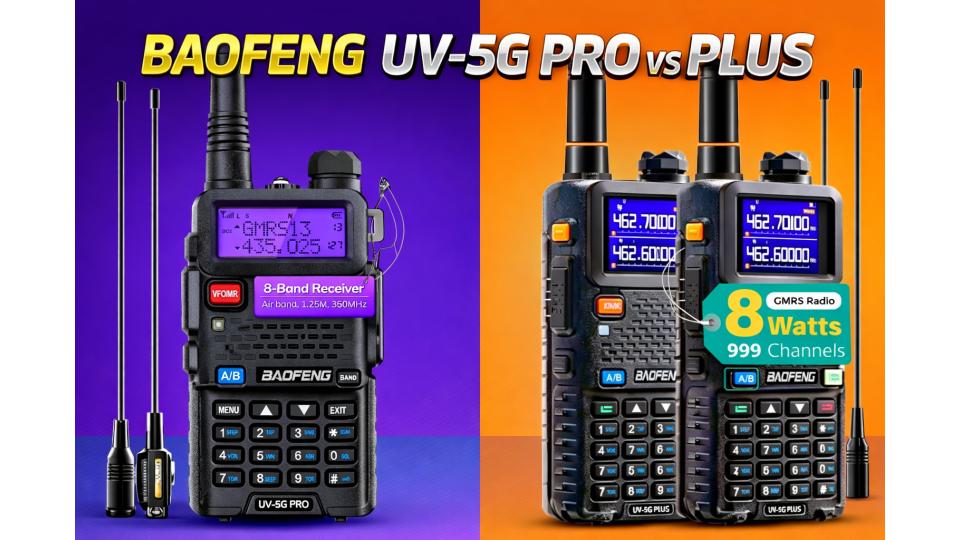
🏆 UV-5G Pro vs UV-5G Plus: Quick Recommendation
Both radios are capable GMRS handhelds, but they target slightly different users.
- Choose the UV-5G Pro if you want the classic UV-5R-style form factor, expanded receive coverage, and a familiar interface backed by a large user community.
- Choose the UV-5G Plus if you prefer a larger color display, USB-C charging, more memory channels, and a more modern feature set.
Our Take: The UV-5G Pro is the better choice for users who value the traditional Baofeng experience and broad receive capabilities. The UV-5G Plus is the better pick if you want a newer design with a larger screen and upgraded usability features.
The UV-5G Pro adds receiver versatility, covering eight bands including airband, while keeping the familiar form factor and channel count of the original. The UV-5G Plus trades some of that receiver breadth for a substantially larger battery, a better display, nearly eight times the memory channels, and wireless frequency copy. Neither radio is perfect, but they are not really competing for the same buyer.
What These Radios Are and Are Not
Both the UV-5G Pro and UV-5G Plus are GMRS radios, not amateur radio transceivers. GMRS operation in the United States requires an FCC licence (currently $35 for a ten-year family licence, no examination required), but no licence is needed simply to receive or listen. Both radios are repeater capable, meaning they can work through GMRS repeaters to dramatically extend their range. Neither radio is legal for amateur radio use, though the UV-5G Plus’s extended frequency coverage makes it useful as a scanner for VHF and UHF receive.
Baofeng UV-5G Pro
A feature-packed GMRS handheld with modern USB-C charging, NOAA weather support, repeater capability, and upgraded firmware features. Excellent for off-grid communication, road trips, emergency preparedness, and beginner GMRS users.
- GMRS + NOAA weather channels
- USB-C rechargeable battery
- Repeater support
- Long range external antenna support
- Strong value for beginners
Frequency Coverage and Receive Bands
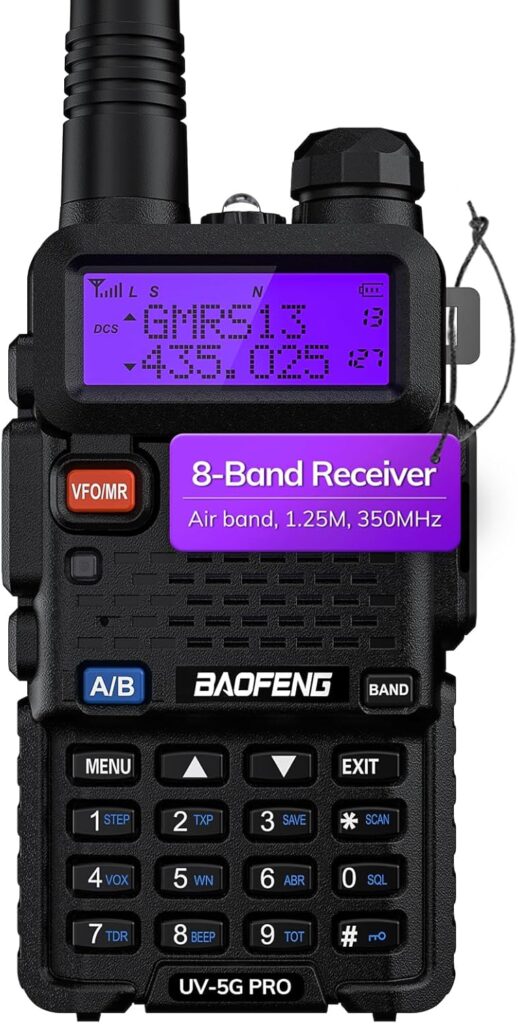
The UV-5G Pro’s headline feature is its eight-band receive capability. It covers FM broadcast (65–108 MHz), the AM aviation band (108–136 MHz), VHF (136–174 MHz), the 1.25m band (220–260 MHz), an additional UHF segment (350–390 MHz), and the main GMRS/UHF band (400–520 MHz), alongside NOAA weather and GMRS channels. Airband receive is the standout feature: reception is receive-only at 108–136 MHz, but users near airports report clear reception of tower and approach communications. The breadth of receive coverage is genuinely impressive for a radio at this price.
Baofeng UV-5G Plus
An upgraded GMRS radio with expanded functionality, stronger audio performance, modern charging support, and compatibility with common GMRS accessories and antennas.
- Enhanced speaker audio
- USB-C charging support
- GMRS repeater capable
- Wide accessory compatibility
- Excellent value for field use
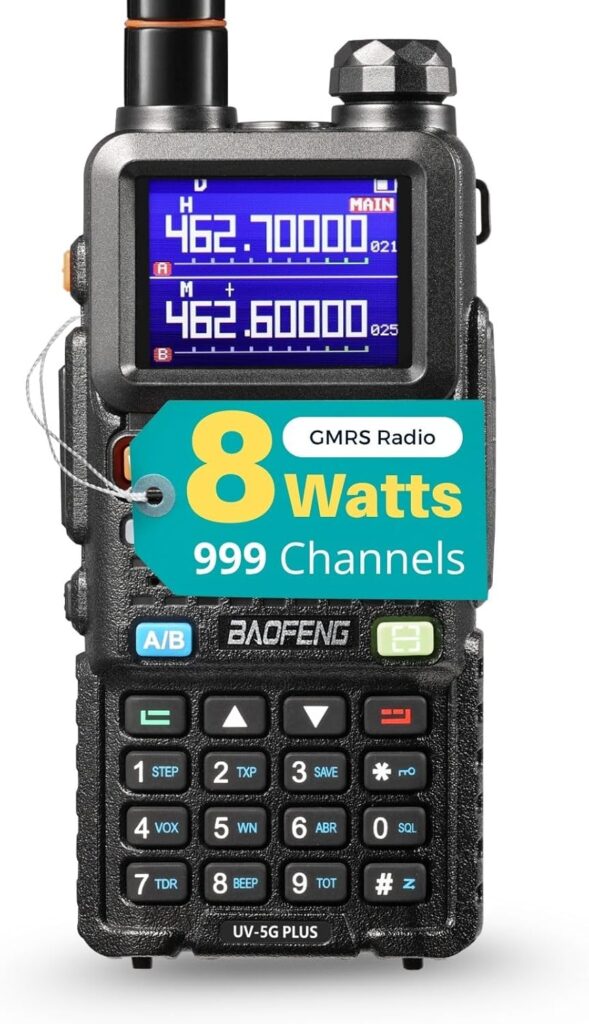
The UV-5G Plus covers GMRS, UHF, VHF, FM broadcast, and NOAA for receive. It does not include airband or the 1.25m band. What it gives up in receive range it makes up for in transmit capability, delivering true 8W power output for extended range and stronger signals in open or urban areas, compared to the UV-5G Pro’s 5W maximum.
For most GMRS users, the difference in receive coverage is less important than transmit power. But for anyone who wants to monitor aviation communications, track weather across multiple bands, or use the radio as a versatile scanner in addition to a transceiver, the UV-5G Pro’s eight-band receive is a meaningful advantage.
Display and Ergonomics
The UV-5G Pro retains the monochrome LCD display of the original UV-5G family. It is functional and readable in most conditions, but it is showing its age against the competition. It is the same basic display format that Baofeng has used across the UV-5R family for over a decade.
The UV-5G Plus makes a more significant leap. It features a 1.9-inch LCD screen that displays frequency, channel number, and current transmit power mode, with a dual watch and dual display layout for easy monitoring and operation. The larger screen is noticeably easier to read, particularly for users who wear glasses or operate the radio in low light. Like most budget colour displays it can wash out in very bright direct sunlight, but this is the norm across the category.
The UV-5G Plus is taller, wider, and heavier than its predecessor and is about the same height as the UV-5R with an extended battery pack fitted. The UV-5G Pro maintains a more compact profile closer to the original UV-5G. If size and weight in a jacket pocket matter to you, the Pro has the edge.
Battery and Charging
This is where the difference between the two radios is most practically significant. The UV-5G Pro ships with a 1,800 mAh battery and charges via a proprietary desktop cradle, the same charging approach Baofeng has used since the UV-5R. It works, but it means carrying a dedicated cradle in the field.
The UV-5G Plus makes a substantial jump on both counts. It features a 2,500 mAh battery (a 40% increase in capacity from the original UV-5G) with a USB-C port for charging from any USB source including power banks, car chargers, and laptops. In practice this means one cable charges your radio, your phone, and any other USB devices you carry. For camping, hiking, and emergency preparedness use, the convenience difference is significant and the extra runtime is genuine.
Channels and Memory
The UV-5G Pro carries 128 memory channels, the same count as the original UV-5G, including 22 pre-programmed GMRS channels and 8 modifiable GMRS repeater channels. For most users this is adequate, but it becomes a constraint if you want to store channels across multiple regions or activity types.
The UV-5G Plus brings 969 fully customisable channels, which is a transformative improvement for anyone who programmes their radio for multiple uses. Repeater channels, simplex channels, weather channels, and monitoring channels can all coexist without the constant reprogramming that a 128-channel radio requires when switching between contexts.
Wireless Frequency Copy
The UV-5G Plus includes wireless frequency copy, the ability to clone channel settings from one radio to another over the air without a programming cable or computer. This simplifies the process of programming frequency settings and allows seamless cloning from one GMRS radio to another nearby. For families or groups with multiple radios, this is a genuine quality-of-life feature. The UV-5G Pro does not include it.
CHIRP Compatibility and Programming
Both radios support CHIRP programming, which remains the most reliable way to manage channel lists on budget GMRS radios. The UV-5G Plus is fully compatible with CHIRP and requires a standard Baofeng programming cable, the same cable used across the UV-5R family. Select “UV-5G Plus” under the Radioddity brand in CHIRP.
The UV-5G Pro is similarly CHIRP compatible. Both radios can also be programmed via keypad, though complex channel lists are better handled through CHIRP on a computer.
Ruggedness and Weather Resistance
Neither radio carries a formal IP rating in its standard specification, though the UV-5G Pro’s casing provides water resistance suitable for light rain and splashes and should not be submerged. Real-world reports suggest reasonable durability for both radios under normal outdoor use, but neither should be treated as waterproof. For a genuinely weather-sealed GMRS radio, Baofeng’s UV-9G with its IP67 rating is the appropriate step up.
Accessory Ecosystem
Both radios use the standard K-type connector for audio accessories, meaning earpieces and speaker-microphones are compatible across the broad Baofeng ecosystem. The UV-5G Pro is compatible with UV-5R series accessories including extended batteries, which gives it access to a larger aftermarket. The UV-5G Plus uses the same battery as the UV-5RM family, with a growing but thinner aftermarket than the UV-5R line.
Comparison Table
| Feature | Baofeng UV-5G Pro | Baofeng UV-5G Plus |
|---|---|---|
| Radio service | GMRS | GMRS |
| TX frequency | GMRS channels | GMRS channels |
| RX frequency | GMRS, UHF, VHF, FM, NOAA, Airband, 1.25m, 350–390 MHz | GMRS, UHF, VHF, FM, NOAA |
| Output power | 5W | 8W |
| Memory channels | 128 | 969 |
| Display | Monochrome LCD | 1.9″ colour LCD |
| Battery | 1,800 mAh | 2,500 mAh |
| Charging | Proprietary desktop cradle | USB-C + cradle |
| Airband receive | Yes (108–136 MHz, RX only) | No |
| NOAA weather | Yes (11 channels) | Yes (10 channels) |
| Wireless freq. copy | No | Yes |
| IP rating | None (splash resistant) | None (splash resistant) |
| CHIRP support | Yes | Yes |
| Accessory connector | K-type | K-type |
| Price (approx.) | Check Price | Check Price |
Pros and Cons
Baofeng UV-5G Pro — Pros
- Eight-band receive coverage including AM airband
- Compact form factor close to original UV-5G
- Compatible with UV-5R series accessories and extended batteries
- Strong value at entry-level price point
- Airband receive genuinely useful near airports
Baofeng UV-5G Pro — Cons
- Only 128 memory channels
- Proprietary desktop cradle charging, no USB-C
- 5W maximum transmit power
- Monochrome display showing its age
- No wireless frequency copy
Baofeng UV-5G Plus — Pros
- USB-C charging from any USB source
- 969 customisable memory channels
- 8W transmit power for extended range
- Larger 1.9-inch colour display
- 2,500 mAh battery, 40% more capacity than the Pro
- Wireless frequency copy for easy group programming
- Strong clean signal with good spurious emissions performance
Baofeng UV-5G Plus — Cons
- No airband receive
- Slightly larger and heavier than the Pro
- Thinner accessory ecosystem than UV-5R family
- Colour display washes out in direct sunlight
- No formal IP rating
Who Should Buy Which
The UV-5G Pro is the right choice if airband receive matters to you. Anyone who wants to monitor aviation communications, enjoys scanning across multiple bands, or wants the broadest possible receive coverage from a single budget radio will find the eight-band receiver a compelling feature that the Plus simply does not match. It also makes sense as a lower-cost option if you already have a UV-5R accessory ecosystem you want to use.
The UV-5G Plus is the better all-round radio for most buyers. The USB-C charging is the single most practically significant improvement in the entire GMRS budget category: the ability to charge from a power bank or car charger in the field without a proprietary cradle genuinely matters on a multi-day trip. The 969-channel memory is transformative compared to the 128-channel limitation of the Pro, and the 8W transmit power gives meaningful extra range in open terrain. If you are buying a GMRS radio for outdoor recreation, emergency preparedness, or family communication and you do not specifically need airband receive, the Plus is the stronger choice.
Neither radio replaces a dedicated Yaesu or Icom for serious amateur radio work, and neither should be treated as waterproof despite their splash resistance. But within the budget GMRS category, both represent good value, and the choice between them is cleaner than it first appears.