Mobitex contains affiliate links and is a member of the Amazon Services LLC Associates Program. If you make a purchase using one of these links, we may receive compensation at no extra cost to you. This helps support our research, testing and writing.
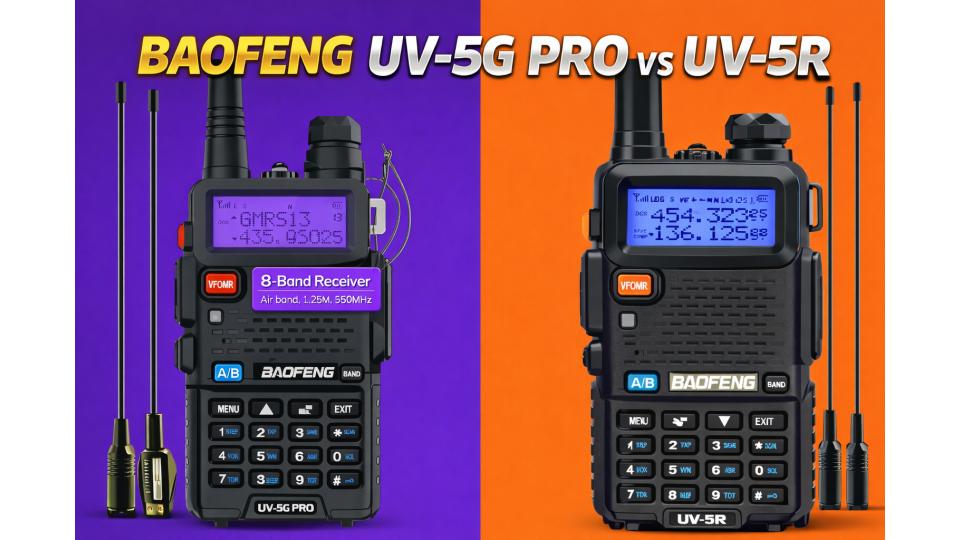
The Baofeng UV-5R and UV-5G Pro look nearly identical sitting side by side. They share the same silhouette, the same K-type audio connector, the same basic menu system, and almost the same price. But they are fundamentally different radios operating under different rules, serving different users, and requiring different licences to transmit. Buying the wrong one is an easy mistake to make, and it is a mistake worth avoiding.
The UV-5R is an amateur radio transceiver. It transmits on ham radio frequencies and requires an FCC amateur radio licence to operate legally. The UV-5G Pro is a GMRS radio. It transmits on General Mobile Radio Service frequencies and requires a GMRS licence instead. The two licences have almost nothing else in common: getting an amateur radio licence requires passing a written exam, while a GMRS licence costs $35, covers your entire immediate family for ten years, and requires no examination at all.
If you are already a licensed amateur radio operator, the UV-5R is the obvious choice. If you have no licence and want to get on the air quickly and legally with your family, the UV-5G Pro is the more practical starting point.
What These Radios Are and Are Not
The UV-5R is an amateur radio handheld transceiver, also called an HT. It transmits on the 2m VHF band (144-148 MHz) and the 70cm UHF band (420-450 MHz) in its US-market configuration. It is one of the best-known and most widely sold radios in amateur radio history and has introduced more people to the hobby than any other single product since it appeared in 2012.
Baofeng UV-5R
One of the most popular entry-level handheld radios ever made. The UV-5R combines low cost, dual-band capability, removable antennas, and massive accessory support into a highly flexible portable radio platform.
- Dual-band VHF/UHF operation
- Removable antenna system
- Wide aftermarket accessory support
- Compact and lightweight
- Popular among hobbyists and preppers
The UV-5G Pro is the GMRS version of the same hardware platform. It transmits only on the 22 dedicated GMRS channels in the 462-467 MHz range, which are pre-programmed and regulated by the FCC. It adds a substantially wider receive band covering aviation, the 1.25m band, additional UHF segments, and NOAA weather channels. It is repeater capable, meaning it can work through GMRS repeaters found across North America to extend its range significantly beyond line of sight.
Baofeng UV-5G Pro
A modern GMRS handheld with USB-C charging, NOAA weather channels, repeater capability, and strong accessory compatibility. Designed for road trips, emergency communication, off-grid use, and beginner-friendly operation.
- GMRS + NOAA weather support
- USB-C rechargeable battery
- Repeater capable
- Compatible with external antennas
- Excellent value for new GMRS users
Neither radio is legal for commercial, business, or public safety use. Neither should be used to transmit without the appropriate licence. The receive-only functions of both radios require no licence at all.
UV-5G Pro vs UV-5R
The UV-5G Pro is better for users wanting a modern GMRS radio with easier setup and cleaner everyday operation. The UV-5R remains the better choice for hobbyists who want maximum flexibility, experimentation, and dual-band amateur radio capability.
Frequency Coverage and Transmit Range
This is the most consequential difference between the two radios and the one most buyers gloss over.
The UV-5R transmits on 144-148 MHz (2m) and 420-450 MHz (70cm) in its standard US configuration. These are amateur radio frequencies with an enormous infrastructure of repeaters across North America, giving a licensed operator genuine long-range capability. The UV-5R also receives across 136-174 MHz and 400-520 MHz in VHF and UHF, plus FM broadcast (65-108 MHz).
The UV-5G Pro transmits only on GMRS channels in the 462-467 MHz range. In exchange it offers significantly broader receive coverage: FM broadcast (65-108 MHz), AM aviation band (108-136 MHz), VHF (136-174 MHz), the 1.25m segment (220-260 MHz), an additional UHF block (350-390 MHz), the main UHF band (400-520 MHz), and 11 dedicated NOAA weather channels. Airband receive is the standout addition: users near airports report clear reception of tower and approach communications. The UV-5R has no airband receive and no NOAA weather channels.
For transmit coverage in practice, the UV-5R connected to the amateur radio repeater network has far greater potential range than the UV-5G Pro on simplex GMRS. A licensed ham operator in most urban and suburban areas can communicate across a city or county using local repeaters. GMRS repeaters exist but are fewer in number and less universally accessible. On simplex (radio to radio, no repeater), both radios have comparable range given their similar power output.
Display and Ergonomics
Both radios use a monochrome LCD display with tri-colour backlighting. The UV-5R display is one of the most imitated in the budget radio category and works well despite showing its age. The UV-5G Pro uses the same basic display platform.
Neither radio has a colour screen. Both show frequency and channel information in the same dual-display format. Both can wash out slightly in very bright direct sunlight, though both are readable in normal outdoor conditions.
Physically the two radios are almost identical. Same dimensions, same button layout, same K-type audio connector. If you have used one, you can operate the other with almost no learning curve. This is intentional: Baofeng built the UV-5G as a near-direct GMRS equivalent of the UV-5R chassis, and the Pro inherits that design relationship.
Battery and Charging
Both radios ship with a 1,800 mAh battery and charge via the same proprietary Baofeng desktop cradle. USB-C charging is available on neither radio in its standard configuration, which is an increasingly notable omission at a time when most competing products have moved to universal charging.
The shared accessory ecosystem means extended batteries from the UV-5R aftermarket are compatible with the UV-5G Pro. The BL-5L 3,800 mAh extended battery fits both radios, giving either substantially improved runtime at the cost of a slightly bulkier profile. This is one of the most worthwhile upgrades for either radio used in field conditions.
Channels, Memory, and Programming
Both radios have 128 memory channels and support CHIRP programming via a standard Baofeng programming cable. The UV-5R’s CHIRP support is among the most comprehensively documented in the hobby: thousands of pre-built channel lists, repeater imports, and configuration guides exist online for nearly every region. Entering “UV-5R CHIRP” into any search engine returns years of community documentation.
The UV-5G Pro is similarly CHIRP compatible but with an important distinction in how you programme it. The GMRS channels are pre-programmed at the factory and the transmit frequencies are locked to those channels by FCC type acceptance. You cannot freely programme arbitrary transmit frequencies the way you can on the UV-5R. What you can programme are channel names, CTCSS/DCS tones, and receive-only channels, but the transmit flexibility that makes the UV-5R so popular among experimenters is simply not present on the UV-5G Pro by design and by law.
The UV-5G Pro includes 50 CTCSS tones and 104 DCS codes for privacy squelch, identical to the UV-5R’s complement.
Licence Requirements
This section matters more than any specification table.
The UV-5R requires an FCC amateur radio licence to transmit legally. In the United States this means passing the Technician class exam, a 35-question multiple choice test that most people can prepare for in a few weeks. The exam costs $15 at most test sessions and the licence is free, valid for ten years, and renewable. An amateur radio licence gives you access not just to the UV-5R’s frequencies but to a vast global hobby infrastructure of repeaters, nets, digital modes, and community resources.
The UV-5G Pro requires a GMRS licence to transmit. This costs $35 for a ten-year family licence through the FCC website, requires no examination, and covers your spouse and children as well. GMRS is specifically designed for family and recreational communication. There is no exam, no study, and no waiting for a test session. You pay the fee and you are legal to transmit.
If you are buying a radio for your family to use on a camping trip next month with no radio background, the UV-5G Pro and a GMRS licence is the correct path. If you are interested in radio as a hobby, want access to the full amateur radio infrastructure, and are willing to spend a few weeks studying for an exam, the UV-5R is the better long-term investment.
Accessory Ecosystem and Community Support
The UV-5R wins this comparison without contest. Thirteen years of production have generated an ecosystem that no other budget radio can match: extended batteries, antennas of every description, speaker-microphones, holsters, waterproof cases, and aftermarket accessories from dozens of suppliers. CHIRP support is the most complete of any radio in the category. Online documentation, YouTube tutorials, forum threads, and preprogrammed channel files number in the tens of thousands.
The UV-5G Pro uses the same K-type audio connector, meaning earpieces and speaker-microphones cross-compatible with the UV-5R ecosystem. It also accepts the BL-5 battery family and the extended BL-5L battery. The programming cable is the same. In most practical accessory respects the UV-5G Pro can draw on the UV-5R ecosystem, which is a significant advantage over more proprietary GMRS hardware.
Baofeng UV-5G Pro
- GMRS ready out of the box
- USB-C charging
- NOAA weather support
- Cleaner beginner experience
- Better everyday usability
Baofeng UV-5R
- Dual-band amateur radio
- Huge accessory ecosystem
- Highly programmable
- Very low entry cost
- Popular with radio enthusiasts
Comparison Table
| Feature | Baofeng UV-5R | Baofeng UV-5G Pro |
|---|---|---|
| Radio service | Amateur (ham) radio | GMRS |
| Licence required | FCC Amateur (Technician class exam) | FCC GMRS ($35, no exam, family coverage) |
| TX frequency | 144-148 MHz VHF, 420-450 MHz UHF | GMRS channels (462-467 MHz) |
| RX frequency | VHF 136-174 MHz, UHF 400-520 MHz, FM | GMRS, UHF, VHF, FM, Airband, 1.25m, 350-390 MHz, NOAA |
| Output power | 5W / 1W | 5W / 1W |
| Memory channels | 128 | 128 |
| TX programmability | Fully programmable within band | Fixed GMRS channels only |
| Display | Monochrome LCD | Monochrome LCD |
| Battery | 1,800 mAh | 1,800 mAh |
| Charging | Proprietary desktop cradle | Proprietary desktop cradle |
| Airband receive | No | Yes (108-136 MHz, RX only) |
| NOAA weather | No | Yes (11 channels) |
| Repeater capable | Yes (amateur repeaters) | Yes (GMRS repeaters) |
| IP rating | None | None (splash resistant) |
| CHIRP support | Excellent | Good |
| Accessory ecosystem | Extensive | Largely UV-5R compatible |
| Price (approx.) |
Pros and Cons
Baofeng UV-5R — Pros
- Full amateur radio transmit flexibility across 2m and 70cm bands
- Access to the entire amateur radio repeater network
- Largest accessory and battery ecosystem of any budget HT
- Unmatched community documentation, CHIRP support, and online resources
- Extended battery options up to 3,800 mAh widely available
- Entry point to a lifelong hobby with global community
Baofeng UV-5R — Cons
- Requires passing a written exam to transmit legally
- No airband receive or NOAA weather channels
- No USB-C charging
- No IP rating or weather resistance
- Ageing monochrome display
Baofeng UV-5G Pro — Pros
- GMRS licence requires no exam, costs $35, covers the whole family
- Eight-band receive coverage including AM airband
- 11 NOAA weather channels
- Repeater capable for extended range
- Compatible with most UV-5R series accessories and batteries
- Straightforward legal path to transmitting for families and beginners
Baofeng UV-5G Pro — Cons
- Transmit locked to GMRS channels, no frequency flexibility
- Requires GMRS licence to transmit (no licence-free transmission)
- No USB-C charging
- No IP rating
- Thinner community documentation than UV-5R
- 128 memory channels only
Who Should Buy Which
The UV-5R is the right choice if you are prepared to get an amateur radio licence or already hold one. The Technician class exam is genuinely not difficult, the study materials are free, and passing it opens up an infrastructure of repeaters, digital modes, emergency communication networks, and a global community that the UV-5G Pro simply cannot access. For anyone who sees radio as a hobby or a serious emergency preparedness tool with long-term investment, the amateur radio path is worth the modest effort of passing an exam.
The UV-5G Pro is the right choice if you want a capable, versatile family radio without the exam. The GMRS licence is as close to frictionless as any licensed radio service gets: pay $35 online, get a licence number, and your whole family is legal to transmit. The broader receive coverage, particularly the airband and NOAA weather channels, makes the UV-5G Pro a more useful monitoring tool than the UV-5R out of the box. For camping, hiking, emergency preparedness, and family communication where everyone wants to get on the air immediately without study or exam, it is the practical choice.
The radios cost roughly the same. The licence costs are comparable over ten years. The real decision is whether you want the exam requirement of amateur radio alongside its vastly richer infrastructure, or the simpler licence path of GMRS alongside a more limited but still functional network. Neither answer is wrong. They serve genuinely different users.